The distinction between pseudo-first-order and instantaneous reactions is the gatekeeper to correct mass transfer coefficient analysis in educational absorption columns. When you model the liquid-phase reaction incorrectly, the enhancement factor you apply to the physical mass transfer coefficient will be fundamentally wrong—leading to flawed calculations of column height, packing efficiency, and overall performance. Recognizing whether a system behaves as pseudo-first-order, where the liquid reactant concentration is nearly constant near the interface, or as instantaneous, where a sharp reaction plane forms, determines which mathematical relationship you use for that enhancement factor.
Without this distinction, students learn to compute numbers rather than to understand the physical reality behind them. The significance lies in teaching that the same macroscopic measurement (a mass transfer coefficient) hides a completely different underlying reaction–diffusion mechanism—and each mechanism demands its own model. Pseudo-first-order systems rely on the Hatta number (β = √M), while instantaneous reactions depend on the ratio of diffusion coefficients and bulk concentrations (β = 1 + cd).
Why Reaction Regimes Govern the Enhancement Factor
The core task in an educational absorption column is to decouple physical mass transport from chemical acceleration. This acceleration is captured by an enhancement factor β, which multiplies the physical mass transfer coefficient kL. β is not a universal number—it is a direct expression of the interaction between reaction kinetics and diffusion.
The Two Mathematical Frameworks Are Irreconcilable
If you treat a fast instantaneous reaction with a pseudo-first-order model, you will underestimate β and overpredict the required column height. Conversely, applying an instantaneous model to a moderately fast reaction leads to overestimation of β and a dangerously undersized column. This is not just a numerical nuance; it is the difference between a design that works and one that fails.
Pseudo-First-Order Reactions: The Constant-Reactant Approximation
The Classic CO₂–NaOH Example
In the absorption of carbon dioxide into sodium hydroxide, the reaction is fast relative to diffusion but the OH⁻ concentration remains high and essentially unchanged in the film. The problem simplifies because the liquid reactant’s concentration can be taken as constant. This is the defining characteristic of a pseudo-first-order regime.
Mathematical Model: β = √M
Under this assumption, the enhancement factor depends only on the Hatta number M (where M = (k₂·CB0·DA) / kL²). The theory teaches that for Ha > 2, β ≈ √M, meaning the reaction’s effect is controlled by the reaction rate constant and the diffusivity of the dissolved gas—not by the concentration ratio of the two reactants. Students learn that packing performance can be directly linked to kinetic constants when this regime holds.
When This Regime Applies
You choose the pseudo-first-order model when the liquid reactant is in excess, the reaction is moderately fast, and no sharp boundary separates the reacting species. This is common in many reactive scrubbing experiments where the absorbent acts as a chemical sink without forming a distinct reaction front.
Instantaneous Reactions: The Reaction Plane Concept
The H₂S–MEA Example
Hydrogen sulfide absorption into monoethanolamine (MEA) is so fast that H₂S and MEA cannot coexist. A reaction plane develops within the liquid film. On one side of this plane, only dissolved gas exists; on the other side, only liquid reactant. The reaction is effectively complete at this plane, and the mass transfer rate is limited only by how quickly the two species can diffuse toward each other.
Mathematical Model: β = 1 + cd
The enhancement factor no longer depends on the reaction rate constant. Instead, β = 1 + (DB·CB0) / (DA·CA,i)—in the reference’s notation, β = 1 + cd. The parameters c and d capture the ratio of reactant concentrations and diffusion coefficients. Students learn that in this regime, kinetic rate data are irrelevant; column performance is governed purely by stoichiometry and diffusional transport.
Implications for Mass Transfer Coefficient
Because kLa determined from such a system reflects this diffusional enhancement, back-calculating a “physical” mass transfer coefficient requires stripping out exactly this factor. Any error in regime identification corrupts the fundamental variable that educational columns are meant to measure: the pure physical mass transfer coefficient of the packing.
Understanding the Trade-offs: Misclassification Is a Common Educational Pitfall
The Danger of a Single-Diagnostic Approach
Some teaching setups rely on one standard gas–liquid system to chart packing efficiency. If that system is CO₂–NaOH (pseudo-first-order), the derived kLa values embed a kinetic dependence. When students later attempt to apply those same kLa values to a system like H₂S–MEA (instantaneous), they implicitly assume the enhancement factor is the same—a dangerous and incorrect assumption that leads to erroneous conclusions about packing performance.
Educational Missteps and How to Avoid Them
A common mistake is teaching the Hatta number as a catch-all without clarifying its limits. For pseudo-first-order reactions, plotting kLa versus operating conditions reveals kinetic trends. For instantaneous reactions, the same plot would be flat—an insight that is lost if the regime is misunderstood. By deliberately contrasting these two models, educators train students to diagnose the regime before touching a single equation, turning mass transfer labs into authentic engineering investigations rather than recipe-following exercises.
Making the Right Choice for Your Teaching or Research Goal
What you want to accomplish determines which reaction system and model you choose.
- If your primary focus is teaching the coupling of reaction kinetics with mass transfer: Use a pseudo-first-order system like CO₂–NaOH. The clear dependence on the Hatta number makes the kinetic enhancement tangible and measurable.
- If your primary focus is isolating the physical mass transfer coefficient of a new packing: Lean toward an instantaneous system (e.g., H₂S–MEA) or a pseudo-first-order system with a very high reaction rate, because the enhancement factor becomes insensitive to kinetics—or use the instantaneous model to back-calculate kL without needing precise kinetic constants.
- If your primary focus is evaluating column packing performance across different solvents: Deliberately run both regimes on the same packing and compare the extracted physical mass transfer coefficients. Agreement between the two validates the method; disagreement reveals the boundaries of your models and teaches the very significance of this distinction.
The choice between a pseudo-first-order and an instantaneous model is not a theoretical footnote—it is the decision that either reveals the true physical mass transfer coefficient or hides it behind a misapplied equation.
Summary Table:
| Feature | Pseudo-First-Order Reactions | Instantaneous Reactions |
|---|---|---|
| Key Example | CO₂–NaOH | H₂S–MEA |
| Enhancement Factor ($\beta$) | $\beta = \sqrt{M}$ (Hatta number dependent) | $\beta = 1 + cd$ (Diffusion dependent) |
| Governing Factor | Reaction kinetics & diffusivity | Diffusion rate & stoichiometry |
| Reaction Zone | Constant reactant concentration near interface | Sharp reaction plane inside liquid film |
Elevate Your Chemical Engineering Lab with LABPARK
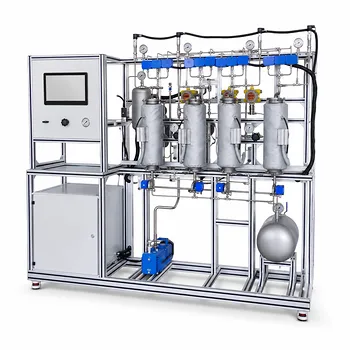
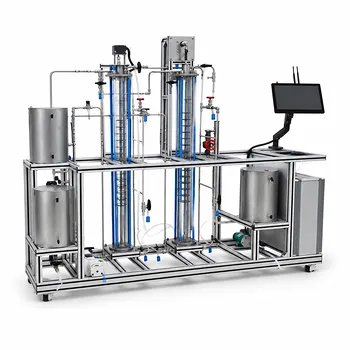
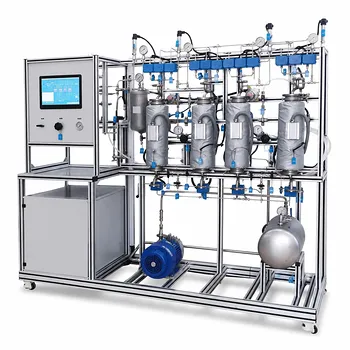
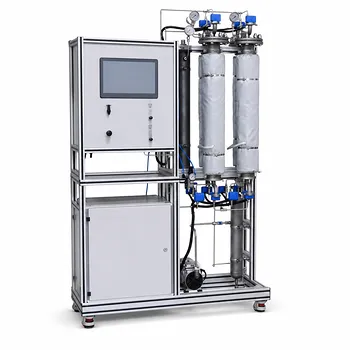
To help your students and researchers master complex mass transfer concepts, reliable and precise experimental data is key. LABPARK provides state-of-the-art Educational and Vocational Unit Operations Pilot Plants in chemical engineering, bioprocess & biotech, and environmental & water treatment tailored for universities, research institutes, and enterprises.
Our pilot plants deliver the hands-on accuracy required to analyze real-world mass transfer coefficients and validate theoretical reaction kinetics with confidence.
Contact LABPARK today to discover the perfect pilot plant solution for your educational and research goals!
Related Products
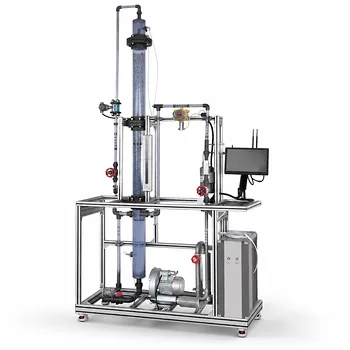
- Packed Bed Absorption Educational Unit Operations Pilot Plant
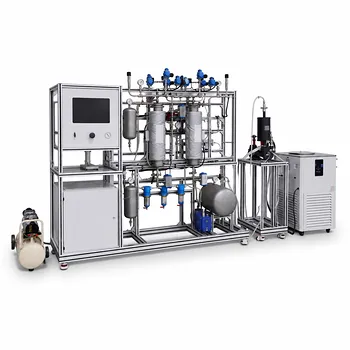
- Absorption and Desorption Educational Unit Operations Pilot Plant
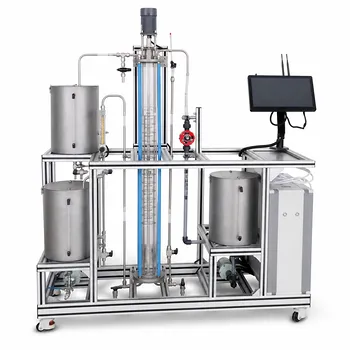
- Multimodal Absorption and Desorption Pilot Plant for Unit Operations Training
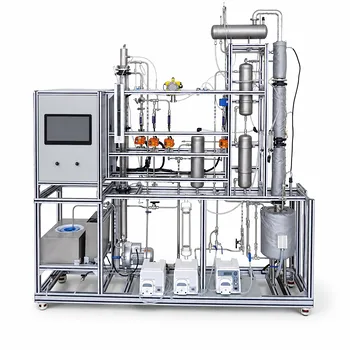
- Bench Scale Dual Column Gas Separation and Capture Educational Pilot Plant
- Educational Rotary Disc Liquid-Liquid Extraction Pilot Plant
People Also Ask
- How Do Flow Regimes Transition in Packed Bed Pilot Plants? Key Scale-up Insights
- How does reactant concentration determine absorption column control? Gas-film vs. dual-film.
- How is the packing height of an absorption column calculated? Master HTU & NTU Concepts
- How does static vs. operating holdup affect pilot plant calibration? Avoid Critical Scale-Up Errors
- Why is counter-current flow selected for gas absorption? Maximize Pilot Plant Efficiency