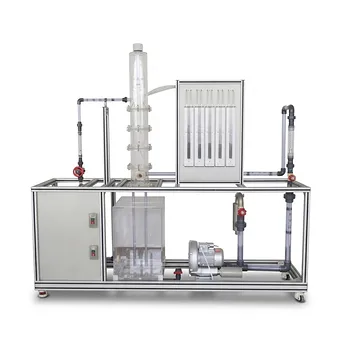
Molecular diffusion sets the floor for mass transfer—it’s what you can’t change. Eddy diffusion is the powerful lever you can pull. In an absorption column pilot plant, distinguishing between them is critical because it tells you exactly how much control you have over the process. It reveals that while the fluid’s inherent molecular movement is largely fixed by temperature and composition, the massive, turbulence-driven eddy diffusion can be manipulated through flow velocity and column internals to slash mass transfer resistance.
Absorption column performance hinges on a single insight: the total mass transfer flux is the sum of a fixed molecular component and a highly controllable turbulent component. Recognizing this duality is the key to diagnosing bottlenecks, interpreting pilot data, and scaling processes with confidence—you stop guessing and start engineering.
The Two Distinct Mechanisms
To understand why the distinction matters, you must first see that molecular diffusion and eddy diffusion are fundamentally different animals. One is a passive material property; the other is an active system variable.
Molecular Diffusion: The Unchangeable Baseline
Molecular diffusion arises from the constant, random thermal motion of molecules. Under a concentration gradient, this motion creates a net flux described by Fick’s Law.
This mechanism is a physical property of the fluid system. It depends primarily on temperature, pressure, and the specific chemical species involved. It is what it is—you cannot alter it significantly without changing the chemistry or the bulk operating conditions. In an absorption column, molecular diffusion dominates only in the stagnant or laminar boundary layers immediately adjacent to the gas–liquid interface.
Eddy Diffusion: The Engineer’s Control Knob
Eddy diffusion is not a physical constant. It is a macroscopic transport phenomenon driven by fluid turbulence—chaotic eddies and bulk motion. These turbulent swirls physically carry packets of fluid, and the dissolved solute within them, across distances far larger than a single molecular jump.
Crucially, eddy diffusion varies with location, flow velocity, and column geometry. It is an engineered response, not a fixed destiny. In the turbulent flow regimes typical of pilot plant absorption columns, the magnitude of eddy diffusion dwarfs that of molecular diffusion in the bulk fluid. This means the heavy lifting of mass transfer happens through turbulence.
Why the Distinction Matters in Absorption Columns
Simply knowing that both mechanisms exist isn’t enough. The real significance lies in how this knowledge transforms your ability to analyze, design, and troubleshoot a pilot plant.
Identifying the True Rate-Limiting Step
Total mass transfer resistance is a series of resistances: through the gas film, across the interface, and through the liquid film. Molecular diffusion governs transport in the laminar boundary layers, while eddy diffusion governs the bulk phases.
When you measure a low overall mass transfer coefficient (( K_L ) or ( K_G )), you must know where the bottleneck lives. Is the boundary layer itself too thick because the turbulence isn’t reaching it? Or is the bulk turbulence adequate, but the molecular diffusion across that thin film is inherently slow? Distinguishing between the two mechanisms points you either toward modifying hydrodynamics or toward altering the liquid phase chemistry (e.g., reactive absorption).
Validating Experimental Data and Scale‑Up Models
In a pilot plant, you manipulate gas and liquid flow rates. As flow increases, the transition from laminar to turbulent regimes triggers a sharp rise in mass transfer coefficients. This is a direct manifestation of eddy diffusion taking over.
Without separating the contributions, you might incorrectly attribute all improvement to a generic “better mixing.” By distinguishing molecular from eddy terms, you can accurately calculate the eddy diffusivity (( D_e )) profile along the column. This profile is essential for validating first‑principles models like computational fluid dynamics (CFD). If you scale up based only on an empirical correlation that lumps everything together, you risk a catastrophic mismatch in the plant.
Making Targeted Operational Improvements
Here’s where the practical payoff crystallizes. Since you cannot practically change the molecular diffusivity of a chosen solvent–solute pair, your only true remediation tools are those that increase ( D_e ):
- Increasing fluid velocity to intensify turbulence.
- Changing packing geometry to promote more frequent break‑up and renewal of the boundary layers.
- Optimizing gas–liquid distribution to eliminate dead zones where eddy diffusion is low.
Distinguishing the two mechanisms validates why these modifications work and helps you quantify the economic return on a higher‑pressure‑drop column.
Understanding the Trade‑offs
This isn’t a free lunch. Recognizing eddy diffusion as the dominant, manipulable variable brings a set of engineering compromises you must navigate.
The Penalty of Turbulence
Eddy diffusion is generated by turbulence, and turbulence is generated by pressure drop. A high‑velocity, highly turbulent column consumes significantly more energy through blowers and pumps. There is always a sharp economic trade‑off between maximizing mass transfer and minimizing operational expenditure.
Diminishing Returns and Flooding
Increasing flow rates to boost eddy diffusion eventually hits a physical limit. You risk flooding the column, where the gas–liquid interface loses its stability, or the pressure drop skyrockets catastrophically. The insight isn’t “more is always better”—it’s that eddy diffusion is a powerful but finite resource you must carefully meter against hydrodynamic constraints.
A Masking Effect on Chemistry
In an extremely turbulent column, eddy diffusion may flatten the concentration gradient so effectively that the process becomes gas‑film controlled. If you are simultaneously testing a chemical absorbent (e.g., CO₂ in an amine solution), you might mistakenly interpret the data as a catalyst problem when the true bottleneck remains on the gas side. Distinguishing the molecular and eddy contributions stops you from chasing the wrong variable.
Making the Right Choice for Your Pilot Plant Study
Your goal determines how you leverage the distinction between molecular and eddy diffusion. Use the following priorities as a decision filter.
- If your primary focus is fundamental research: Deliberately design experiments that decouple the two. Run columns at very low flow rates to isolate the molecular contribution, then systematically increase turbulence to map how ( D_e ) evolves with Reynolds number.
- If your primary focus is process optimization and scale‑up: Treat eddy diffusion as your primary design variable. Test multiple packing geometries and flow regimes while continuously monitoring pressure drop to find the most cost‑effective point on the trade‑off curve.
- If your primary focus is troubleshooting poor separation: First, calculate the expected molecular diffusion resistance from your fluid properties. If that alone can’t explain the performance deficit, the problem lies in insufficient eddy diffusion—start improving liquid distribution or packing area.
- If your primary focus is evaluating reactive absorbents: Always first characterize the hydrodynamic contribution separately. Only then can you isolate the true kinetic enhancement factor; otherwise, you risk crediting the turbulence as chemical magic.
The power of your pilot plant isn’t just in the data it produces, but in the framework you use to interpret it. Distinguishing molecular diffusion from eddy diffusion transforms an absorption column from a black box into a transparent, controllable system.
Summary Table:
| Feature | Molecular Diffusion | Eddy Diffusion |
|---|---|---|
| Driving Force | Thermal molecular motion (Fick's Law) | Fluid turbulence & bulk motion |
| Control Level | Fixed physical property (fluid-dependent) | Highly controllable (flow, geometry) |
| Primary Region | Laminar boundary layers | Turbulent bulk fluid core |
| Engineering Levers | Temperature, solvent choice | Flow velocity, packing type |
Bridge the Gap Between Theory and Pilot-Scale Operation
Ready to optimize your mass transfer studies and train the next generation of engineers? LABPARK provides state-of-the-art Educational and Vocational Unit Operations Pilot Plants in chemical engineering, bioprocess & biotech, and environmental & water treatment. Designed specifically for universities, research institutes, and enterprises, our systems offer the precise control and hydrodynamic flexibility needed to analyze complex transport phenomena.
Contact LABPARK today to discover how our customizable pilot plants can elevate your research and training capabilities!
Related Products
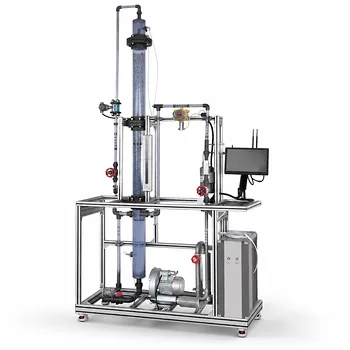
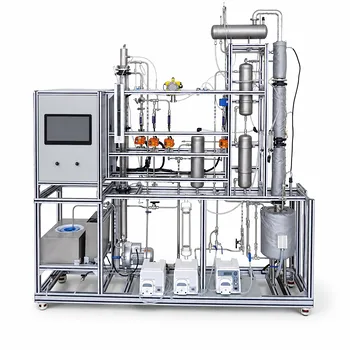
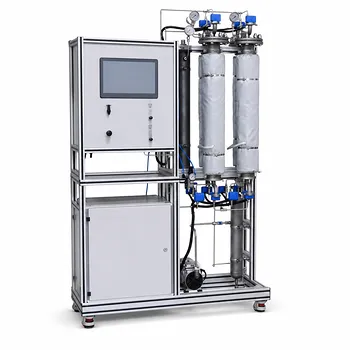
- Packed Bed Absorption Educational Unit Operations Pilot Plant
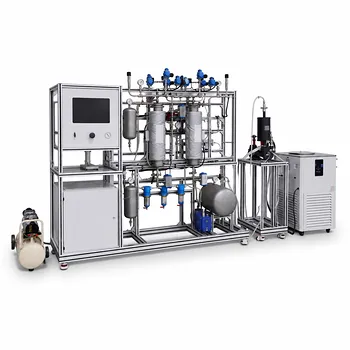
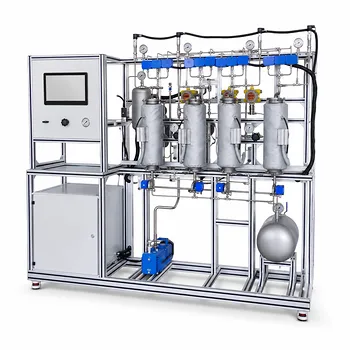
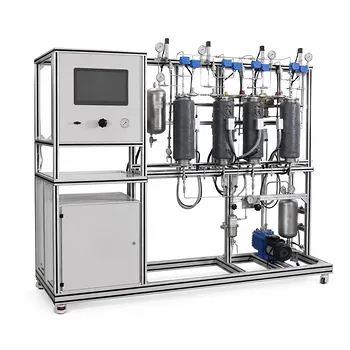
- Absorption and Desorption Educational Unit Operations Pilot Plant
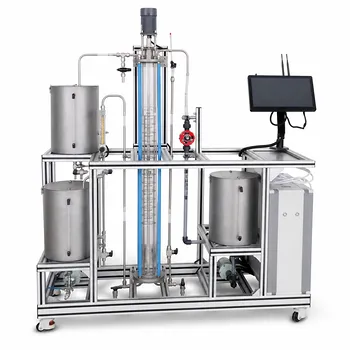
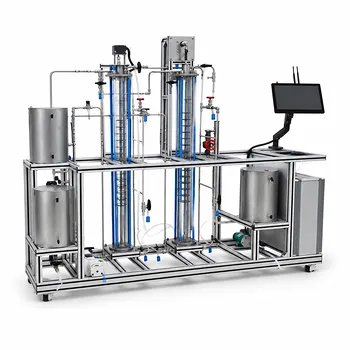
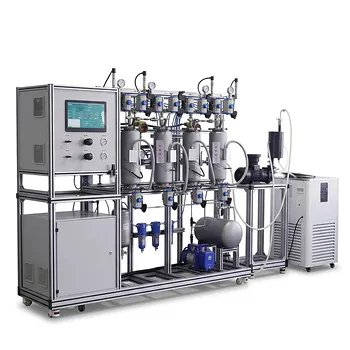
- Multimodal Absorption and Desorption Pilot Plant for Unit Operations Training
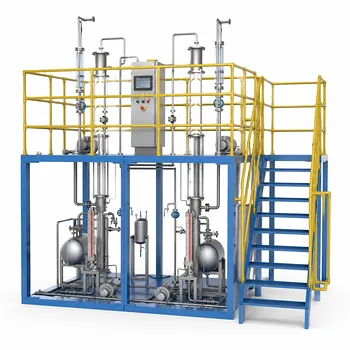
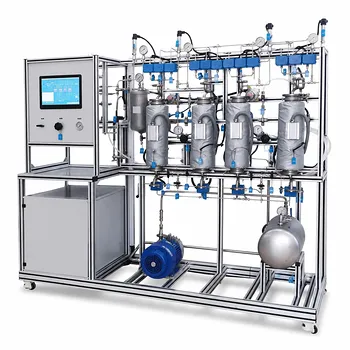
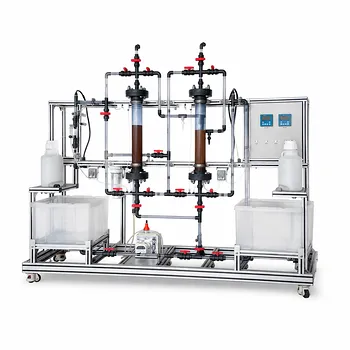
- Bench Scale Dual Column Gas Separation and Capture Educational Pilot Plant
- Educational Rotary Disc Liquid-Liquid Extraction Pilot Plant
People Also Ask
- How Do Flow Regimes Transition in Packed Bed Pilot Plants? Key Scale-up Insights
- How does reactant concentration determine absorption column control? Gas-film vs. dual-film.
- How is the packing height of an absorption column calculated? Master HTU & NTU Concepts
- How does static vs. operating holdup affect pilot plant calibration? Avoid Critical Scale-Up Errors
- Why is counter-current flow selected for gas absorption? Maximize Pilot Plant Efficiency