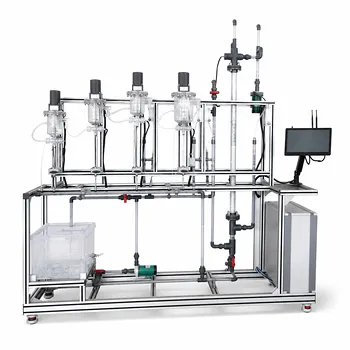
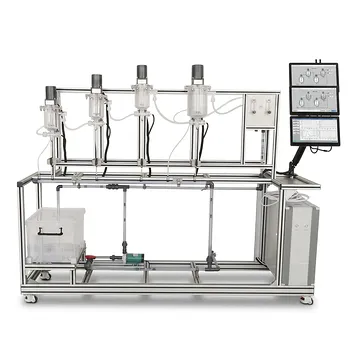
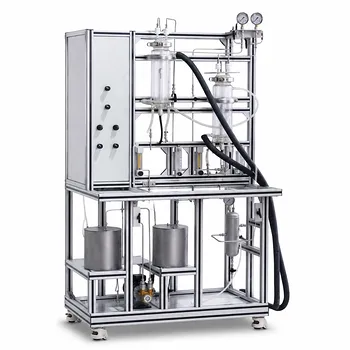
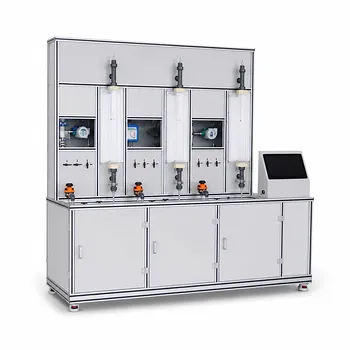
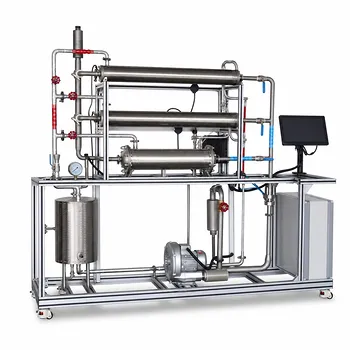
Scaling a reactor for educational pilot plants demands a deliberate, two-pronged strategy. The recommended approach is to begin with a modelling-based dimensioning workflow—using first-principle balances to define an initial geometry and operating window—and then to rigorously validate and refine that design through targeted experimental scale-up studies on the pilot unit itself. This hybrid methodology teaches both the predictive power of engineering fundamentals and the irreplaceable insight that only physical data can provide.
The core challenge is bridging the gap between a clean theoretical model and the messy reality of mixing, heat transfer, and material limits. An iterative loop of simulation-guided design, stepwise experimental validation against clear scale-up criteria, and cost-conscious material selection transforms the pilot plant from a classroom curiosity into a genuine preparation for industrial practice.
Moving Beyond Guesswork with Model-Based Dimensioning
A purely trial-and-error approach on a pilot plant wastes resources and obscures learning. Systematic dimensioning starts with the theory.
Starting with the Fundamental Balances
The most defensible method is grounded in the stagewise nonisothermal model equations. You begin by setting initial trial values for the reactor’s geometric dimensions—diameter, height, jacket surface area—and the key operating parameters like temperature, pressure, and feed rates.
With these as a starting point, you calculate or independently measure the physical and kinetic data specific to your reaction system. This could be reaction rate constants, heat of reaction, or fluid properties. These numbers are fed into a loop that simultaneously solves material, equilibrium, and enthalpy balances. The iterative output reveals the self-adjusting parameters, such as the resulting hydrodynamics and mass transfer rates, that determine if the reactor will actually work as intended.
This isn't just a design exercise; it teaches students how seemingly separate thermodynamic and transport concepts lock together inside a real vessel.
Defining the Mechanical Envelope Early
Because many educational pilot-reactor systems operate under non-isothermal or pressurized conditions, they must immediately be treated as pressure vessels. The modeling step must therefore also specify the mechanical boundaries.
This means calculating the required wall thickness, selecting appropriate head types (e.g., ellipsoidal vs. flat), and defining nozzle orientations. Doing this early ensures that the vessel can safely handle the designed operating window and allows students to see how a process decision—like running a reaction at 10 bar instead of 5 bar—directly cascades into a heavier, costlier mechanical design.
Integrating Experimentation to Validate the Model
A purely mathematical model is just a hypothesis. The educational value, and the engineering truth, emerges from testing that hypothesis systematically.
The Hybrid Scale-Up Revolution
The old way of scaling up was to build a small pilot plant, run it, build a 10x larger one, and repeat—a process that was both slow and prohibitively expensive. Modern methodology has changed this entirely.
Today’s recommended approach is to combine experimental data from a single, reliable bench-scale or small pilot-scale setup with advanced computer modeling. This hybrid strategy allows you to bypass multiple intermediate scale-up stages. You can directly validate your model and then use it to leap to a much larger scale, focusing the pilot plant’s mission on proving the model’s predictive power rather than simply being a tiny version of the final plant.
What to Measure and Scale
When you scale a reaction unit, several parameters don't change linearly. The modeling step predicts the shifts, but the experimental pilot plant must verify them. Key physical parameters that demand careful experimental monitoring during scale-up include:
- Mass and volumetric flow rates: These increase substantially, often requiring more reactor tubes per shell or increased reactor length to maintain the target residence time.
- Heat load: This grows dramatically, so the pilot plant must be equipped with robust jacketed temperature control systems and effective heat transfer surfaces to confirm that the model's thermal predictions hold true.
By actively managing these parameters, students confront the direct link between a vessel’s geometry and its thermodynamic stability.
Mastering the Art of Mixing Scale-Up
No aspect of reactor design teaches scale-up’s complexity better than agitation. There is no single “right” scale-up rule; the choice depends entirely on what you are trying to control.
Selecting the Right Criterion for Your Goal
When scaling up an agitator, you typically compare three geometrically similar vessels of different sizes and choose a scale-up criterion. Each criterion preserves one critical property at the expense of others:
- Constant Reynolds Number ($Re$): Keeps the flow regime identical. In practice, this leads to very low rotational speeds in larger tanks, making it almost useless for maintaining mass transfer. It illustrates a powerful lesson: simple dimensional similarity fails.
- Constant Power per Unit Volume ($P/V$): Ensures equal energy input into every unit of liquid. This is the most practical starting point for general chemical and biochemical reactions because it helps maintain similar mixing intensity and bubble breakup.
- Constant Impeller Tip Speed ($\pi nd$): Keeps the maximum shear rate constant. This is the critical choice when scaling up a shear-sensitive bioprocess, like a cell culture, even though it will degrade heat and mass transfer performance in the larger tank.
- Constant Mass/Heat Transfer Coefficients: Used when the reaction’s success is entirely dictated by transport. This requires empirical correlations involving Reynolds, Prandtl, or Schmidt numbers to calculate the new speed and power draw.
By experimentally validating these different criteria on the pilot plant, students see that a “perfect” geometric scale-up is a myth; they learn to trade off mixing, shear, and heat transfer with open eyes.
Understanding the Trade-offs: Cost, Material, and Safety
No design is complete without confronting the hard physical and economic constraints that shape a real reactor.
The Economics of Reactor Materials
The pilot plant is the perfect place to teach material selection. The scaling relationship Cost = A × VolumeB reveals a profound difference. A glass-lined steel reactor has a low cost exponent (B ≈ 0.32–0.42), meaning that moving to a larger size dramatically reduces the cost per unit volume and offers laboratory-level corrosion resistance. A stainless steel reactor has a much higher exponent (B ≈ 0.75), making volume scale-up relatively more expensive.
The trade-off is not just economic. Glass-lined steel provides outstanding chemical inertness but often limits pressure ratings and jacket design. Stainless steel can handle higher pressures and more robust welded jacket configurations but may corrode in your specific chemistry. Operating pilot reactors of both materials turns these abstract cost curves into a tangible lesson in capital expenditure (CAPEX) trade-offs.
The Pitfall of Ignoring Heat Transfer
A common mistake is to fixate on achieving the target residence time via physical volume while underestimating the explosive growth in heat load. A model might happily predict perfect conversion in a larger vessel, but if the jacket area doesn’t scale proportionally with the heat generation, the experimental run will quickly run away. A robust educational pilot plant must celebrate this mismatch as the critical learning moment it is, reinforcing the need for a holistic, simultaneous solution of the mass and energy balances.
Making the Right Choice for Your Educational Goal
The best approach isn't a single formula; it’s a framework that you adapt based on what you need your students to learn.
- If your primary focus is teaching fundamental design logic: Lead with the full model-based dimensioning workflow. Have students perform the iterative nonisothermal balance calculations by hand before ever touching the software, so they grasp the interplay of kinetics, thermodynamics, and geometry.
- If your primary focus is hands-on process validation: Use the hybrid scale-up method. Provide a pre-characterized bench-scale data set and let students use modeling to specify the pilot plant conditions, then run the experiment to prove or disprove their predictions.
- If your primary focus is industrial cost awareness: Build the curriculum around the agitator scale-up criteria and material cost scaling. Assign projects where students must select a mixing criterion and a reactor material to satisfy a given process and budget, then defend their choices with experimental pilot plant data.
By weaving together first-principles modeling, disciplined experimental scaling, and objective material economics, you transform a simple pilot plant into a definitive learning system that prepares engineers for the complexity of the chemical process industries.
Summary Table:
| Scale-Up Phase | Core Focus / Method | Educational & Practical Value |
|---|---|---|
| Model-Based Dimensioning | Nonisothermal equations, material/enthalpy balances | Teaches predictive design and thermodynamic constraints |
| Experimental Validation | Flow rates and heat load verification | Bridges theoretical simulation with physical reality |
| Agitator Scale-Up | Choosing criteria: Constant $P/V$, $Re$, or tip speed | Illustrates mixing trade-offs (shear vs. heat/mass transfer) |
| Economic Selection | Cost exponents (Glass-lined vs. Stainless steel) | Introduces capital expenditure (CAPEX) limits and chemistry compatibility |
Bring Industrial-Scale Learning to Your Classroom with LABPARK
Teaching students to bridge the gap between chemical engineering theory and physical reality requires robust, reliable equipment.
LABPARK provides state-of-the-art Educational and Vocational Unit Operations Pilot Plants designed specifically for universities, research institutes, and enterprises. Our solutions span across:
- Chemical Engineering (including advanced reactor scale-up and dimensioning systems)
- Bioprocess & Biotech (ideal for shear-sensitive cell culture scaling)
- Environmental & Water Treatment
Help your students master mixing criteria, thermodynamic balances, and material economics with hands-on systems built for modern engineering curricula.
Contact LABPARK Today to explore our pilot plant configurations and request a detailed quote!
Related Products
- Multi Functional Catalytic Reaction and Reactor Evaluation Educational Unit Operations Pilot Plant
- Residence Time Distribution and Reactor Flow Characteristics Determination Educational Pilot Plant
- Tubular Reactor Flow Characteristics Determination Educational Unit Operations Pilot Plant
- 100L Continuous Loop Hydrogenation Educational Unit Operations Pilot Plant
- Multi-Stage Stirred Tanks in Series Residence Time Distribution and Mixing Performance Determination Educational Pilot Plant
People Also Ask
- What reaction engineering principles are shown in a catalytic reactor pilot plant? SO2 Oxidation Guide
- Why is FTIR integration in catalytic pilot plants important? Real-Time Student Insights
- How to analyze active metal distribution & identify catalyst poisoning in pilot plants? Expert Diagnostic Guide
- How do temperature limits and WHSV influence catalytic reactor optimization? Scale-Up Guide
- What operational insights do catalyst pellet concentration profiles provide? Optimize Reactor Yield