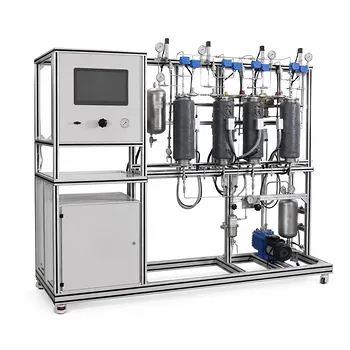
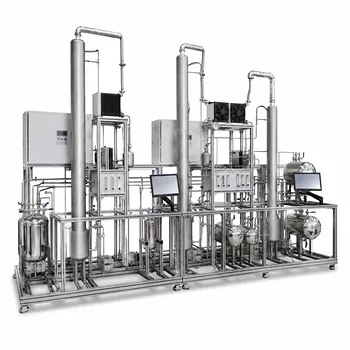
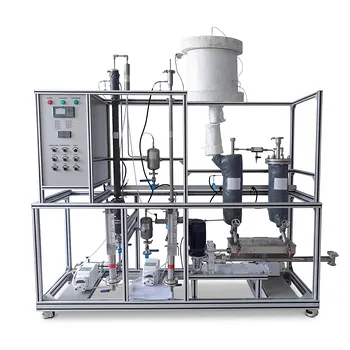
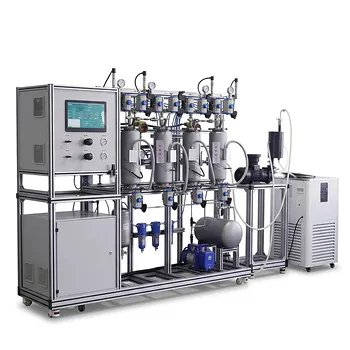
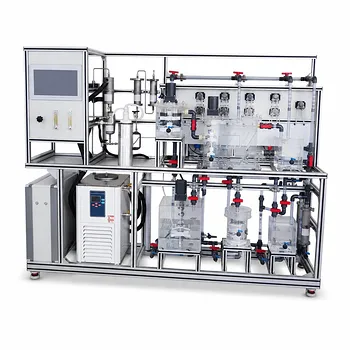
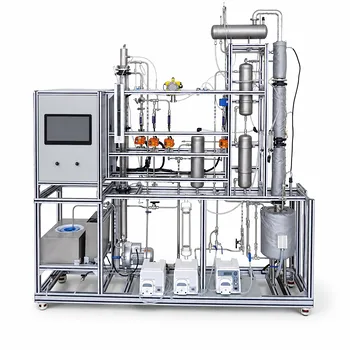
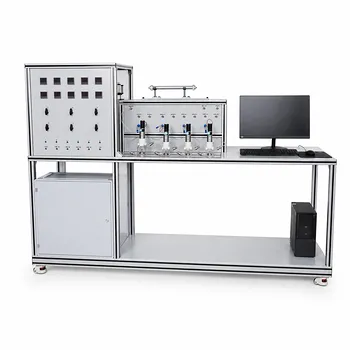
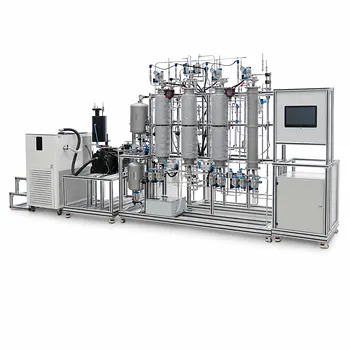
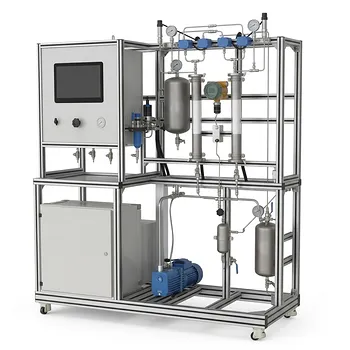
The operational difference in a pilot plant comes down to where separation occurs: on a solid surface or within a bulk liquid.
In an adsorption pilot plant, gas or liquid flows through a fixed bed of solid particles, and target molecules accumulate exclusively at the solid’s interface. An absorption pilot plant, by contrast, sends gas upward through a column where a liquid solvent sprays downward; contaminants dissolve directly into the body of that liquid. This single distinction cascades into different column designs, regeneration cycles, and performance metrics.
Adsorption uses a solid sorbent to capture molecules at its surface, making it ideal for trace contaminant removal and cyclic regeneration. Absorption dissolves gases into a bulk liquid, which excels at high‑volume scrubbing but demands continuous solvent management. In a pilot plant, you’ll recognize adsorption by a static packed bed and transient concentration curves, while absorption feels like a steady‑state liquid‑gas exchange in a vertical column.
The Fundamental Operational Difference
Surface Adhesion vs. Bulk Dissolution
Adsorption is a surface‑specific phenomenon.
Contaminants (adsorbates) leave the fluid stream and physically or chemically bind to the internal and external surfaces of a solid adsorbent like activated carbon or zeolite. Nothing enters the solid’s crystalline lattice; the interaction happens strictly at the interface.
Absorption is a bulk‑phase transfer.
Gas molecules penetrate the liquid surface and mix thoroughly into the solvent’s volume. The entire liquid phase participates, not just its boundary layer. This is a dissolution process—whether purely physical or aided by a chemical reaction within the liquid.
Equipment Footprint: Packed Beds vs. Scrubbing Columns
An adsorption pilot plant revolves around a fixed‑bed column.
A vertical or horizontal vessel is packed with granular adsorbent. Fluid enters at the top or bottom and passes through a stationary bed. The unit may also include a regeneration loop, gas heaters, or vacuum pumps for pressure‑swing cycles.
An absorption pilot plant uses a continuous counter‑current column.
Here you’ll see a tall vertical tower with structured packing or sieve trays. Liquid solvent flows down the column while gas rises, maximizing contact area. A recirculating pump, solvent tank, and often a secondary stripping column for solvent regeneration complete the setup.
The operational mindset is different.
In adsorption, you load a bed and monitor how the concentration front (adsorption wave) moves through it over time. In absorption, you run a steady‑state process and measure the concentration profile along the column height while maintaining constant liquid and gas flow rates.
How Students Measure Performance
In adsorption, breakthrough curves are the central diagnostic.
A pilot plant records outlet concentration over time. Once the bed saturates, the contaminant breaks through; the resulting S‑shaped curve tells you about mass transfer zone length and dynamic capacity. Thermocouples may track the heat of adsorption in near‑real‑time.
In absorption, the key metric is the mass transfer coefficient.
Students measure inlet and outlet gas and liquid concentrations under steady conditions. With physical absorption, they explore how pressure and temperature shift equilibrium. With chemical absorption, they quantify how a reactant in the liquid boosts the driving force and reduces liquid‑side resistance.
Underlying Mechanisms in Pilot Plant Demonstrations
Physical vs. Chemical Adsorption: A Temperature Signature
Physical adsorption operates through van der Waals forces.
It features low adsorption heat (<40 kJ/mol), is fast, reversible, and allows multi‑layer build‑up. In a pilot plant, you can regenerate the bed simply by lowering the pressure (pressure‑swing) or heating it slightly (temperature‑swing). Students can observe immediate desorption when the system is depressurized.
Chemical adsorption involves true chemical bonds.
High heat of adsorption (80–400 kJ/mol) and often irreversible nature define it. Regeneration demands aggressive heating or chemical displacement. Pilot‑scale demonstrations show that even as temperature rises, adsorption rate can increase—a clear marker of chemisorption’s activation energy requirement.
This distinction dictates the auxiliary equipment needed.
A physical adsorption pilot needs vacuum pumps or mild heaters. A chemical adsorption rig requires robust temperature controls and possibly a step for chemical wash, giving students a practical lesson in energy‑versus‑selectivity trade‑offs.
Physical vs. Chemical Absorption: Why Solvent Choice Matters
Physical absorption relies on pure solubility.
Dissolving CO₂ into methanol at –40 °C (as in the Rectisol process) is a classic physical absorption demonstration. The pilot plant must enable precise pressure and temperature swings to shift equilibrium. Regeneration occurs in a flash tank through depressurization, showing how little energy the core dissolution step itself consumes.
Chemical absorption adds a reactive partner in the liquid phase.
Using an amine solution or NaOH to capture CO₂ illustrates a dramatic jump in mass transfer. The reaction consumes the dissolved gas instantly, lowering the equilibrium partial pressure and pulling more solute into the liquid. This is where students measure how chemical enhancement multiplies the overall absorption rate.
Operationally, chemical absorption pilots are more complex.
They need dosing systems for reactive liquids, careful heat management (reactions are exothermic), and often corrosion‑resistant materials. But they demonstrate unmatched removal efficiency for acid gases.
Why This Matters for Process Design
Pilot plants bridge the gap between principle and scale‑up.
When you run an adsorption pilot, you’re testing bed life, pressure drop, and regeneration cycle times. When you run an absorption pilot, you’re optimizing liquid‑to‑gas ratios, column design, and solvent stability.
The choice between adsorption and absorption often comes down to concentration and flow regime.
Trace contaminants (ppmb levels) that must be eliminated entirely favor adsorption’s surface‑selectivity. Large gas flows with moderate contaminant loadings fit absorption’s continuous, high‑capacity nature.
Regeneration: The Operational Crossroads
Adsorbent Regeneration
Physical adsorbents regenerate via pressure or temperature swings.
A typical pilot plant will first load the bed with adsorbate, then isolate it and either evacuate the vessel (PSA) or heat it while purging with a hot gas (TSA). The exit stream becomes a concentrated product, demonstrating how adsorption is inherently cyclic.
Chemical adsorbents are harder to reset.
Because chemisorption forms bonds, regeneration needs energy‑intensive high temperatures or chemical displacement. Pilot plants illustrating chemisorption often include a separate high‑temperature desorption furnace or a solvent‑washing stage, highlighting the operating expense.
Solvent Regeneration in Absorption
Physical absorption regeneration is often just a pressure release.
In a pilot plant demonstrating physical absorption, the rich solvent is throttled into a flash drum. Pressure drops, solubility plummets, and the gas flashes out. This elegant separation is a favorite for showing how pressure‑dependent equilibrium works.
Chemical absorption regeneration demands heat.
Loaded amine solutions must be heated to about 105 °C in a stripping column. The pilot plant’s reboiler and stripping section mirror industrial carbon‑capture trains, letting students see how thermal regeneration energy dominates operating costs.
Understanding the Trade‑offs
When Adsorption Outshines Absorption
Adsorption excels at ultralow concentrations.
If your goal is achieving parts‑per‑million or sub‑part‑per‑million purity, adsorption’s large surface area and strong binding can capture what a bulk solvent would leave behind. It also avoids large solvent inventories and secondary liquid waste streams.
However, adsorption capacity is finite.
A bed saturates, requiring a switch to standby vessels or a regeneration cycle. Pressure‑swing or temperature‑swing operation adds complexity and energy cost.
When Absorption Is the Better Choice
Absorption handles high flow rates with steady operation.
A scrubber can process enormous gas volumes continuously, making it the default for bulk acid‑gas removal. The liquid solvent acts as a limitless sink as long as you regenerate it.
But solvent management can be tricky.
Degradation, foaming, corrosion, and the high heat load of chemical absorption regeneration can erode the simplicity you were hoping for. Pilot experiments often reveal that the energy for stripping dwarfs the absorption column’s own demands.
The Hidden Cost of Regeneration
Both processes force you to pay for separation twice.
In adsorption, you spend energy to liberate the captured molecules. In absorption, you spend energy to strip the gas from the solvent. A well‑designed pilot plant makes these energy flows visible, helping technologists weigh the true ownership cost.
Making the Right Choice for Your Pilot Plant Goal
Your operational decision in a pilot plant setting depends on what you need to demonstrate or study. Align the hardware to the learning or development objective.
- If your primary focus is demonstrating surface‑selective trace removal: Choose an adsorption fixed‑bed pilot. It clearly illustrates breakthrough behavior and the impact of bed depth on mass transfer zone.
- If your primary focus is continuous bulk scrubbing of a gas stream: Choose an absorption column pilot. You’ll be able to vary liquid‑to‑gas ratios and immediately see changes in outlet purity.
- If you need to explore regeneration efficiency and energy penalties: Select a pilot that can cycle the adsorbent through PSA/TSA or that couples an absorption column with a stripper. The operational contrast will become vividly clear.
- If the goal is to quantify the enhancement from chemical reactions: An absorption pilot running both physical and chemical solvents side‑by‑side (e.g., water vs. an amine solution) will deliver direct mass‑transfer coefficient comparisons.
To truly master unit operations, let the pilot plant’s configuration speak the language of the mechanism: surface for adsorption, volume for absorption.
Summary Table:
| Feature | Adsorption Pilot Plant | Absorption Pilot Plant |
|---|---|---|
| Separation Site | Solid surface (interface) | Bulk liquid volume (dissolution) |
| Equipment Setup | Fixed-bed column (static) | Counter-current vertical column (flow) |
| Operation State | Transient (time-dependent breakthrough) | Steady-state continuous exchange |
| Primary Metric | Breakthrough curve & dynamic capacity | Mass transfer coefficient & equilibrium |
| Best Used For | Trace contaminant removal | High-volume gas scrubbing |
| Regeneration | Pressure/Temperature swings (PSA/TSA) | Thermal stripping or flash depressurization |
Enhance Your Chemical Engineering Lab with LABPARK
Are you looking to provide students and researchers with hands-on experience in mass transfer operations? LABPARK designs and manufactures high-quality Educational and Vocational Unit Operations Pilot Plants specializing in chemical engineering, bioprocess & biotech, and environmental & water treatment.
Whether you are a university, research institute, or enterprise, our pilot plants are built to demonstrate complex processes like adsorption breakthrough curves and absorption column dynamics safely and effectively.
Contact LABPARK today to discuss your laboratory requirements and request a customized quote!
Related Products
- Fixed-Bed Chemical Reaction and Gas Dust Tar Removal Unit Operations Pilot Plant
- Bench Scale Carbon Dioxide Capture Educational Unit Operations Pilot Plant
- Green Anhydrous Ethanol Purification Extractive Distillation Unit Operations Training Pilot Plant
- Electrolyte Distillation Purification and Formulation Educational Pilot Plant
- Ion Exchange Water Purification Educational Pilot Plant for Engineering Unit Operations
People Also Ask
- When to transition from PID to adaptive control in pilot plants? Key process indicators.
- How do deviations in estimating latent heat impact pilot plant thermal systems? Avoid hardware mis-sizing.
- Why Compare Predicted and Experimental Excess Enthalpy? Key to Accurate Pilot Plant Scale-up
- Why Use PTFE & Hastelloy in Chemical Pilot Plants? Prevent Corrosion & Ensure Safety
- How to study gasification in pilot plants? Compare exit gas composition & efficiency