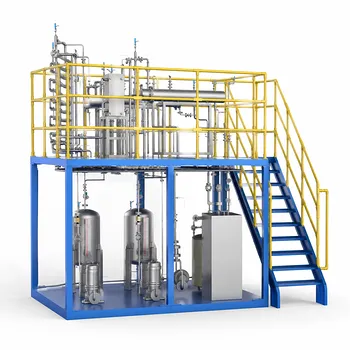
Configuring control loops on a unit operations pilot plant is not about advanced optimization—it’s about instilling a handful of inviolable design principles. The fundamental rules to teach begin with hardware placement: only one control valve per process stream, phase boundaries maintained by level controllers, valves located on pump discharge lines, and temperature regulation via utility flows or bypasses. The overall material balance is anchored by the main feed flow controller, making it the heartbeat of the plant’s stability.
Effective pilot-plant control education bridges the gap between static hardware rules and dynamic system behavior. The real lesson is that every control decision—from valve placement to controller tuning—must respect process hydraulics, material balances, and interaction dynamics to prevent inevitable operational failures.
The Five Non-Negotiable Hardware Rules
When configuring loops on a chemical engineering pilot plant, students must first internalize a set of physical constraints. These rules prevent the most common—and most dangerous—configuration errors.
‣ One Stream, One Control Valve
On any designated process stream between unit operations, only one control valve should be installed. Two valves on the same stream create competing loops that fight each other, destabilizing the entire section. The plant’s degrees of freedom are fixed; adding a second valve introduces an uncontrollable interaction.
‣ Phase Boundaries Demand a Level Controller
Every gas‑liquid or liquid‑liquid interface requires a dedicated level controller to maintain the boundary. Without it, vapors can blow through liquid seals, liquid can carry over into gas lines, and phase separation collapses. This is non‑optional.
‣ Put the Valve on the Pump Discharge
In liquid level control—for example at the bottom of a distillation column—the control valve belongs on the discharge line, never the suction. A valve on the suction side starves the pump, induces cavitation, and destroys hydraulic stability. Placing it downstream preserves pump performance and reliable control.
‣ Temperature Control via Utilities or Bypass
Temperature is almost always manipulated by adjusting the flow of a utility stream (steam, cooling water) or by using a bypass around a heat exchanger. This method avoids direct process‑side throttling that could upset reaction stoichiometry or separation efficiency.
‣ Material Balance Anchored at the Feed
The overall material balance must be established by a flow regulator or ratio flow controller on the main feed stream. Everything downstream—levels, pressures, compositions—depends on a stable influx. If the feed controller is wrong, the entire pilot plant drifts.
Controller Selection: Matching Algorithm to Dynamics
Beyond hardware, the choice of control algorithm is a fundamental rule of pilot‑plant operation. The wrong selection creates unnecessary offsets or wild instability.
‣ P‑only for Tolerance‑Friendly Loops
A Proportional controller is simple and fast but always leaves a steady‑state offset after a load disturbance. It’s acceptable only for auxiliary level controls where exact setpoint precision is not required—for example, a surge drum that just needs to stay within range.
‣ PI as the Workhorse
For most flow, pressure, and level loops that demand zero offset, a Proportional‑Integral (PI) controller is the default. Integral action eliminates the steady‑state error, making it the standard choice for any loop without massive lag.
‣ PID for Lag‑Heavy Processes
Processes with significant thermal inertia or transfer lag—such as jacketed reactors or pilot‑scale heat exchangers—require PID control. The derivative term reacts to the rate of error change, stabilizing the loop and accelerating the return to setpoint. Without derivative, these loops would oscillate endlessly.
Managing Loop Interactions and Coupling
In multi‑variable systems like distillation columns, loops inevitably interact. Teaching how to minimize coupling is just as vital as teaching how to tune a single loop.
‣ Optimal Variable Pairing
The first defense is to pair manipulated and controlled variables that are naturally close to one‑to‑one. For a column, pairing reflux with top composition and boil‑up with bottom composition often gives the most decoupled response.
‣ Detune for Separation
When interaction persists, stagger the speed of the controllers. Make the fast loop (e.g., a flow loop) highly responsive, while making the slower loop (e.g., pressure) deliberately sluggish. This frequency separation reduces fighting without complex compensators.
‣ Reduce the Problem
In some cases, the best control is partial control. In a distillation column, controlling only the top composition—and letting the bottom composition float within bounds—can eliminate severe interaction entirely. Less can be more.
‣ Decoupling When Necessary
For unavoidable coupling, implement a decoupling compensator between the controllers and the process model. This dynamic element counteracts the cross‑coupling signals, making each loop behave as if it were independent.
Special Considerations for Educational Pilot Plants
Pilot plants designed for teaching have unique needs that go beyond standard industrial practice. These are not exceptions to the rules; they are elaborations.
‣ Uniform Control for Surge Vessels
In surge tanks that buffer flow between units, the goal is not tight level control but flow smoothing. Uniform control loops must be extremely gentle. The proportional band is set very wide (low gain), and any integral time is set long enough to prevent overflow over tens of minutes. Derivative is never used.
‣ Cascade and Feedforward as Teaching Tools
Standard configuration software provides pre‑built cascade loops (e.g., jacket temperature responding to reactor temperature) and feedforward‑feedback combinations. These demonstrate how layered control structures reject disturbances before they upset the product.
‣ PAT and Closed‑Loop Quality Control
Modern pilot plants can integrate Process Analytical Technology (PAT), such as NIR spectroscopy, to monitor composition in real time. This closes the loop on quality, allowing students to see how real‑time measurements drive immediate adjustments to feed rates or reagent addition.
Understanding the Trade-offs
Every control rule involves a compromise. True expertise means knowing when a principle must bend—and when it should not.
‣ Speed Versus Robustness
A tightly tuned PI loop recovers fast but amplifies noise and may interact with other loops. Detuning improves stability at the cost of slower response. On a pilot plant, detuning is often the safer teaching choice, as it lets students see the process drift before a human response is required.
‣ Simplicity Versus Precision
P‑only control is simple and foolproof, but the steady‑state offset can accumulate errors over long runs. PI eliminates offset but adds risk of integral windup and overshoot. Teach students to choose based on the consequence of drift: in a reflux accumulator, offset may be tolerable; in a reactor feed ratio, it is not.
‣ Uniform Control’s Hidden Danger
Extremely sluggish level control (wide proportional band, long integral time) prevents flow disturbances downstream, but it also means the vessel can approach empty or overflow if a sustained imbalance continues. Operators must understand that uniform control trades fast level recovery for hydraulic peace.
How to Apply These Principles in Your Pilot Plant
The best education comes when rules are translated into concrete configuration choices. Align your loop design with the learning outcomes you want to achieve.
- If your primary focus is teaching fundamental stability: Rigorously enforce the single‑valve rule, discharge‑side placement, and phase‑boundary level control. Let students discover the chaos that happens when these are violated.
- If your primary focus is dynamic tuning and process response: Introduce PI and PID loop exercises on flow, pressure, and temperature units. Have students compare offset, overshoot, and settling time while documenting sensor noise sensitivity.
- If your primary focus is multivariable interaction: Configure a distillation column with at least three loops and let students experiment with variable pairing, detuning, and partial control to stabilize product composition.
- If your primary focus is modern PAT integration: Add an inline NIR or pH probe looped back to a feed ratio controller, showing how real‑time quality data can close a control loop without a human operator.
The fundamental rules of pilot‑plant control are not just a checklist—they are the physical vocabulary of safe, stable operation. When students master both the hardware commandments and the tuning principles, they leave the lab ready to control any process they’ll meet in industry.
Summary Table:
| Control Rule / Category | Key Principle | Practical Application |
|---|---|---|
| One Valve per Stream | Never place two control valves on the same process line | Prevents loops from competing and destabilizing the system |
| Phase Boundary Control | Every liquid-gas/liquid-liquid interface needs a level controller | Prevents vapor blow-through and maintains hydraulic seals |
| Valve Placement | Position control valves on the pump discharge, never the suction | Avoids pump starvation and destructive cavitation |
| Algorithm Selection | Match P, PI, or PID controllers to the specific process lag | Use PI for general loops; PID for heavy thermal lag (reactors) |
| Material Balance | Anchor the overall balance at the main feed flow controller | Establishes a stable baseline for all downstream processes |
Build Next-Generation Engineering Talents with LABPARK
To effectively teach these critical process control dynamics, students need robust, real-world hardware. LABPARK provides state-of-the-art Educational and Vocational Unit Operations Pilot Plants in chemical engineering, bioprocess & biotech, and environmental & water treatment. Designed specifically for universities, research institutes, and enterprises, our plants offer hands-on configuration of safe, industry-standard control loops.
Ready to upgrade your laboratory training equipment and prepare your students for industry challenges? Contact LABPARK today to request a custom pilot plant proposal!
Related Products
- Carbon Dioxide Hydrogen Methanol Synthesis Educational Unit Operations Pilot Plant
- Multi Pump Fluid Transport Process Piping Unit Operations Training Pilot Plant
- Natural Product Extraction Unit Operations Training Pilot Plant
- Multi-Modal Distillation Unit Operations Training Pilot Plant
- Multi-Reactor Educational Pilot Plant for Reaction Engineering Unit Operations
People Also Ask
- How do temp & pressure affect methanol synthesis pilot plants? Optimize equilibrium and catalyst performance.
- Why is a purge system necessary when operating a gas recirculation loop in a methanol synthesis pilot plant? (Guide)
- Why do modern methanol pilot plants operate at lower pressures? Catalyst & Feed Requirements Explained
- What are the operational requirements for catalyst activation? Safe Methanol Pilot Plant Operation
- Why is the chemical plant startup schedule crucial? De-risk scale-up with pilot plants.