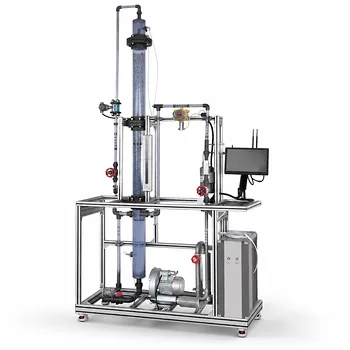
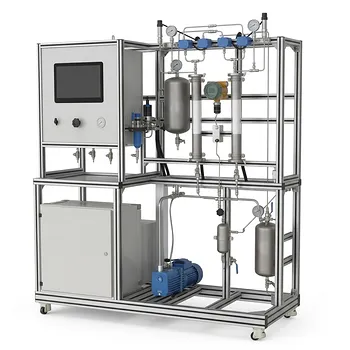
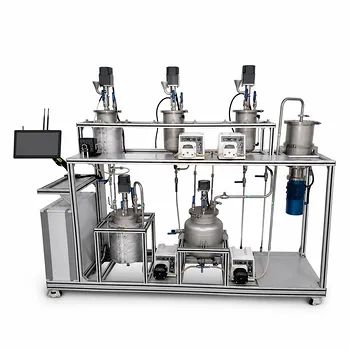
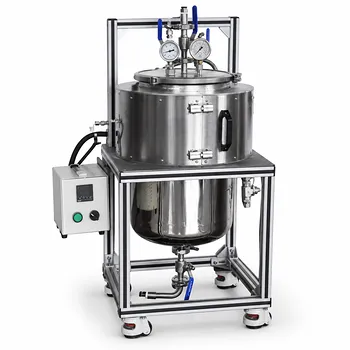
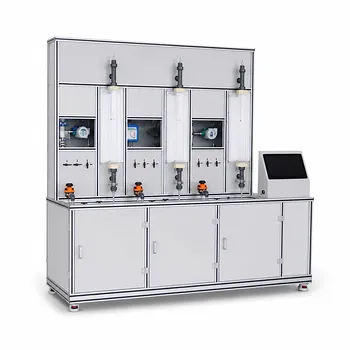
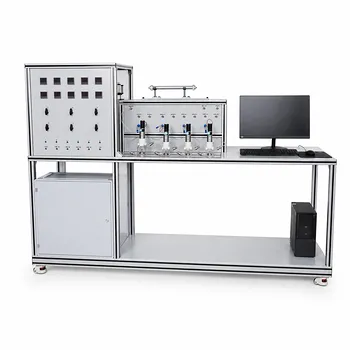
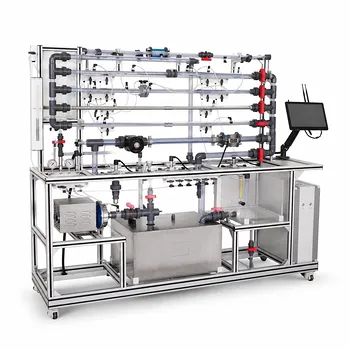
In a gas-solid fluidized bed pilot plant, the same bed of particles can behave like a solid, a liquid, or a dilute cloud—all depending on gas velocity. The principal regimes you observe are minimum fluidization, bubbling, slugging, spouting, and transport. The bubbling and slugging regimes are particularly important for heat and mass transfer because vigorous particle motion creates rapid mixing, yielding typical heat transfer coefficients around 200 W/(m²·°C) and near-instantaneous gas-particle temperature equilibration within a shallow bottom zone.
A pilot plant’s transparent column reveals how the bed transitions from a fixed state to chaotic bubbling and slugging. These hydrodynamic regimes directly govern the extraordinary heat uniformity and rapid drying/reaction rates that make fluidized beds ideal for highly exothermic processes, but the same intense mixing introduces a backmixing trade-off that can reduce single-pass conversion efficiency.
Mapping the Fluidization Regimes in a Pilot Plant
From Fixed Bed to Minimum Fluidization
At low gas velocities, the bed remains fixed with particles stationary and the pressure drop rising linearly. Minimum fluidization velocity (uₘf) marks the point where the upward drag force just balances the bed’s weight. At uₘf, the pressure drop plateaus and becomes constant, equal to the effective weight of the bed per unit area. Experimentally measuring this transition teaches the fundamental link between particle size, fluid properties, and fluidization onset. The Broadhurst and Becker correlation provides a theoretical prediction of uₘf from particle density, gas density, particle diameter, and gas viscosity, allowing students to compare sensor data with theory.
Bubbling and Slugging – The Workhorse Regimes
Just above uₘf, the bed enters the bubbling regime: gas gathers into distinct bubbles that rise through the particle suspension, causing mild, then vigorous, particle agitation. In narrower pilot columns with coarse particles, bubbles can coalesce and grow until they span the entire cross‑section, creating the slugging regime. Both regimes drive continuous upward and downward circulation of solids, producing liquid‑like flow behavior. This intense mixing is the engine of high heat and mass transfer performance. Transparent pilot columns let you visually correlate bubble size, frequency, and slug formation with the measured heat and mass transfer rates.
Spouting and Transport Regimes
For very coarse particles or special gas inlet designs, a spouting regime emerges—a central fountain of solids rises and rains back down the bed periphery. When gas velocity exceeds the terminal settling velocity of individual particles, the bed enters transport mode: solids are carried out of the column, transitioning from fluidized bed to pneumatic conveying. These regimes are less common in conventional catalytic reactors but are valuable for studying elutriation and entrainment behavior in pilot‑scale operations.
How the Regimes Supercharge Heat and Mass Transfer
Near‑Instantaneous Gas‑Particle Equilibrium
In a bubbling or slugging bed, heat transfer between gas and solid particles is extremely rapid. The finely divided solids provide an enormous surface area per unit volume, and their volumetric heat capacity far exceeds that of the gas. About 90 % of the gas temperature change occurs within a shallow bottom layer only a few particle diameters thick. Consequently, the entire vigorously bubbling bed operates at an essentially uniform temperature, even during highly exothermic reactions—a stark contrast to the hot spots common in fixed‑bed pilot plants.
Uniform Bed Temperature and Wall Heat Transfer
The continuous solids circulation eliminates thermal gradients, yielding a flat temperature profile across the entire bed section. Heat transfer to containing walls or immersed heat exchangers becomes comparable to boiling‑liquid coefficients (on the order of 200 W/(m²·°C)). This high rate depends on the unceasing particle motion against the heat‑transfer surface. Immersed heat exchangers must be carefully designed not to obstruct particle movement, as any interference degrades fluidization and local heat transfer. That makes fluidized bed pilot plants exceptionally safe for strongly exothermic reactions that demand tight temperature control.
Mass Transfer Enhancement and its Hidden Limitation
The intense contact between gas and solids also amplifies mass transfer. In drying experiments, students can plot drying curves that demonstrate dramatically faster moisture removal compared to static drying—a direct illustration of why industrial fluidized bed dryers operate at high throughput. However, mass transfer is not universally superior in every detail.
When nonporous particles are used, gas mixing in the interstitial spaces is extremely poor because closely packed particles suppress turbulence, and the gas largely bypasses as bubbles. This can hurt reactor performance if reactants are fed separately. Porous catalyst particles partially overcome this limitation: they absorb, transport, and release gas, introducing a limited but helpful degree of cross‑mixing. For very fine particles (e.g., ~100 μm), the interstitial Reynolds number is tiny (≈10⁻¹), so gas‑particle mass transfer coefficients approach their lower limiting values—reminding us that not every operating point maximizes mass transfer.
Understanding the Trade‑offs in Fluidized Bed Operation
The Backmixing Penalty: Uniformity vs. Conversion Efficiency
The same vigorous solids circulation that guarantees thermal uniformity also creates strong axial backmixing. Particles rise with bubbles and descend through the dense phase, mixing the bed contents nearly perfectly along the reactor height. This produces highly uniform temperature and concentration profiles but reduces the concentration driving force from inlet to outlet. Result: for a given mean residence time, a fluidized bed reactor may achieve a lower overall reactant conversion than a plug‑flow fixed‑bed reactor. Pilot plant studies let you quantify this trade‑off directly—measuring temperatures, conversions, and residence time distributions to balance heat‑transfer safety against reaction efficiency.
Gas Bypassing and Bubble‑to‑Dense Phase Transport
In the bubbling regime, a significant fraction of the gas can ride through the bed as bubbles without intimate contact with the dense phase of solids. The mass transfer of reactants from bubbles into the emulsion phase becomes a limiting step. Educational pilot plants can demonstrate this by varying bed height, distributor design, or particle properties and measuring the resulting conversion or mass transfer rate. The slugging regime can amplify bypassing even further, as the large slugs carry gas rapidly through the bed with minimal solids interaction, reducing both heat and mass transfer effectiveness.
Making the Most of Your Fluidized Bed Pilot Plant
Every pilot plant run can be tailored to highlight a specific aspect of fluidization science. Choose your focus:
- If your primary focus is intense heat management: Operate in the bubbling regime and design immersed heat exchangers to sit flush with bed movement. A flat temperature profile prevents catalyst‑damaging hot spots and enables safe study of highly exothermic reactions.
- If your primary focus is mass‑transfer‑limited reactions: Pay careful attention to gas bypassing and backmixing. Use porous catalyst particles to improve interstitial mixing, consider staging to push conversion closer to plug‑flow performance, and measure the trade‑off between temperature uniformity and per‑pass conversion.
- If your primary focus is education and demonstrative insight: Use the pilot plant’s transparent column to visualize regime transitions and correlate pressure drop measurements, uₘf determination, and drying curves with theoretical predictions. This transforms abstract multiphase flow theory into an intuitive, quantitative framework.
- If your primary focus is scale‑up research: Study the onset of slugging and transport regimes to define operating windows that avoid particle entrainment and attrition, while still capturing the heat‑transfer benefits of vigorous fluidization.
By observing and manipulating fluidization regimes directly, a pilot plant equips you to predict, optimize, and troubleshoot the thermal and mass‑transfer behavior that defines industrial fluidized‑bed reactors and dryers.
Summary Table:
| Fluidization Regime | Key Hydrodynamic Characteristics | Heat & Mass Transfer Impact |
|---|---|---|
| Minimum Fluidization | Drag force balances bed weight; pressure drop plateaus. | Onset point; baseline for studying transfer kinetics. |
| Bubbling & Slugging | Vigorous particle agitation; bubble/slug coalescence. | High wall heat transfer (~200 W/m²·°C); risk of gas bypassing. |
| Spouting & Transport | Central fountain of solids or complete particle entrainment. | Lower reaction efficiency; ideal for elutriation and drying studies. |
Accelerate Your Research and Education with LABPARK
Enhance your laboratory's practical training and research capabilities with LABPARK's advanced Educational and Vocational Unit Operations Pilot Plants. Serving universities, research institutes, and enterprises, we provide robust, transparent, and safe systems across key disciplines:
- Chemical Engineering (including fluidized beds, distillation, and reactors)
- Bioprocess & Biotech
- Environmental & Water Treatment
Ready to bring hands-on engineering excellence to your institution? Contact LABPARK today to discuss your specific pilot plant requirements!
Related Products
- Fluidized Bed Gas Solid Catalytic Reaction Educational Pilot Plant
- Two-Dimensional Fluidization Hydrodynamics Educational Pilot Plant for Unit Operations Training
- Fixed Bed Gas Solid Catalytic Reaction Educational Pilot Plant
- Educational Unit Operations Pilot Plant for Intraparticle Diffusion Effective Factor Measurement
- Fixed-Bed Chemical Reaction and Gas Dust Tar Removal Unit Operations Pilot Plant
People Also Ask
- Why is the bed height-to-diameter ratio (L/dt) critical? Fluidized bed pilot plant selection guide.
- How is the minimum fluidization velocity (U_mf) determined and utilized? A Unit Operations Guide
- How does the Mears criterion evaluate transport resistance? Key Guide to Intrinsic Kinetics
- How do reactor pilot plants safely study gas-solid reactions? Master kinetics with thermal & flow control.
- How do pilot plants demonstrate fluidized-bed reactor advantages over fixed-bed? Find Out Now