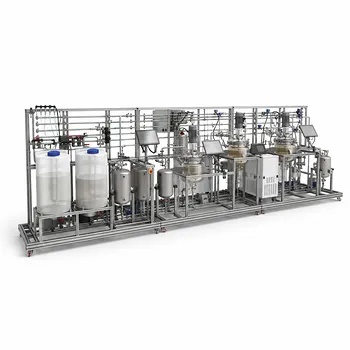
Separation hinges on mastering one physical event: droplet coalescence. The rate at which tiny dispersed-phase droplets merge in a mixer-settler is governed by five primary factors: interfacial tension, density difference, continuous phase viscosity, droplet size, and the presence of temperature or impurities. This process is critical because incomplete coalescence directly results in phase entrainment, where droplets of one liquid contaminate the other, destroying the purity and efficiency of the entire extraction operation.
Effective phase separation is a race against droplet stability. While a large density difference and low viscosity accelerate the process, the dominant challenge in a pilot plant is often managing interfacial tension and invisible surfactant impurities. Mastering coalescence is less about a single property and more about managing the dynamic film-drainage event.
Beyond Droplet Size: The Physics of Film Drainage
The surface-level question asks for the “what”—the list of factors. The deep need is understanding the “why”—the hidden mechanism that makes these factors matter, especially in a research environment.
The Hidden Bottleneck: Thin Film Drainage
Droplet coalescence is not a single collision event. It is a two-step process where droplets must first collide, and then the thin film of continuous phase trapped between them must drain and rupture.
The primary reference correctly identifies that continuous phase viscosity controls this step. A high viscosity fluid resists being squeezed out, acting like a lubricating cushion between the droplets.
Interfacial tension plays a dual role here. While high tension helps the film rupture quickly once it's thin, low tension (often desired for mass transfer) makes the film flexible and remarkably difficult to break, directly "increasing coalescence time."
Why It's Critical: The Cost of Entrainment
The “critical for process separation” point is about more than just losing product. In a pilot plant, unresolved dispersion creates two severe problems.
First, carryover of aqueous droplets into the organic phase, or vice versa, contaminates downstream unit operations, rendering material balances and kinetic data invalid.
Second, a stable emulsion band, or "rag layer," at the liquid-liquid interface effectively reduces the active settler volume. This chokes the throughput capacity and can lead to a total operational shutdown.
The Five Governing Factors in a Pilot Plant Setting
Optimizing a settler requires manipulating these interconnected variables. The goal is a clear, sharp interface, not a murky dispersion.
1. Interfacial Tension: The Stabilizer
This is often the most confounding variable for researchers. The primary reference correctly notes that lower tension increases coalescence time.
A chemically efficient extraction system often operates with very low interfacial tension to maximize mass transfer area. The pilot plant then reveals the trade-off: you’ve created a highly stable dispersion that resists the very separation you now need to perform.
2. Density Difference: The Driving Force
A larger density difference between the two immiscible phases provides a stronger buoyant force, driving droplets to the interface more quickly.
While Newton’s law governs the rate of approach, the key insight is that a rapid approach doesn’t guarantee rapid coalescence. Droplets can pack densely at the interface but remain separated by stubborn films, highlighting that settling and coalescing are distinct, sequential steps.
3. Continuous Phase Viscosity: The Brake
The impact of viscosity is physically intuitive: it’s harder to move through honey than water.
In a pilot setting, this property is highly sensitive to temperature control. A cold laboratory in winter can unexpectedly increase viscosity, slowing film drainage and causing an otherwise well-designed settler to fail.
4. Droplet Size: The Surface Area Problem
This factor creates an exponential problem. As the reference states, smaller droplets have a higher surface-to-volume ratio and lower buoyancy.
Poor mixer design or excessive agitation creates these "micro-droplets." They settle so slowly that gravity becomes ineffective, and their high curvature creates a pressure barrier that physically resists film drainage. The settler’s primary job becomes overcoming this excessive surface energy.
5. Temperature and Impurities: The Wild Cards
The primary reference highlights these as operational variables that can silently sabotage a run.
Impurities are the most insidious factor. Trace surfactants from upstream reactions or even cleaning agents collect at the interface and act as physical barriers to coalescence. This creates a mechanically stable emulsion that no amount of residence time can break. A pilot plant scale-up’s first lesson is often the critical need for feed-stream purity.
Understanding the Trade-offs: Design vs. Operation
Coalescence optimization is rarely a pure science. It’s a series of compromises with physical and economic limits.
The Mass Transfer vs. Separation Paradox
The fundamental conflict is with the mixer. Good mixing demands dispersion, which creates small droplets and often uses chemistries with low interfacial tension. This directly conflicts with the settler’s need for large, high-tension droplets.
A pilot plant designer cannot optimize one unit in isolation. They must accept a deliberate compromise in mixing intensity to create a droplet size distribution that the settler can feasibly resolve. Pushing mass transfer to its absolute limit inevitably creates an unbreakable emulsion downstream.
The Pitfall of Ignoring Surfactants
The most common mistake students and researchers make is to focus solely on the bulk fluid properties while ignoring the environment. Surface-active molecules have a dis-proportionate effect, accumulating molecularly at the droplet surface.
This means a very low concentration of a contaminant can reduce coalescence efficiency far more than a large change in density. Solving a separation problem often requires a chemical scrub or a solvent wash, not a hydraulic adjustment.
Making the Right Choice for Your Pilot Plant Goal
Operational success depends on diagnosing the root cause of poor separation and applying a targeted fix.
- If your primary focus is achieving a sharp interface for purity: Aggressively manage feed impurities and investigate trace surfactants first. Consider a slight temperature increase to reduce continuous phase viscosity, but never at the cost of excessive vaporization losses.
- If your primary focus is debottlenecking settler throughput: Evaluate the droplet size distribution from the mixer. A more gentle primary mixing zone or a coalescing medium may produce larger droplets that settle faster, even if it requires a marginal compromise on stage efficiency.
- If your primary focus is handling a difficult, low-tension chemistry: Design for the separation limitation from the start. This means prioritizing coalescing internals (mesh pads, electrostatic grids) and accepting a longer settler residence time rather than trying to brute-force the separation with an incompatible chemistry.
Ultimately, a pilot plant settler is not just a separating device; it’s a sensitive diagnostic instrument that reveals the true stability of your liquid-liquid system and the hidden impact of every molecule in your feed.
Summary Table:
| Governing Factor | Physical Impact on Coalescence | Key Operational Challenge |
|---|---|---|
| Interfacial Tension | Low tension increases coalescence time, stabilizing droplets. | Balancing mass transfer efficiency with separation speed. |
| Density Difference | High difference drives faster droplet approach to the interface. | Rapid settling does not guarantee immediate film rupture. |
| Continuous Phase Viscosity | High viscosity acts as a brake, slowing thin film drainage. | Highly sensitive to temperature variations in the lab. |
| Droplet Size | Smaller droplets settle slower and resist film drainage. | Avoiding excessive mixer agitation that creates micro-droplets. |
| Impurities (Surfactants) | Collect at interface to form a mechanical barrier against merging. | Trace contaminants causing unresolved "rag layers" or emulsions. |
Optimize Your Extraction Workflows with LABPARK
Struggling with phase entrainment or emulsion layers in your separation processes? LABPARK provides state-of-the-art Educational and Vocational Unit Operations Pilot Plants in chemical engineering, bioprocess & biotech, and environmental & water treatment.
Specially designed for universities, research institutes, and enterprises, our pilot plants help students and researchers master liquid-liquid extraction, droplet coalescence physics, and scale-up dynamics.
Contact LABPARK today to find the ideal pilot plant system for your laboratory or training facility!
Related Products
- Agitation and Mixing Educational Unit Operations Pilot Plant
- Multi Pump Fluid Transport Process Piping Unit Operations Training Pilot Plant
- Multi-Reactor Educational Pilot Plant for Reaction Engineering Unit Operations
- Multimodal Absorption and Desorption Pilot Plant for Unit Operations Training
- Multi-Functional Drying Educational Unit Operations Pilot Plant
People Also Ask
- How do cost-capacity exponents vary across chemical equipment? Scaling insights.
- What are the primary considerations when managing and scaling up shear rates in pilot plant mixing operations? Guide
- What are the differences between set-point, servo, and program control? Master unit operations training.
- Evaluate Tablet Compaction: Force, Density & Porosity in Unit Operations Pilot Plants
- Why Switch Unit Operations Flow Configurations? Impact on Experimental Measurements