The critical factors defining the boundary between stable operation and a catastrophic thermal runaway in a multitubular reactor pilot plant are a dynamic interplay between the reaction’s intrinsic kinetics and the system’s heat removal capacity. At its core, runaway is triggered when the rate of heat generation from the exothermic reaction irreversibly exceeds the rate of heat removal by the cooling system. The specific parameters governing this dangerous imbalance are the activation energy, reaction order, feed temperature, feed concentration, and the crucial ratio of the heat transfer capacity to the reaction rate.
The central challenge in pilot plant safety isn't just identifying these factors individually, but recognizing their non-linear and synergistic relationship. A minor, seemingly safe adjustment to the inlet temperature can trigger a runaway if the cooling system is already operating near its limit, especially for reactions with low reaction orders that sustain rapid kinetics even as the reactant is consumed. The ultimate goal of pilot-scale study is to precisely map this catastrophic boundary without crossing it.
The Thermodynamic Triggers: Heat Generation vs. Removal
The fundamental cause of thermal runaway is a positive feedback loop where a temperature increase accelerates the reaction rate, which releases more heat, which further increases the temperature. Two dimensionless parameters capture this battle at the reactor scale.
The Heat of Reaction Parameter (B)
This parameter represents the system's potential for a temperature spike. It is defined by the adiabatic temperature rise (ΔT_ad) and the activation energy. A reaction with a high heat of reaction, and therefore a high adiabatic temperature rise (often classified as ΔT_ad > 50°C), has enormous destructive potential if the heat isn't removed. These "highly energetic" reactions are inherently closer to the runaway boundary, demanding significantly more robust cooling strategies from the outset.
The Heat Transfer Parameter (δ/Da)
This is the dimensionless ratio of the system's ability to remove heat (δ) to its tendency to consume reactants (the Damköhler number, Da). A low value of this parameter signifies that the reactor is poorly equipped to handle the heat it's generating. Runaway becomes highly likely when the heat of reaction is high and this heat transfer parameter is low. In a pilot plant, this is your primary lever of control, adjusted through jacket flow rate, coolant temperature, and the thermal conductivity of the reactor walls.
The Kinetic Drivers of Unstable Behavior
Beyond the gross heat balance, the specific kinetics of the reaction profoundly influence parametric sensitivity, dictating why two reactions with the same heat release can behave completely differently.
The Dominant Role of Activation Energy
Reactions with large activation energies are fundamentally more sensitive. The reaction rate constant's exponential dependence on temperature becomes a double-edged sword. A small, localized temperature rise in a high-activation-energy reaction causes a disproportionately large increase in the reaction rate. This creates a powerful, self-amplifying feedback loop that rapidly spirals into runaway. This high sensitivity makes precise, multi-point axial temperature monitoring mandatory to detect the earliest formation of a hot spot.
The Counterintuitive Danger of Low Reaction Orders
It is a critical and often overlooked fact that thermal runaway is more likely to occur when the reaction order is lower. A first-order reaction (n=1) maintains a high rate even as the reactant is significantly consumed. This means the runaway-driving heat generation persists deep into the reactor. In contrast, a second-order reaction (n=2) slows down more rapidly as concentration drops, offering a self-limiting mechanism. This is why studying zero- and first-order reactions in a pilot plant requires extra vigilance.
The Operational Triggers and Pilot Plant Safeguards
This theoretical understanding is put to the test by the tangible operating conditions you directly control on the pilot plant console.
Inlet Temperature and Concentration
The inlet temperature of the feed is the primary match that can ignite a runaway in a sensitive system. A higher feed temperature pushes the reactor closer to a "tipping point" from which stable cooling cannot return it. Similarly, increasing the feed concentration directly increases the available chemical potential energy, raising the adiabatic temperature rise and pushing the system closer to the critical boundary. Your pilot plant's feed preheaters and dosing pumps are the most critical control points, and they must be configured with high-precision control and automated safety limits.
Pilot Plant Instrumentation for Safe Study
To safely probe these limits, an educational or R&D pilot plant is not just a scaled-down production unit; it's an instrumented safety experiment. Multi-point axial thermocouples are non-negotiable. A single outlet sensor is blind to the deadly hot spot forming at a specific point along the catalyst bed or reactor tube. Responsive, multi-zone cooling jackets with automated emergency cooling loops are required. The system must not only maintain a set point but also aggressively respond to an unexpected exotherm. Automated safety interlocks—such as automatic feed shut-off valves triggered by a temperature threshold—are the final safeguard. They prevent a manageable temperature deviation from becoming a catastrophic loss of containment or catalyst destruction, especially when studying the runaway boundary itself.
Understanding the Trade-offs and Pitfalls
A purely defensive, maximum-cooling operational philosophy is not the optimal strategy for learning or for process development.
The Risk of Overly Restrictive Limits
Setting the cooling system to its absolute maximum might keep you far from the runaway region, but it also masks the true kinetic behavior you're trying to study. Over-cooling can quench the reaction, leading to low conversion and data that is useless for scale-up predictions. The art is to operate within a safe margin of the critical heat of reaction parameter (Bc) —the boundary where the mathematical conditions for stability vanish—without imposing conditions that make the experiment itself meaningless.
The Danger of Undetected Secondary Exotherms
Your primary reaction might be perfectly stable, but a secondary decomposition reaction could be catastrophic. This is a classic pitfall in processes like Grignard reagent formation, where the initiation of a secondary exotherm can occur at a higher temperature. The pilot plant must be used to identify this initiation temperature. Techniques often recommended for this include limiting initial reagent charges (e.g., to no more than 20% before initiation) and using online FTIR spectroscopy to track reaction progress and detect a delayed exotherm before a thermocouple registers a rapid temperature change.
Making the Right Choice for Your Goal
Your specific objective for pilot-scale operation will dictate which parameters you prioritize and how you configure the system's safety envelope.
- If your primary focus is mapping the safe operating window for scale-up: Systematically and carefully vary the inlet temperature and flow rate while monitoring the axial temperature profile. Your goal is to map the approach to the runaway boundary, not to cross it, using your cooling capacity to safely retreat at the first sign of hot spot formation.
- If your primary focus is demonstrating the theory of parametric sensitivity for education: Choose a model reaction with well-known, strong sensitivity (high activation energy, low reaction order). Deliberately step-change the inlet temperature in tiny increments while maintaining a constant, logged heat transfer parameter, allowing students to see the non-linear temperature response in near-real-time.
- If your primary focus is handling a highly hazardous, highly exothermic reaction: Your first experimental step must be a rigorous calorimetric study to determine the adiabatic temperature rise and the temperature of any secondary exotherms. In the pilot plant, start every experiment with a minimal initial charge and use a formal hazard evaluation to set your safety interlock thresholds at a safe distance from identified decomposition onsets.
Mastering these factors in a pilot plant is the critical bridge between a theoretical kinetic model and a safe, profitable industrial process.
Summary Table:
| Factor | Impact on Runaway Risk | Control / Mitigation Strategy |
|---|---|---|
| Activation Energy | High sensitivity; rapid feedback loop | Multi-point axial temperature monitoring |
| Reaction Order | Lower orders sustain high reaction rates longer | Vigilant feed dosing and concentration control |
| Heat of Reaction (B) | High adiabatic rise increases energy potential | Robust cooling and minimal initial reagent charges |
| Heat Transfer Parameter | Low ratio limits heat removal capacity | Adjust coolant flow, temperature, and jacket zones |
Secure Your Chemical Engineering Research with LABPARK
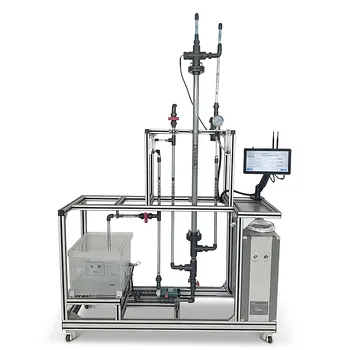
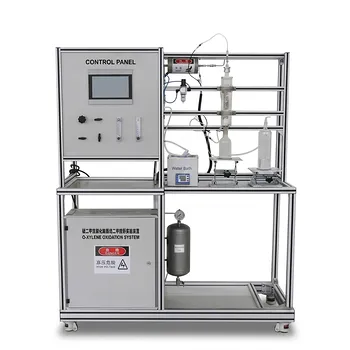
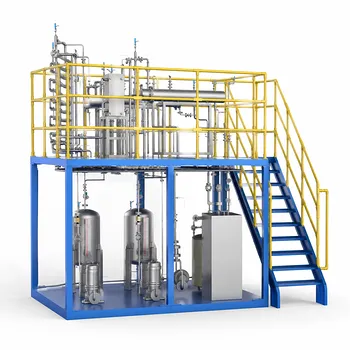
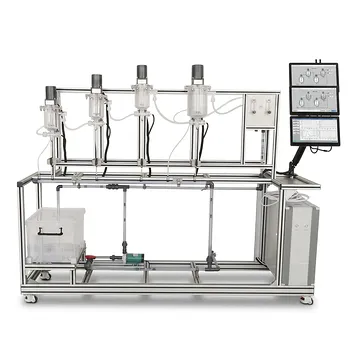
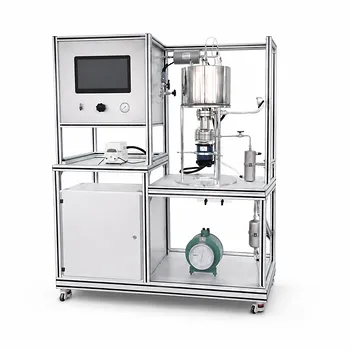
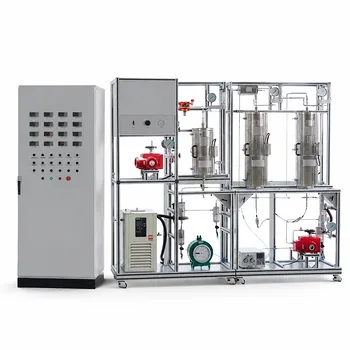
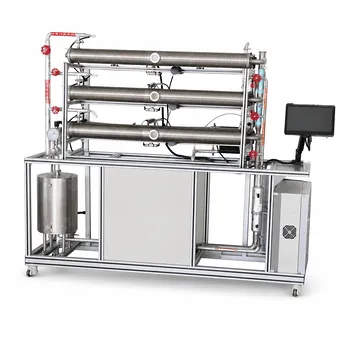
To safely study parametric sensitivity without risking catastrophic runaway, researchers need highly precise and responsive pilot systems. LABPARK provides state-of-the-art Educational and Vocational Unit Operations Pilot Plants in chemical engineering, bioprocess & biotech, and environmental & water treatment. Specifically designed for universities, research institutes, and enterprises, our pilot plants are equipped with advanced multi-zone cooling, precise axial monitoring, and automated safety interlocks.
Ensure maximum safety and accurate data in your scaling-up processes. Contact LABPARK today to find the perfect pilot plant solution for your lab.
Related Products
- Multi-Reactor Educational Pilot Plant for Reaction Engineering Unit Operations
- Tubular Reactor Flow Characteristics Determination Educational Unit Operations Pilot Plant
- Residence Time Distribution and Reactor Flow Characteristics Determination Educational Pilot Plant
- Multi Functional Catalytic Reaction and Reactor Evaluation Educational Unit Operations Pilot Plant
- Educational Unit Operations Pilot Plant for Intraparticle Diffusion Effective Factor Measurement
People Also Ask
- How do educational unit operations pilot plants address safety and waste management when scaling up?
- How do educational unit operations pilot plants bridge theory and design? Bridge the Engineering Gap
- Why Compare Predicted and Experimental Excess Enthalpy? Key to Accurate Pilot Plant Scale-up
- How to study gasification in pilot plants? Compare exit gas composition & efficiency
- Why Use PTFE & Hastelloy in Chemical Pilot Plants? Prevent Corrosion & Ensure Safety