When a pilot plant’s wet mill recirculates a slurry of nonconductive organic solvents, the very act of pumping and agitation creates an invisible, high-energy hazard. Frictional contact between the moving liquid, suspended solids, and internal surfaces generates static electricity that cannot dissipate in a fluid with very low conductivity. If this accumulated charge discharges as a spark, it can readily ignite the flammable solvent vapors, leading to a catastrophic fire or explosion. The essential mitigation strategy combines the use of conductive, grounded equipment, inert atmospheres, and carefully managed flow dynamics to prevent charge buildup and eliminate ignition sources.
Wet milling with nonconductive solvents (conductivity <100 pS/m) presents a unique electrostatic risk where charge generation from flow friction cannot safely relax. The answer is a layered defense: eliminate static accumulation via bonding and conductive materials, remove the oxidizer with nitrogen inerting, and engineer a flow velocity that balances charge prevention with solids suspension.
Why Wet Milling with Nonconductive Solvents Creates a Perfect Electrostatic Storm
Pilot-plant wet milling involves continuous recirculation of a solid-liquid mixture through pumps, pipes, and the mill chamber. Each component interaction becomes a potential static generator when the liquid is an electrical insulator.
The Charge Generation Mechanism
Static electricity builds through triboelectric charging at the fluid-solid interface. As the slurry flows, electrons are stripped from the pipe or vessel walls, leaving the liquid carrying a net charge. Agitation and high-velocity flow—especially through narrow gaps in the milling chamber—significantly amplify this effect, acting like a continuous Van de Graaff generator on a process scale.
The Danger of Nonconductive Solvents
The electrostatic hazard is defined not just by charge generation, but by a liquid’s ability to relax that charge. Solvents like hexane, heptane, and toluene typically have conductivities well below the critical threshold of 100 pS/m. In these insulating fluids, electrostatic charges can linger for tens of seconds or minutes, far longer than the transport time between charge generation and a potential discharge point. This means charge accumulates cumulatively in receiving vessels until a breakdown condition is met.
The Recipe for Disaster: Flammable Vapors and Settled Solids
The presence of flammable organic vapors in the headspace of a mill or holding tank turns a static spark into a fireball. The risk is compounded by the solids in the slurry: if a charged, poorly conducting solids bed settles in a vessel, it can accumulate extreme potentials and discharge directly into a vapor space with enormous energy. A single spark discharge, often inaudible, is enough to ignite most organic solvents.
Mitigation Strategies: A Layered Defense for Pilot Plants
Effective safety design does not rely on a single barrier. Instead, it combines passive engineering controls, process modifications, and operational discipline.
Eliminate the Ignition Source: Bonding, Grounding, and Conductive Materials
The most fundamental step is ensuring all metal equipment shares a common electrical potential and a low-resistance path to earth. Bonding connects adjacent components (flanges, pipe spools, vessels) to prevent potential differences, while grounding safely dissipates charge into the earth. Per standards like NFPA 77 and API RP 2003, bonding straps across every flange and grounding leads on every mobile vessel are non-negotiable. Critically, nonconductive materials like Teflon-lined pipes or glass components act as capacitors; they must be replaced with conductive alternatives such as stainless steel throughout the recirculation loop.
Modify the Process Fluid: Antistatic Additives and Solvent Selection
Where possible, changing the solvent itself can dramatically improve safety. Adding a small, compatible antistatic agent can raise conductivity above the 100 pS/m threshold, enabling charges to relax almost instantly. Alternatively, reformulating the process with a more conductive solvent—for example, adding a small proportion of a polar cosolvent—can achieve the same effect without large-scale equipment modifications. Always validate chemical compatibility with your product and process before introducing additives.
Control the Process Environment: Inert Gas Blanketing
Removing the oxygen eliminates the fire triangle. Operating the entire wet milling circuit under a nitrogen or other inert gas blanket ensures that even if a static discharge occurs, there is no oxidizer to support combustion. The inerting system must be monitored continuously for oxygen concentration, with automated shutdowns if levels exceed a safe limit (typically below the limiting oxygen concentration for the solvent). This strategy protects the mill internals, downstream filters, and receiving vessels.
Manage Flow Dynamics: Velocity Limits and Hold Times
The rate of charge generation is proportional to fluid velocity. Design the recirculation loop for a low linear velocity through the piping to minimize static buildup. However, this velocity must remain high enough to keep the solid particles in suspension, preventing settling. Downstream of the charging zone, provide sufficient hold-up volume (or hold time) in a grounded vessel to allow any residual charge to relax to a safe level before the slurry encounters a flammable vapor space. This requires a deliberate trade-off between process throughput and safety-relaxation time constants.
Understanding the Trade-offs
No mitigation strategy is without consequence. A well-engineered pilot plant balances safety with process performance.
The Velocity vs. Settling Conundrum
The requirement for low velocity to curb static generation directly conflicts with the need for high velocity to suspend solids and maintain efficient milling. Oversizing pipes to reduce fluid velocity can lead to solid dropout, plugging, and poor heat transfer. This trade-off demands careful hydraulic analysis to find the minimum velocity that prevents both static accumulation and sedimentation. Often, a stepped pipe diameter, with a larger diameter return line after the mill, is the optimal compromise.
The Cost and Complexity of Inerting
Nitrogen blanketing is extremely effective but increases operational complexity and cost. It requires a reliable nitrogen supply, specialized oxygen analyzers, pressure-regulating equipment, and rigorous purging procedures during start-up and maintenance. In a multi-purpose pilot plant frequently switching between solvent systems, the management of an inert atmosphere can become a significant operational burden.
Material Compatibility with Conductive Additives
Antistatic additives are not a universal silver bullet. They can alter reaction selectivity, contaminate a final product, or degrade under process conditions. They may also be incompatible with certain downstream purification steps, such as distillation or crystallization. Before selecting this route, a thorough risk assessment of the entire process lifecycle is essential.
Making the Right Choice for Your Pilot Plant
The appropriate safety strategy depends on your specific operational constraints and risk tolerance. Your design should reflect your primary objective.
- If your primary focus is a new, ground-up facility design: Prioritize an inherently safer design from the start. Specify all-conductive wetted parts (stainless steel, conductive polymers), design piping for a maximum velocity of 1–2 m/s with sufficient drop-leg holdup, and incorporate a central inert gas system with automated oxygen monitoring.
- If your primary focus is retrofitting an existing glass or Teflon-containing pilot plant: Immediately focus on bonding and grounding integrity, as you cannot easily change nonconductive materials. Add antistatic additives where chemically feasible, and enforce strict operating procedures for nitrogen inerting during all milling campaigns. Replace glass sight-glasses with conductive, static-dissipative alternatives.
- If your primary focus is maximum flexibility for R&D with multiple solvents: Invest in a portable inerting and gas-purification panel that can be commissioned per campaign. Rely heavily on solvent conductivity testing before every run and maintain a rigorous operator training program that includes static hazard demonstrations and clear velocity limits for each solvent-slurry system.
The key is to treat electrostatic safety not as a compliance checklist but as an integrated process design challenge—where every choice in material, flow, and atmosphere directly contributes to keeping your pilot plant and people safe.
Summary Table:
| Hazard Factor | Hazard Mechanism | Key Mitigation Strategy |
|---|---|---|
| Charge Generation | Triboelectric charging from fluid-solid friction during flow and agitation | Use conductive materials; implement comprehensive bonding and grounding |
| Charge Accumulation | Nonconductive solvents (<100 pS/m) retain static charges for long periods | Add antistatic additives or use polar cosolvents to raise conductivity |
| Flammable Vapors | Static spark discharges ignite solvent vapors in the headspace | Implement nitrogen (inert gas) blanketing with continuous oxygen monitoring |
| Flow Dynamics | High velocity increases charge buildup; low velocity causes solids to settle | Optimize pipe diameters to balance minimum settling velocity with charge relaxation |
Ensure Safety and Precision in Your Pilot Plant Operations with LABPARK
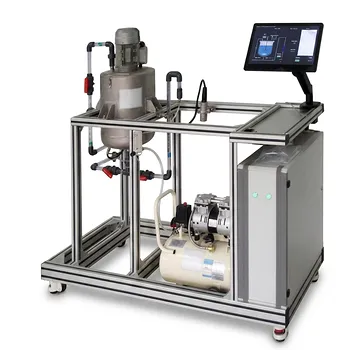
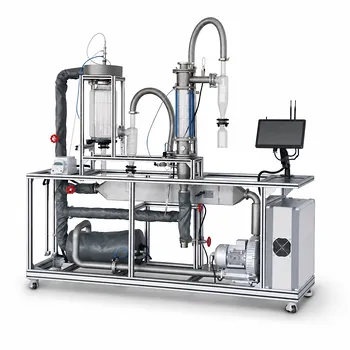
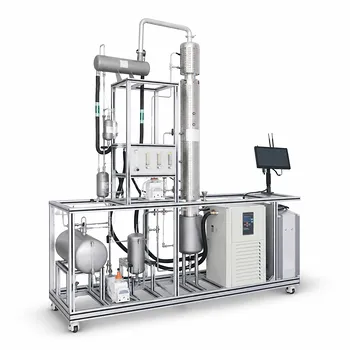
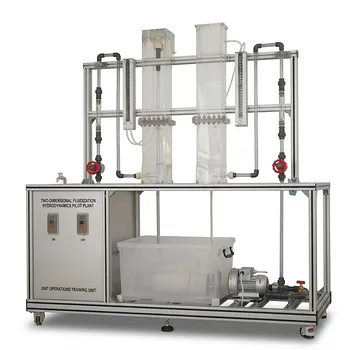
Managing electrostatic hazards in chemical processes requires precision-engineered equipment. LABPARK provides high-quality Educational and Vocational Unit Operations Pilot Plants in chemical engineering, bioprocess & biotech, and environmental & water treatment. Designed specifically for universities, research institutes, and enterprises, our pilot plants are built with advanced safety controls, robust grounding configurations, and customizable flow systems to ensure safe, reliable, and realistic scale-up training.
Take the risk out of your chemical process development. Contact LABPARK today to find the ideal pilot plant solution for your lab!
Related Products
- Agitation and Mixing Educational Unit Operations Pilot Plant
- Multi-Functional Drying Educational Unit Operations Pilot Plant
- Multi-Modal Distillation Unit Operations Training Pilot Plant
- Continuous Sieve-Plate Distillation Pilot Plant for Unit Operations Laboratory Education
- Natural Product Extraction Unit Operations Training Pilot Plant
People Also Ask
- How do cost-capacity exponents vary across chemical equipment? Scaling insights.
- What are the primary considerations when managing and scaling up shear rates in pilot plant mixing operations? Guide
- What are the differences between set-point, servo, and program control? Master unit operations training.
- Evaluate Tablet Compaction: Force, Density & Porosity in Unit Operations Pilot Plants
- Why Switch Unit Operations Flow Configurations? Impact on Experimental Measurements