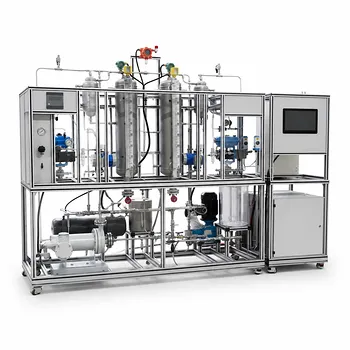
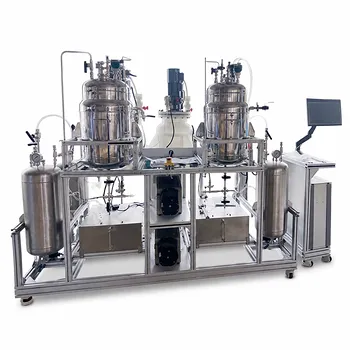
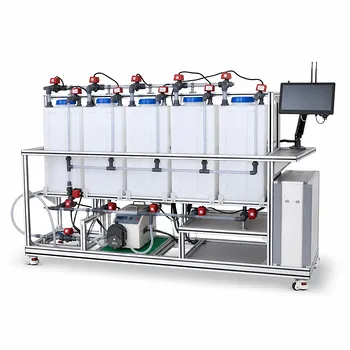
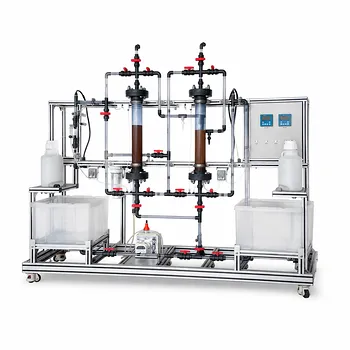
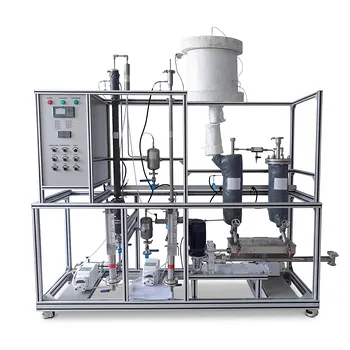
For an educational unit operations pilot plant designed to demonstrate the electrolytic production of hydrogen and oxygen, the standard, highly reliable configuration is an aqueous sodium hydroxide (NaOH) electrolyte, paired with an iron cathode and a nickel anode. This specific combination is chosen because it provides a clear, stable, and cost-effective demonstration of water splitting while minimizing side reactions that could confuse students or damage the equipment.
The pairing of an alkaline NaOH solution with an iron cathode and nickel anode is the definitive, low-risk blueprint for teaching water electrolysis. It directly generates hydrogen at the cathode and oxygen at the anode, resisting unwanted corrosion and delivering consistent, measurable results that align with textbook electrochemical theory.
Why This Specific Electrolyte and Electrode Combination?
The core goal in an educational setting is to isolate the fundamental reaction: $2\text{H}_2\text{O} \rightarrow 2\text{H}_2 + \text{O}_2$. Every material choice—the electrolyte and both electrodes—works together to make this reaction observable and quantifiable without interference from parasitic chemistry.
The Role of the Alkaline Electrolyte (Aqueous NaOH)
An alkaline environment is essential for this demonstration. Pure water is a poor conductor, so an electrolyte like NaOH is added to provide ionic conductivity without introducing anions that would compete with the water-splitting reaction.
At the high pH provided by NaOH, the thermodynamic potential for oxygen evolution is lower, and the corrosion of many non-noble metals is greatly reduced. This means we can use sturdy, affordable metals like iron and nickel instead of expensive platinum-group metals. It also ensures that the only gases evolved, when measured correctly, are hydrogen and oxygen, keeping student mass-balance calculations clean.
The Iron Cathode: A Stable Hydrogen Producer
At the cathode, the reduction of water molecules occurs to produce hydrogen gas. Iron is the material of choice for this electrode because it is catalytically active for the hydrogen evolution reaction (HER) in alkaline media and is highly stable under cathodic protection.
When current flows, the negative potential of the cathode actually protects the iron from oxidizing. Students will observe a steady stream of gas bubbles forming directly on the iron surface. The material is also easy to fabricate into sheets or meshes, making it mechanically robust for repeated lab sessions and simple to clean between experiments.
The Nickel Anode: Resisting Oxidation to Release Oxygen
At the anode, the hydroxide ions (OH⁻) are oxidized to form oxygen gas and water. Selecting the anode material here is far more challenging, as many metals will simply corrode or dissolve instead of evolving oxygen. Nickel is the ideal educational solution because it forms a thin, passive oxide layer in alkaline conditions.
This microscopic layer protects the underlying metal from further attack while remaining electrically conductive enough to sustain the oxygen evolution reaction (OER). Without this passivation, a reactive metal like copper or plain steel would quickly degrade, contaminating the electrolyte and skewing gas volume measurements. Nickel thus acts as an "inert" anode for this specific chemistry, ensuring only oxygen is produced.
Understanding the Trade-offs in an Educational Plant
While the NaOH/Iron/Nickel configuration is the gold standard for teaching water electrolysis, it’s not without its limitations. Recognizing these helps instructors prevent common pitfalls and appreciate why this setup is universally adopted.
Alternative Electrode Materials and Their Drawbacks
Students often ask why cheaper or more familiar materials aren't used. The supplementary references for electrolysis education highlight the critical principle of avoiding secondary reactions, and this applies directly here.
Carbon/graphite anodes, excellent for evolving chlorine in other experiments, are a poor choice for oxygen. In an alkaline medium at the high potentials required for OER, carbon will oxidize to carbon dioxide, physically degrading the electrode and contaminating the oxygen product stream. Stainless steel anodes, while common in some hobbyist setups, can suffer from pitting corrosion at the high anodic potentials used for oxygen evolution, eventually leaching iron and chromium ions into the electrolyte. Brass, mentioned as a stable cathode for metal deposition in other systems, would introduce zinc that could form interfering oxide layers if used as an anode here. The iron/nickel pair avoids all these failure modes.
The Cost-Value Equation in Education
Platinum and iridium-based electrodes offer exceptional catalytic activity and stability for both hydrogen and oxygen evolution. However, using them in a teaching pilot plant would be counterproductive.
The high cost creates operational anxiety and restricts experiment scale. More importantly, it would obscure a key learning objective: understanding the economic trade-offs of industrial electrolysis. The iron/nickel setup directly mirrors the material choices in large-scale commercial alkaline electrolyzers, allowing students to grapple with real-world efficiency versus capital cost calculations. It teaches that a slightly higher operating voltage (lower energy efficiency) is often acceptable in exchange for a massively lower system cost.
Absolute Purity Requirements
The greatest threat to a clean demonstration is a contaminated electrolyte. Traces of chloride ions, even from improper cleaning, are catastrophic. The chloride oxidation potential is lower than that of oxygen, meaning a nickel anode would start evolving toxic chlorine gas instead of oxygen. This would corrode the nickel, create a safety hazard, and completely invalidate the Faraday efficiency experiment. Strict use of deionized or distilled water and analytical-grade NaOH pellets is non-negotiable.
Making the Right Choice for Your Educational Goal
While the NaOH/Iron/Nickel system is the recommended foundation, the final configuration can be tweaked based on the core teaching priority. Use this guide to align the setup with your curriculum.
- If your primary focus is demonstrating classic water electrolysis with maximum robustness: Use a 20–30% w/w aqueous NaOH solution, a pure iron sheet cathode, and a pure nickel sheet anode. This replicates traditional industrial setups and is the most tolerant to minor procedural errors by students.
- If your primary focus is measuring Faraday efficiency and electrode kinetics: Use a lower concentration NaOH electrolyte (e.g., 1M) to reduce ohmic heating, and consider using a high-purity nickel mesh anode to increase surface area. This requires more precise current control but yields data closely matching theoretical predictions.
- If your primary focus is material science and corrosion studies: Add a demonstration cell with a stainless steel anode alongside the standard nickel anode. Have students measure the mass change and gas purity from both cells over time to directly observe the consequences of anodic corrosion—transforming a textbook fact into an unforgettable, practical lesson.
A well-designed educational pilot plant using these materials does more than just make gas; it turns thermodynamic equations and abstract principles of reduction-oxidation into a tangible, memorable experience that forms the bedrock of chemical engineering intuition.
Summary Table:
| Component | Typical Material | Role / Function | Key Advantage in Education |
|---|---|---|---|
| Electrolyte | Aqueous NaOH (20–30% w/w) | Provides high ionic conductivity | Prevents competitive reactions; reduces material corrosion |
| Cathode | Iron (Fe) | Promotes Hydrogen Evolution Reaction (HER) | High catalytic activity; cathodically protected from rust |
| Anode | Nickel (Ni) | Promotes Oxygen Evolution Reaction (OER) | Forms a protective passive oxide layer; resists corrosion |
Bring Industrial-Scale Electrolysis to Your Classroom & Lab
Looking to equip your facility with robust, hands-on learning systems? LABPARK provides premium Educational and Vocational Unit Operations Pilot Plants across chemical engineering, bioprocess & biotech, and environmental & water treatment.
Designed specifically to meet the high standards of universities, research institutes, and enterprises, our systems offer students safe, practical experience with real-world chemical processes.
Contact our engineering experts today to customize the perfect pilot plant configuration for your curriculum!
Related Products
- Electrolytic Hydrogen Production Educational Unit Operations Pilot Plant
- 100L Continuous Loop Hydrogenation Educational Unit Operations Pilot Plant
- Alkaline Membrane Water Electrolysis Educational Pilot Plant Unit Operations Training System
- Water Electrolysis Hydrogen Production and Storage Educational Pilot Plant
- Electrochemical Water Treatment Educational Unit Operations Pilot Plant
People Also Ask
- How do educational unit operations pilot plants address safety and waste management when scaling up?
- How do educational unit operations pilot plants bridge theory and design? Bridge the Engineering Gap
- Why is the chemical plant startup schedule crucial? De-risk scale-up with pilot plants.
- When to transition from PID to adaptive control in pilot plants? Key process indicators.
- Why Use PTFE & Hastelloy in Chemical Pilot Plants? Prevent Corrosion & Ensure Safety