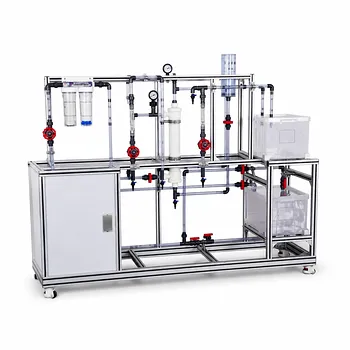
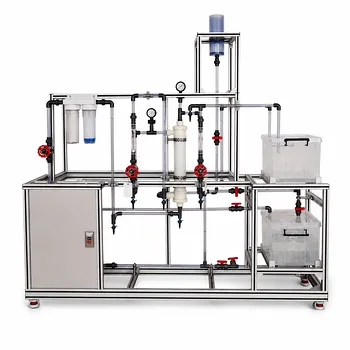
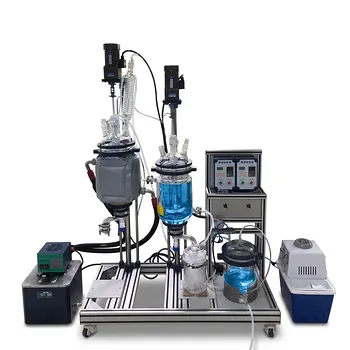
Nanofiltration (NF) pilot plants are advanced educational tools that compress an entire industrial water treatment plant into a hands-on learning station. They enable students and researchers to simulate real-world separations—removing salts, organic molecules, and microorganisms—by manipulating pressure, flow rate, and feed chemistry. From brackish water desalination to textile dye recovery, these self-contained systems turn abstract concepts like size exclusion and charge-based rejection into measurable, visualizable results.
The true educational power of an NF pilot plant lies not just in demonstrating what contaminants are removed, but in teaching why specific separations occur and how to optimize those processes against real-world constraints like energy use and membrane fouling. It transforms theoretical membrane science into a practical problem-solving discipline.
Turning Theory into Tangible Skills
The gap between a textbook diagram of size exclusion and the actual operation of a pressure-driven membrane is significant. NF pilot plants close that gap by giving students direct control over process variables and forcing them to confront the messy realities of industrial water treatment.
Simulating Real-World Separation Challenges
Unlike static demonstrations, a pilot plant lets users design their own experiments. They can decide to desalinate brackish water, concentrate a solution of organic molecules, or strip heavy metals from a simulated waste stream.
By altering the feed composition, they immediately see how a membrane that excels at removing divalent ions like magnesium sulfate (90–98% rejection) might struggle with monovalent sodium chloride (20–80% rejection). This first-hand observation cements the critical principle of charge-dependent selectivity, which is the foundation of industrial water softening and partial desalting.
Teaching Process Integrity, Not Just Performance
A running pilot plant reveals the entire system, not just the membrane. Students learn that permeate quality depends equally on pre-treatment, pump efficiency, and post-treatment polish. They measure how a poorly maintained pre-filter or a fluctuating feed pressure knocks the entire operation out of spec.
This holistic view is what distinguishes a technician who understands a single component from an engineer who can design and troubleshoot a full-scale facility.
Key Educational Experiments Enabled by NF Pilot Plants
The versatility of an NF pilot unit means it can serve multiple courses, from environmental engineering to food science. The experiments below map directly to core curriculum objectives for advanced water purification and industrial wastewater treatment.
Selective Ion Rejection and Water Softening
NF membranes block particles smaller than 1 nanometer and reject organic compounds with a molecular weight of 200–400 Da. More importantly, they treat monovalent and divalent ions differently.
A classic experiment involves running a hard water feed (rich in calcium and magnesium) through the unit. Students record that hardness ions (divalent) are rejected at over 90%, while sodium (monovalent) passes through much more easily. This demonstrates a low-energy alternative to reverse osmosis for softening and TDS reduction, and teaches the ion-selective mechanisms that regulatory standards rely on.
Targeting Organic Pollutants and Dyes
For industrial wastewater courses, the pilot plant can be configured with a simulated textile wastewater containing large dye molecules. NF membranes reject these high-molecular-weight dyes almost completely, producing a clear permeate that—if not potable—is suitable for reuse in the plant.
This experiment grounds lessons in zero-liquid discharge ambitions and circular economy thinking. By measuring the concentration factor, students calculate how much water can be recycled before the concentrate stream requires further treatment, directly mirroring a real sustainability decision.
Energy Benchmarking Against Reverse Osmosis
An NF pilot plant that records power consumption allows a head-to-head comparison with RO systems running the same feed. Because NF operates at lower pressures (typically 4–20 bar versus 10–60 bar for RO), students can graph the trade-off between salt rejection and specific energy consumption.
This exercise cements the economic logic of membrane selection: you sacrifice a bit of rejection for a significant gain in energy efficiency, provided the application does not require near-total demineralization.
Membrane Fouling and Mitigation Studies
No membrane course is complete without fouling. A pilot plant lets students intentionally foul a membrane with a feed high in organics or colloidal silica and then track the decline in permeate flux.
They then test cleaning protocols—backwashing, chemical cleaning agents, adjusting cross-flow velocity—and measure the recovery. This teaches the operational reality that membrane lifespan and operating cost are not dictated by the membrane’s pristine performance but by the operator’s ability to manage concentration polarization and irreversible fouling.
Bridging Nanotechnology and Practical Water Treatment
The educational value extends beyond classical solute rejection. The same pilot plant can be a testbed for evaluating the very technologies that promise to revolutionize water treatment: engineered nanomaterials.
Nanomaterial Safety and Removal
Because nanomaterials are too small to see and present unique health risks, a pilot plant can simulate an industrial wastewater stream intentionally spiked with nanoparticles. Students then use the NF unit to capture and concentrate them, while a downstream adsorption column or advanced oxidation step neutralizes any residue.
This sequence trains researchers to think in terms of a complete safety protocol—separation, capture, and destruction—rather than just a single filter pass, directly addressing the environmental, health, and safety concerns that accompany nanotechnology deployment.
De-risking Novel Membrane Development
For research institutions, a pilot plant is the ideal platform to test prototype membranes under realistic hydrodynamic conditions. A new nanomaterial-based membrane can show excellent rejection in a lab beaker but collapse under the tangential shear of a spiral-wound module. The pilot plant reveals these failure modes early, providing a practical bridge between materials science and process engineering.
Understanding the Trade-offs and Limitations
An objective technical education must also confront the downsides. NF is not a universal solution, and students who learn only its successes are ill-prepared for the field.
Cost, Scale, and Complexity
A benchtop NF pilot plant is a sophisticated tool that requires careful maintenance, membrane replacement, and a reliable feed supply. Scaling the results to a 10 million-gallon-per-day plant is not linear; students must learn the complexities of multi-stage arrays, booster pumps, and concentrate management.
Ignoring these factors leads to technically elegant but economically unviable designs. The pilot plant should therefore be used not just to show what works, but to demonstrate how quickly costs spiral when energy recovery devices or fouling-resistant membranes are omitted.
Fouling as an Unavoidable Reality
Membrane cleaning cycles, while educational, are also repetitive and time-consuming. A heavy focus on pristine performance metrics can obscure the fact that in many industrial settings, the majority of operator time is spent managing fouling and cleaning. A well-designed curriculum uses the pilot plant to teach that the “best” membrane is often the one that maintains an acceptable flux with the simplest, cheapest cleaning regimen—not the one with the highest initial rejection.
Making the Right Choice for Your Educational Goal
The experiments you design around the NF pilot plant should align with the specific technical skills you want your students to graduate with. Below are recommendations based on common educational objectives.
- If your primary focus is process engineering and plant design: Emphasize energy benchmarking, cross-flow velocity optimization, and the effect of staging on recovery. Teach students to read a pump curve and calculate specific energy consumption per cubic meter of permeate.
- If your primary focus is environmental chemistry and pollutant removal: Prioritize selective rejection experiments with mixed salt solutions and dye-laden wastewater. Use charge-dependent rejection to explain the fate of ions in advanced treatment trains.
- If your primary focus is nanotechnology and advanced materials safety: Configure the plant to simulate nanoparticle-laden wastes and test removal efficiency across different membrane types. Integrate adsorption columns to demonstrate complete hazard management.
- If your primary focus is sustainability and water reuse: Run juice concentration or textile wastewater recycling experiments, and require students to perform a mass balance accounting for both product recovery and concentrate disposal.
A single well-configured nanofiltration pilot plant does not just demonstrate a separation; it forces a confrontation with the physical, chemical, and economic constraints that define modern water treatment. That confrontation is what creates engineers who can design systems that work in the real world.
Summary Table:
| Experiment / Application | Educational Value & Focus | Key Process Parameters |
|---|---|---|
| Water Softening | Demonstrates selective ion rejection (divalent vs. monovalent) | Rejection rate, TDS reduction |
| Wastewater Treatment | Teaches dye recovery, organic pollutant removal, & reuse | Color removal, concentration factor |
| Energy Benchmarking | Compares NF low-pressure operation vs. RO energy consumption | Operating pressure (bar), energy/m³ |
| Fouling & Mitigation | Explores flux decline, cleaning cycles, & membrane lifespan | Permeate flux, chemical cleaning recovery |
Elevate Your Engineering Curriculum and Research with LABPARK
Bridge the gap between theoretical chemistry and industrial scale-up. LABPARK designs and manufactures premium Educational and Vocational Unit Operations Pilot Plants tailored for:
- Universities & Vocational Colleges: Enhance engineering curriculums with safe, hands-on, and visualizable pilot scale experiments.
- Research Institutes: Accelerate membrane testing, nanotechnology validation, and process optimization under realistic hydrodynamic conditions.
- Enterprises: De-risk new process designs and train operators on advanced water treatment systems.
Our systems span core disciplines including chemical engineering, bioprocess & biotech, and environmental & water treatment.
Ready to transform your laboratory training? Contact LABPARK today to discuss your custom pilot plant specifications.
Related Products
- Multifunctional Membrane Separation Educational Pilot Plant with Ultrafiltration, Nanofiltration, Reverse Osmosis
- Multi-Functional Membrane Separation Educational Pilot Plant for Unit Operations Lab
- Photocatalytic Membrane Separation and Degradation Unit Operations Pilot Plant
- Hollow Fiber Ultrafiltration Membrane Separation Educational Pilot Plant
- Ultrafiltration Membrane Separation Educational Pilot Plant
People Also Ask
- Pervaporation vs. Vapor Permeation: Handling Suspended Solids in Membrane Pilot Plants
- How do PEI, PVDF, and PSU membranes compare in pilot plants? Find the best fit.
- What are the trade-offs of polymer vs inorganic membranes in teaching pilot plants? Key laboratory comparison.
- What are the key flow configuration loops in membrane pilot plants? Optimize Performance
- What are the advantages of membrane separation in pilot plants? Efficient Organic Vapor Recovery