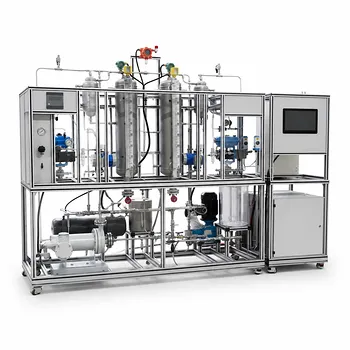
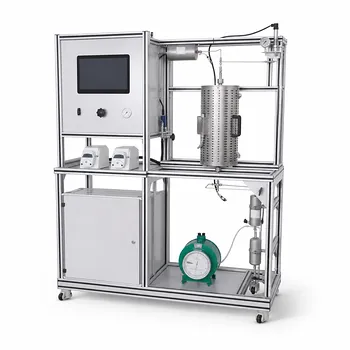
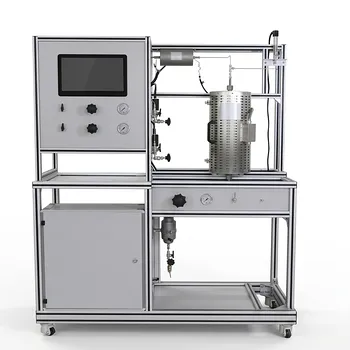
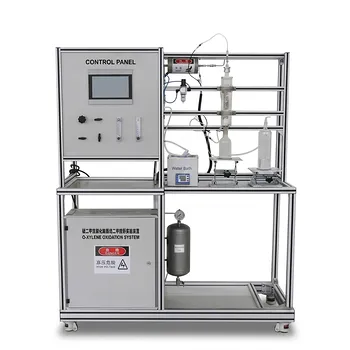
A low-pressure rhodium-catalyzed hydroformylation training pilot plant integrates a continuous loop of gas purification, mild-condition reaction, gas-liquid separation with unreacted gas recycle, thermal product recovery that spares the catalyst, and isomer-separating distillation. In essence, the plant feeds purified propylene and syngas into a liquid-filled reactor housing a dissolved rhodium catalyst, strips the crude aldehyde product under vacuum below 150 °C—keeping the thermally sensitive catalyst intact—and then fractionates the normal- and iso-butyraldehyde streams so students and researchers can trace every step from raw gas to marketable aldehyde.
The defining configuration choice is operating at low pressure (typically 10–30 bar) with a rhodium-based catalyst, which allows the entire pilot train—from pretreatment to final distillation—to be built with moderate-pressure vessels and transparent sight glasses. This turns a high-pressure, hazardous technology into an accessible, hands-on teaching platform while preserving the rate law, selectivity, and recycle dynamics of an industrial oxo unit.
Core Unit-Ops Blocks and How They Link Together
Feed Gas Purification: Guarding the Catalyst Investment
The training plant begins with purification beds that strip oxygen, sulfur compounds, and water from propylene and syngas. Even trace poisons rapidly degrade the expensive rhodium complex, so this step is non-negotiable.
In a typical pilot skid, activated alumina driers and metal oxide traps (e.g., CuO/ZnO) lower sulfur to sub-ppm levels. Flow indicators and sampling ports at the exit let trainees quantify poison breakthrough and link feed purity directly to reaction rate.
The Low-Pressure Reactor: Gas‑Liquid Contact at Mild Conditions
The purified gases are sparged into a mechanically stirred or bubble‑column reactor that holds the liquid rhodium catalyst dissolved in a high‑boiling solvent. Thanks to the rhodium‑phosphine complex’s high activity—10³ to 10⁴ times that of legacy cobalt catalysts—the reaction can proceed at 10–30 bar and 80–120 °C.
- Safety and transparency — Mild pressures let the reactor be fabricated from borosilicate glass or 316L stainless steel with large sight windows. Students can directly observe gas holdup, bubble size, and mixing patterns, connecting transport phenomena to conversion.
- Selectivity control — The reactor includes independent gas mass-flow controllers for H₂ and CO, plus an in-line FTIR or GC sampling loop. This allows real‑time study of how the H₂/CO ratio shifts the normal-to-iso aldehyde ratio, a classic ligand‑kinetics experiment.
Gas‑Liquid Separator and Recycle Loop: Closing the Gas Cycle
After the reactor, a knock‑out drum or cyclone separator disengages the liquid catalyst stream from the gas phase. Unreacted gases are re‑compressed and returned to the reactor inlet via a gas recycle blower.
This loop accomplishes two training goals:
- It demonstrates gas recycle ratio as a process intensification lever, showing how lowering the single‑pass conversion can still achieve high overall propylene utilization while keeping temperature profiles mild.
- It exposes students to compressor surge and seal‑loss phenomena, building troubleshooting skills that transfer to full‑scale plants.
Product Recovery Without Catalyst Death: The Vacuum Vaporizer
Thermal separation of the volatile butyraldehydes from the high‑boiling catalyst solution is the most delicate step. The rhodium complex begins to degrade above 150 °C, so the pilot plant uses a falling‑film or wiped‑film evaporator operated under vacuum (typically 20–50 mbar absolute).
- Gentle conditions keep the skin temperature well below 150 °C, preserving catalyst activity for multi‑day continuous runs.
- A cold‑trap condenser captures the aldehyde‑rich vapor, while the non‑volatile catalyst stream flows back to the reactor, forming the liquid recycle loop that mimics industrial catalyst retention.
Isomer Separation: Closed‑Loop Distillation
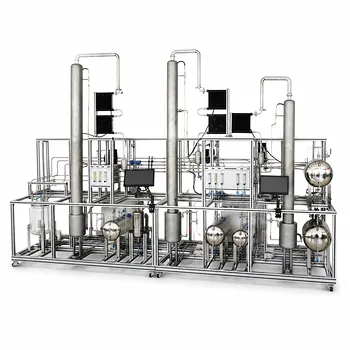
The condensed product liquid goes to a two‑column fractionation train. The first column removes lights and any dissolved gases; the second, larger column separates the normal-butyraldehyde (boiling point 75 °C) from iso-butyraldehyde (64 °C) at atmospheric pressure or slight vacuum.
Each column is glass‑clad with structured packing and multiple feed‑point options, enabling students to run batch‑to‑continuous transitions and to study tray‑efficiency under total reflux. The isomer purity can be linked back to reactor conditions in real time, closing the process‑parameter‑to‑product‑quality loop.
Understanding the Trade‑offs
Catalyst Cost vs. Mild Operating Envelope
Rhodium is precious, but its high activity allows glass reactors and simple gasketed flanges. A training plant using rhodium accepts a higher one‑time catalyst inventory cost in exchange for drastically lower capital and safety overhead versus a high‑pressure cobalt system. The lesson taught is that catalyst choice drives the entire plant’s mechanical design.
Temperature Ceiling and Heavy‑End Formation
Staying below 150 °C avoids catalyst death, but it also limits reboiler driving force, which forces the distillation train to operate under vacuum. This adds vacuum‑seal and leak‑detection complexity. Students learn that protecting the catalyst creates a cascade of design decisions: “Because we must vacuum‑strip the product, we must train on vacuum system troubleshooting.”
Selectivity vs. Throughput
Adjusting the phosphine ligand ratio to boost normal‑aldehyde selectivity often slows the overall rate. A well‑instrumented pilot plant makes this trade‑off visible: students can plot isomer ratio against propylene conversion and calculate the economic sweet spot.
Making the Right Choice for Your Goal
- If your primary focus is process safety education and visual process insight: Choose a pure rhodium‑phosphine system in a glass‑walled bubble column. The low‑pressure, transparent setup maximizes learning with minimal hazard.
- If your primary focus is catalyst‑recycle longevity and kinetic modeling: Specify a wiped‑film evaporator with in‑line UV‑Vis sampling and a precise vacuum control system to enable week‑long catalyst stability studies.
- If your primary focus is product‑purification and distillation dynamics: Configure the pilot plant with double‑fractionation columns that allow feed‑point manipulation, side‑stream withdrawals, and advanced control strategies such as reflux‑ratio optimization.
- If your primary focus is comparing historical and modern catalysts: Design interchangeable reactor heads to switch between a high‑pressure cobalt autoclave (200+ bar) and the low‑pressure rhodium unit, so students measure the activity difference firsthand.
A well‑configured training plant turns a daunting homogeneous‑catalysis process into a visible, step‑by‑step journey through every unit operation—each piece reinforcing the core lesson that the catalyst’s identity defines the plant’s entire pressure, material, and safety envelope.
Summary Table:
| Unit Operation Block | Typical Configuration / Parameters | Educational & Training Value |
|---|---|---|
| Feed Gas Purification | Activated alumina & metal oxide traps (sub-ppm sulfur) | Teach catalyst protection & monitoring poison breakthrough |
| Low-Pressure Reactor | 10–30 bar, 80–120 °C, glass or 316L SS vessel | Observe gas-liquid mixing; study selectivity vs. kinetics |
| Separator & Recycle | Knock-out drum with gas recycle blower | Practice gas recycle optimization & compressor troubleshooting |
| Vacuum Vaporizer | Wiped/falling-film evaporator (<150 °C, 20–50 mbar) | Learn thermal separation while preserving sensitive catalyst |
| Isomer Distillation | Two-column fractionation train (atmospheric/vacuum) | Run batch-to-continuous transitions & study tray efficiency |
Elevate Your Chemical Engineering Program with LABPARK
Are you looking to provide hands-on, industry-relevant training for your students or researchers? LABPARK provides state-of-the-art Educational and Vocational Unit Operations Pilot Plants in chemical engineering, bioprocess & biotech, and environmental & water treatment.
We help universities, research institutes, and enterprises build safe, highly instrumented, and visually transparent training platforms that bridge the gap between classroom theory and industrial reality.
Ready to design the perfect pilot plant for your facility? Contact LABPARK today to discuss your specific training and research requirements!
Related Products
- Dual-Mode Rectification Pilot Plant for Practical Training Unit Operations
- Carbon Dioxide Hydrogenation Methanol Synthesis Educational Unit Operations Pilot Plant
- Alkaline Membrane Water Electrolysis Educational Pilot Plant Unit Operations Training System
- Ethylbenzene Dehydrogenation Educational Unit Operations Pilot Plant
- Crude Benzene Hydrogenation Educational Unit Operations Pilot Plant
People Also Ask
- How does polyphosphate hydrolysis affect scale and corrosion in pilot plants? Essential Monitoring Guide
- How do predictive thermodynamic models integrate into pilot plants? Bridging Theory and Practice
- Why Use Center Points in Process Analyzer Calibration? Key Benefits Explained
- How can process control schemes be configured to teach basic and advanced control?
- Which cross-validation strategy should be selected for pilot plant time-series & batch data? Avoid Data Leakage