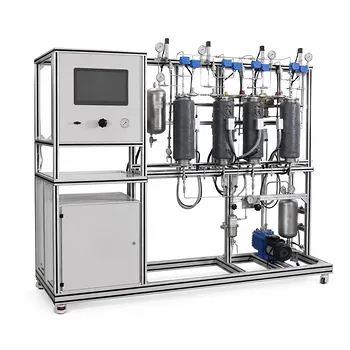
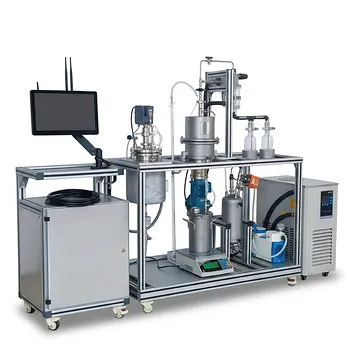
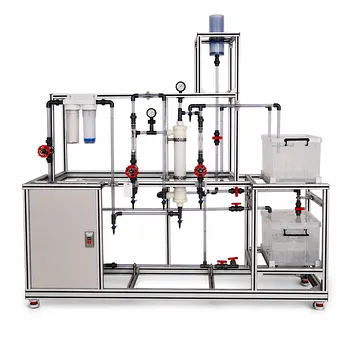
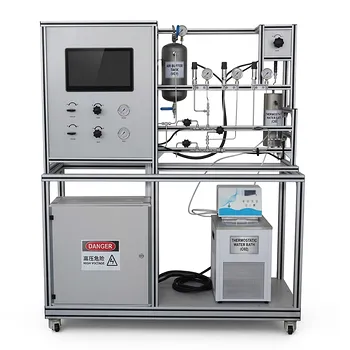
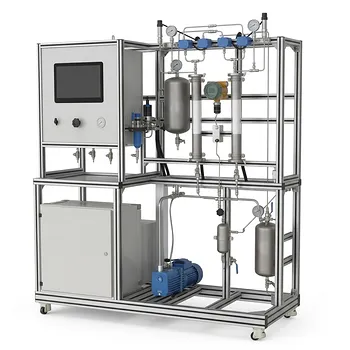
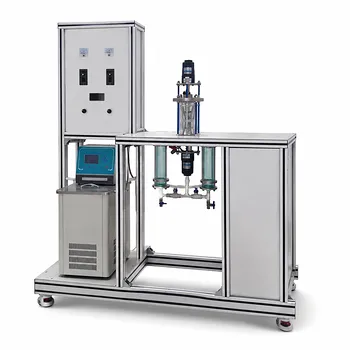
The maximum scale-up factor you can safely achieve is not a universal constant—it is intrinsically tied to the specific physics of each unit operation. While a distillation column can be scaled up 50,000 times from a lab prototype, a crystallizer might fail if scaled up just 30 times. This vast discrepancy exists because, at a massive commercial scale, fluid dynamics, heat transfer, and mass transfer do not increase linearly with volume. The primary role of a pilot plant is to provide the missing experimental data at an intermediate scale, allowing you to validate models and isolate high-risk operations before you bet millions on a full-scale facility.
Pilot plants are the definitive bridge between a chemical recipe and a viable industrial process. The fundamental challenge of scale-up is not just "making things bigger," but identifying where non-linear physical phenomena—like mixing dead zones, gas redistribution, or heat transfer collapse—will cause a successful lab reaction to fail catastrophically in production.
Dissecting the Scale-Up Risk: Why "Bigger" Isn't Just "More"
The core limitation in scaling unit operations stems from the break in geometric, kinematic, and dynamic similarity. As vessel volume increases, the surface-area-to-volume ratio plummets. This single physical fact disrupts everything: the ability to add or remove heat, the contact patterns between phases, and the uniformity of flow.
The Hierarchy of Scale-Up Sensitivity
Not all equipment is equally forgiving. The maximum reliable scale-up factor is a reflection of how tightly coupled the process is to microscale physics.
- Low Sensitivity (High Scale-Up Factor): Mature, well-understood single-phase fluid systems sit here. Distillation and absorption columns can often be scaled reliably by factors of 1,000 to 50,000 because their performance is dominated by predictable counter-current flow and well-characterized packing hydraulics.
- High Sensitivity (Low Scale-Up Factor): Operations involving solids, multiphase mixing, or precipitation are extremely sensitive.
- Crystallization carries a maximum safe scale-up factor of just 20 to 30. The nucleation and growth kinetics are exquisitely sensitive to local supersaturation and mixing energy, which vary wildly in a large tank.
- Gas-solid fluidized bed reactors are limited to factors of 50 to 100. They suffer from complex phenomena like slugging, channeling, and gas bypassing that simply do not exist in a small bench-scale unit.
The Hidden Trap of Heterogeneous Chemistry
A critical pitfall occurs when scaling a process designed for a homogeneous (single-phase) system. Mixing and mass transfer limitations become critical, and the original lab reactor configuration is often fundamentally insufficient.
At the lab scale (grams), a magnetic stir bar provides near-instantaneous mixing. At the commercial scale (tons), mixing times can stretch to minutes. If a reaction is faster than the mixing time, the vessel develops stagnant zones and concentration gradients. A pilot plant using a modular stirred-tank design allows you to physically test impeller designs and baffle configurations to achieve the necessary phase contact, an optimization that is impossible to derive from software alone.
The Semiworks Strategy: How Pilot Plants Neutralize Uncertainty
A unit operations pilot plant, often called a semiworks, is an intermediate-scale system designed specifically to fail safely and generate data cheaply. Its purpose is to surface the "unknown unknowns" that mathematical modeling misses, particularly when dealing with unfamiliar technologies or difficult solids handling.
Validating the Mathematical Black Box
Fixed-bed catalytic reactors illustrate the danger of pure mathematical reliance. Scaling up fixed-bed reactors cannot rely on similarity theory alone because commercial units exhibit radial and axial flow maldistribution absent in lab tubes. A pilot reactor is essential to measure how gases redistribute after passing through an interstage heat exchanger. This empirical data allows engineers to tune "effective" parameters in computational models—closing the gap between idealized simulation and messy reality.
The Pivot to Continuous Processing
A strategic advantage of pilot plants is that they facilitate the shift from batch to continuous unit operations (CSTRs or PFRs) . By integrating extraction, evaporation, and crystallization directly into a continuous train, pilot studies reveal significant practical benefits beyond just reaction kinetics:
- Lowered Risk Profile: Continuous systems drastically reduce the active volume of hazardous reagents at any given moment.
- Process Intensification: Continuous downstream separation minimizes equipment downtime and energy consumption while dramatically improving the reproducibility of product quality.
Quantifying Variability and Economic Viability
Beyond chemistry, a pilot plant generates data to quantify operational variability. Fluctuations in filtration flux, reaction duration, or centrifuge times can be modeled using probability distributions (like triangular distributions) derived from pilot runs.
This data fuels sensitivity analysis, which often reveals a surprising insight: a single physical operation (like filtration flux) frequently has the greatest impact on annual throughput and unit production cost, not the chemical kinetics. By identifying this variance driver, R&D can focus optimization precisely where it has the highest economic return, ensuring production certainty before the factory is built.
Understanding the Trade-offs: Costs, Time, and Predictive Limits
While indispensable for high-risk steps, pilot plants are not a silver bullet for every project. An objective assessment must acknowledge their limitations.
- Financial and Time Investment: Designing, building, and operating a pilot plant adds significant cost and 12-24 months to a development timeline. For extremely low-risk, well-established processes, this might be an unnecessary redundancy.
- The "Scale-Down" Deception: A pilot plant only helps if it accurately mimics the proposed commercial design. If the pilot uses a continuous flow pattern but the commercial design is batch, or if the pilot PFA tubing masks a mixing problem that will appear in a large vessel, the data is dangerously misleading.
- Corrosion Data is a Long Game: While a pilot plant allows for material compatibility testing, exposure for a few weeks will miss long-term corrosion mechanisms like stress corrosion cracking that take months to incubate.
Making the Right Choice for Your Goal
The necessity and design of your pilot plant must be dictated by your primary technical risk. Generic "rules of thumb" for scale-up factors are only a starting point for identifying danger zones.
- If your primary focus is scaling a well-mixed liquid-phase reaction: You may not need a full semiworks. Your risk is lower, but you must rigorously validate mixing times and heat removal capacity at the intended scale.
- If your primary focus is scaling a crystallization or solids-handling step: A pilot plant is non-negotiable. You must operate at an intermediate scale where the mechanisms of agglomeration, breakage, and fouling manifest physically, not just theoretically.
- If your primary focus is introducing a high-pressure or high-temperature process: Use a pilot plant to conduct a preliminary hazard analysis under realistic flow conditions. Focus on generating accurate reaction enthalpies and testing the failure scenarios (interlocks and backups) that will prevent runaway reactions in the commercial plant.
A pilot plant is your ultimate risk management tool, converting catastrophic commercial failure into manageable, instructive "small-scale" failure in a controlled environment.
Summary Table:
| Unit Operation | Scale-Up Factor | Key Risk / Sensitivity | Pilot Plant Role |
|---|---|---|---|
| Distillation & Absorption | 1,000 to 50,000 | Low; predictable hydraulics | Validate mass transfer & packing efficiency |
| Fluidized Bed Reactors | 50 to 100 | High; gas bypassing, slugging | Map gas-solid flow dynamics & heat transfer |
| Crystallization | 20 to 30 | High; nucleation & growth kinetics | Optimize mixing energy & local supersaturation |
| Multiphase Stirred Reactors | Variable | High; mixing dead zones, scale lag | Test impeller designs & baffle configurations |
Accelerate Your Process Scale-Up with LABPARK
Bridging the gap between laboratory research and industrial-scale production requires reliable, real-world data. LABPARK provides state-of-the-art Educational and Vocational Unit Operations Pilot Plants in chemical engineering, bioprocess & biotech, and environmental & water treatment.
Whether you are a university training the next generation of engineers, a research institute validating novel processes, or an enterprise looking to de-risk commercial scale-up, our modular pilot systems deliver the physical insights you need to eliminate uncertainty.
Contact LABPARK today to discuss your pilot plant requirements!
Related Products
- Bench Scale Carbon Dioxide Capture Educational Unit Operations Pilot Plant
- Supercritical High-Gravity Flash Evaporation Educational Unit Operations Pilot Plant
- Ultrafiltration Membrane Separation Educational Pilot Plant
- Methanol Synthesis and Catalyst Performance Evaluation Educational Unit Operations Pilot Plant
- Multifunctional Membrane Separation Educational Pilot Plant with Ultrafiltration, Nanofiltration, Reverse Osmosis
People Also Ask
- What unit operations are critical for CCUS training pilot plants? Build hands-on engineering expertise.
- What are the differences between post- and pre-combustion carbon capture training pilot plants?
- How can pilot plants show tail gas vs flue gas CO2 capture differences? Key educational insights.
- How do temperature variations affect CO2 transport models in pilot plants? Model vs Reality
- How does operating pressure influence the transition between absorption and desorption in a CO2 pilot plant?