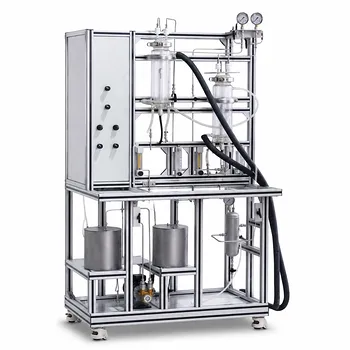
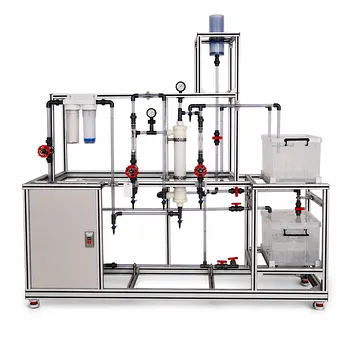
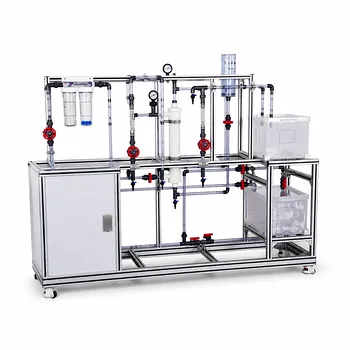
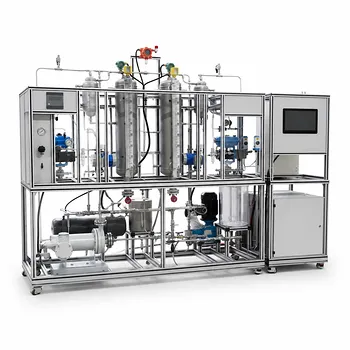
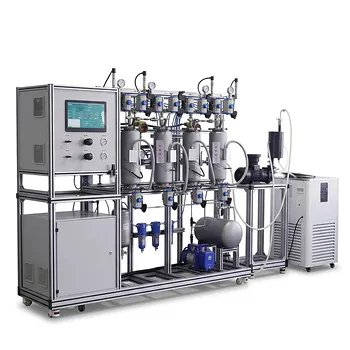
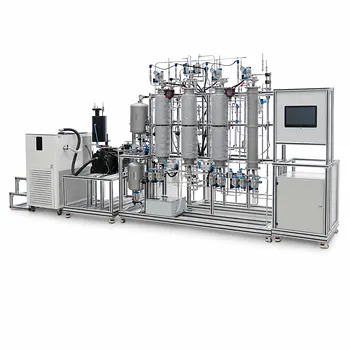
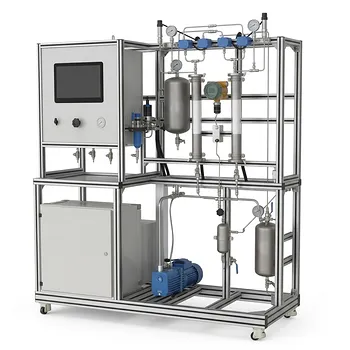
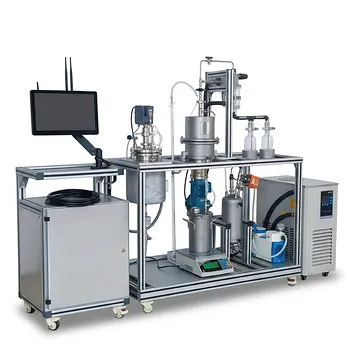
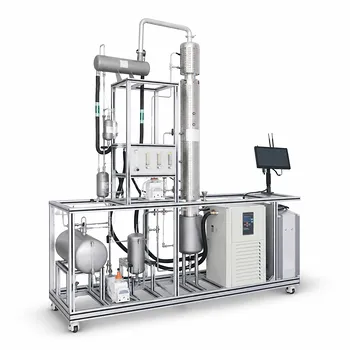
The real bottleneck for bio-succinic acid isn’t fermentation—it’s separation. The primary downstream purification challenge is the high cost of recovering and purifying succinic acid from fermentation broth, specifically removing similar organic acid by-products like acetic, formic, and lactic acids. Electrodialysis (ED) can be integrated into a bioprocess training pilot plant as a versatile, non-thermal separation module that uses adjustable voltage, flow control, and pH monitoring to teach ion transport and membrane fouling dynamics under near-industrial conditions.
The core economic hurdle for biomass-derived succinic acid is separating it from a cocktail of fermentation by-products. Electrodialysis directly addresses this because these organic acids ionize in solution, enabling selective removal. When embedded in a training pilot plant with real-time monitoring of voltage, flow, and pH across diluate and concentrate streams, ED becomes an unmatched tool for learning ion transport kinetics, membrane fouling, and energy optimization—critical knowledge for scaling any bio-based organic acid process.
The Downstream Purification Bottleneck for Bio-Succinic Acid
The production cost of succinic acid from renewable feedstocks is not primarily driven by the fermentation itself. The true expense hides in the recovery stages that turn a complex broth into a high-purity product.
Why Recovery Costs Dominate Production
Fermentation yields a relatively dilute mixture of succinic acid, residual sugars, salts, and other metabolic acids. Conventional chemical recovery often requires multiple pH adjustments, precipitation steps, and energy-intensive thermal methods. This cascade of unit operations inflates both capital and operating expenses, undermining the economic advantage of using biomass.
The Separation Problem: A Cocktail of Similar Acids
The most stubborn purification challenge is the presence of acetic acid, formic acid, and lactic acid—by-products that closely resemble succinic acid in solubility and molecular weight. These analogous acids co-extract and co-precipitate, making selective removal difficult and expensive when relying on traditional non-ionic separation techniques. Achieving the high purity demanded for polymer or chemical feedstocks demands a method that can differentiate molecules not by size, but by their ionic character.
Why Electrodialysis is the Solution
Electrodialysis capitalizes on the very property that makes these impurities hard to separate otherwise: their ability to ionize in solution.
The Power of Ionization in Organic Acid Separation
When dissolved, succinic acid and its by-products dissociate into charged ions under appropriate pH conditions. ED applies an electrical potential difference to drive these ions through ion-exchange membranes, separating them from non-ionic compounds like sugars and proteins. This non-thermal, charge-based mechanism sidesteps the need for extreme temperatures, preserving heat-sensitive bio-products and dramatically lowering energy consumption compared to distillation.
Key Membrane Properties for Effective ED
The selective transfer of succinate ions depends on membranes that possess high charge selectivity, allowing only ions of a specific charge to pass. Practical operation also demands membranes with moderate swelling resistance in the feed solution to maintain structural integrity, and high mechanical strength to withstand the pressure differentials in a continuous-flow system. Without these properties, co-transport of unwanted ions and water would undo the purification gains.
Integrating Electrodialysis into a Bioprocess Training Pilot Plant
A well-designed pilot-scale ED module turns theory into hands-on knowledge. The goal is to create a transparent, adjustable system that mirrors real industrial challenges.
Essential Process Monitoring and Control Points
The setup must include adjustable voltage controls to vary the driving force for ion migration. Flow-rate meters on both the diluate and concentrate loops are critical for understanding residence time and its impact on separation efficiency. In-line pH monitoring in both streams is non-negotiable; it reveals the degree of ionization and helps predict the transport of organic acids versus competitive ions like Na⁺ or Cl⁻.
What Students and Researchers Can Investigate
This configuration transforms the pilot plant into a research platform for ion transport kinetics, showing how current density relates to the rate of succinic acid removal. It allows direct observation of membrane fouling caused by biofoulants or scaling compounds from the fermentation broth, a problem that kills industrial efficiency. Crucially, users can measure energy consumption per kilogram of acid separated under varying conditions, linking operational parameters to real-world process economics.
Understanding the Trade-offs and Practical Limitations
ED is powerful but not a silver bullet. Its successful integration demands a sober assessment of its weaknesses.
Membrane Fouling and Lifecycle Costs
Over time, proteins, cell debris, and multivalent ions from fermentation broth deposit on membrane surfaces. This fouling increases electrical resistance, raises energy use, and requires chemical cleaning cycles that add downtime and consumable costs. The cost of membrane replacement is a factor that must be tracked in pilot-plant training.
Energy Consumption vs. Concentration Limits
The electrical energy needed per ion transported rises sharply at high product concentrations, because the diluate's resistance increases as ions are removed. An ED stack can efficiently concentrate succinic acid, but it will not reach the very high purities required for some markets without a subsequent polishing step like crystallization or ion exchange.
Pretreatment Requirements
Directly pumping raw fermentation broth into an ED stack is a recipe for rapid fouling. Realistic operation demands upstream microfiltration or centrifugation to remove cells and macromolecules, a lesson in the interdependence of unit operations that a well-designed pilot plant must teach. The integration with filtration units mirrors challenges seen in enzyme catalyst recycling, where particle-free streams protect downstream membranes.
Making the Right Choice for Your Training Pilot Plant
The design of your ED module should directly serve the learning objectives. Tailor the configuration to the deep need.
- If your primary focus is fundamental ion transport education: Opt for a simple, transparent ED stack with precise voltage and pH monitoring, using synthetic acid mixtures initially to isolate kinetic principles without fouling noise.
- If your primary focus is bio-succinic acid process development: Pair the ED unit with a pre-filtration system (microfiltration or ultrafiltration) and a downstream crystallization vessel, creating an integrated cell-to-crystal flow sheet that mimics industrial reality.
- If your primary focus is economic analysis and scale-up: Instrument the module to log voltage, current, flow, and conductivity continuously, allowing students to calculate specific energy consumption and predict the total cost of recovery per kilogram of product.
A well-instrumented electrodialysis module turns a purification bottleneck into the clearest window you can have on the principles that will define the next generation of bio-based manufacturing.
Summary Table:
| Training Focus | Primary Objective | Recommended Pilot Plant Configuration |
|---|---|---|
| Ion Transport Kinetics | Study fundamental ion migration and membrane dynamics | Transparent ED stack with precise voltage and pH monitoring using synthetic mixtures |
| Process Development | Mimic industrial-scale purification and scaling | Integrated flow sheet combining pre-filtration (MF/UF), ED unit, and downstream crystallization |
| Economic & Scale-up Analysis | Calculate specific energy consumption and recovery costs | Fully instrumented ED module with continuous logging of voltage, current, flow, and conductivity |
Bring Industrial-Scale Bioprocessing into Your Lab
Are you looking to equip your students and researchers with hands-on experience in advanced separation technologies like electrodialysis?
LABPARK provides state-of-the-art Educational and Vocational Unit Operations Pilot Plants in chemical engineering, bioprocess & biotech, and environmental & water treatment. Tailored for universities, research institutes, and enterprises, our pilot plants bridge the gap between theory and industrial practice. We help you model real-world purification challenges, study ion kinetics, and optimize process economics.
Ready to elevate your training and research capabilities? Contact LABPARK today to customize your pilot plant solution!
Related Products
- Multi-Functional Membrane Separation Educational Pilot Plant for Unit Operations Lab
- Photocatalytic Membrane Separation and Degradation Unit Operations Pilot Plant
- Ultrafiltration Membrane Separation Educational Pilot Plant
- Multifunctional Membrane Separation Educational Pilot Plant with Ultrafiltration, Nanofiltration, Reverse Osmosis
- Hollow Fiber Ultrafiltration Membrane Separation Educational Pilot Plant
People Also Ask
- What are the key differences in membrane configurations? Choose the Right Unit Operations Pilot Plant
- How Do Pervaporation, Vapor, and Gas Permeation Differ in Pilot Plants? Key Comparison
- What are the advantages of membrane separation pilot plants? Energy-saving process intensification.
- Pervaporation vs. Vapor Permeation: Handling Suspended Solids in Membrane Pilot Plants
- How do PEI, PVDF, and PSU membranes compare in pilot plants? Find the best fit.