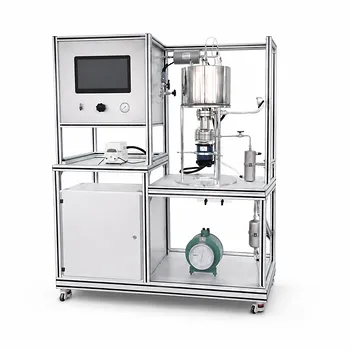
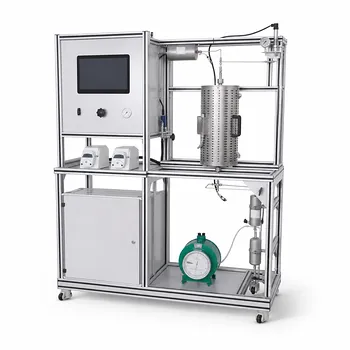
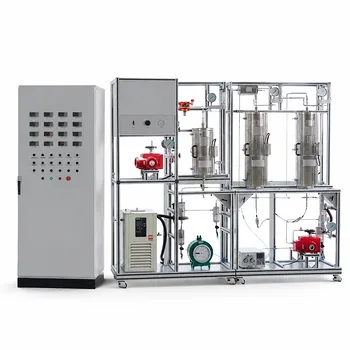
The operational sweet spot for a catalytic reactor is a moving target—and liquid hourly space velocity (LHSV) is the dial that controls it. In a pilot plant, drifting outside the optimal LHSV window creates immediate, measurable consequences. A space velocity that is too low (excessive residence time) promotes unwanted side reactions, degrades product selectivity, and accelerates catalyst coking. A space velocity that is too high provides insufficient contact for complete conversion, leaving you with low single-pass yields and an oversized, energy-intensive separation train downstream.
The core challenge of LHSV management is balancing conversion quality against operational sustainability. Operating too low burns catalyst life and purity, while operating too high saddles the process with heavy recycle loads and wasted energy. The pilot plant’s true value is mapping this trade-off to find the window where throughput, selectivity, and long-term stability coexist.
How LHSV Governs Reactor Performance
Liquid hourly space velocity is the ratio of the volumetric feed rate to the catalyst bed volume. It directly sets the average contact time between the liquid reactants and the active sites. In the pilot plant, this relationship becomes a powerful diagnostic lever—every change in LHSV exposes a different layer of kinetic and deactivation behavior.
The Chemistry of Residence Time
At the molecular level, a primary reaction converts the feed into the desired product. Side reactions are inevitable; they may run in parallel by consuming the raw feed, or sequentially by attacking the freshly formed product.
When residence time stretches too long, those slower, secondary pathways accumulate and steal a significant fraction of the yield. Simultaneously, heavy byproducts like polyaromatic compounds can polymerize, condense, and lay down carbonaceous deposits—coke—on the catalyst surface.
Defining the Optimal Window
Every catalyst system has a characteristic conversion-versus-space-velocity curve. In the reference data provided, the healthy operating range sits between 0.4 h⁻¹ and 0.6 h⁻¹. Below and above these thresholds, two distinct failure modes emerge. The pilot plant’s job is to verify that window under realistic conditions and document how the system degrades when it drifts outside.
Consequences of Operating Outside the Optimal Range
Moving LHSV away from the designed peak triggers a cascade of operational penalties. These problems don’t just shrink yield; they reshape the economics of the entire downstream plant.
When LHSV Is Too Low (Below 0.4 h⁻¹): The Coking Trap
An excessively long residence time forces the catalyst to host reactions that were never intended to occur.
- Selectivity erosion. Sequential reactions convert the desired product into unwanted byproducts, cutting the net yield even if the single-pass conversion number looks high.
- Accelerated catalyst coking. The prolonged contact encourages the formation of heavy, carbon-rich molecules. These molecules block micropore mouths and active sites, leading to a rapid increase in pressure drop and a permanent loss of activity. This demands earlier regeneration or replacement, shrinking the campaign window.
- Misleading high conversion. A very low LHSV can produce a momentarily impressive conversion figure that hides the true problem: the majority of that converted feed went to waste or to coke, not to product.
When LHSV Is Too High (Above 0.6 h⁻¹): The Recycle Burden
Starving the catalyst of residence time kills the reaction before it reaches economic completion.
- Low single-pass conversion. The reactor outlet stream is rich in unreacted feed. In a commercial setting, this forces a high recycle ratio, where the same molecules must be re-heated, re-pumped, and re-processed multiple times.
- High separation load downstream. The product mixture is now dilute, requiring significantly more energy in the distillation or separation columns to achieve the final purity specification. Capital and operating costs swell as heater duties, coolant flows, and column diameters ramp up.
- Wasted energy intensity. Because a large fraction of the throughput simply makes a round trip through the reactor and separator without reacting, the energy consumption per kilogram of final product soars.
Understanding the Trade-offs
There is no “universal best” LHSV—only the best compromise for your specific economics and catalyst stability. The pilot plant’s central role is to quantify these conflicting forces.
Throughput vs. Conversion
A higher space velocity pushes more volume through the reactor per hour, boosting nameplate capacity. However, the cost is lower per-pass conversion. The operator must decide whether the debottlenecking downstream (bigger towers, more reboilers) is cheaper than building a larger reactor. The pilot plant generates the exact conversion-versus-LHSV curve needed for that capital-versus-operating-expense trade-off.
Catalyst Deactivation vs. Separation Costs
On one side, a low LHSV sacrifices catalyst lifetime to coking, driving up solid-exchange or regeneration frequency. On the other, a high LHSV sacrifices energy and capital to handle an ever-growing recycle stream. The optimal economic LHSV sits where the combined cost of catalyst replacement and separation energy reaches a minimum. A pilot plant campaign that systematically varies LHSV while monitoring pressure drop and product purity can locate that minimum within days.
Making the Right Choice for Your Pilot Plant Campaign
Use the following goal-driven recommendations to extract the maximum value from your LHSV experiments.
- If your primary focus is maximizing product selectivity: Run trials near the lower end of the safe window (around 0.4 h⁻¹) but carefully monitor the rate of coking to ensure you don’t trigger a runaway deactivation event.
- If your primary focus is minimizing downstream separation load: Target the upper end of the window (approaching 0.6 h⁻¹) to achieve a higher single-pass conversion, but verify that recycle internal flows remain manageable and the catalyst is not starved.
- If your primary focus is extending catalyst life and runtime: Operate at the exact LHSV that gives the flattest pressure-drop profile over time, even if that means sacrificing a few points of conversion—the data from a clean run will guide you to the true long-term economic optimum.
The LHSV dial in a pilot plant is a lens into the entire process economy. Rather than chasing an arbitrary number, use it to map the landscape where conversion, selectivity, and catalyst durability intersect—and you’ll turn a laboratory exercise into a blueprint for a profitable unit.
Summary Table:
| LHSV Status | Residence Time | Key Consequences | Downstream / Operational Impact |
|---|---|---|---|
| Too Low (< 0.4 h⁻¹) | Long | Selectivity loss, catalyst coking, byproduct formation | High pressure drop, frequent catalyst regeneration |
| Too High (> 0.6 h⁻¹) | Short | Low single-pass conversion, incomplete reaction | Heavy recycle load, increased separation energy costs |
Optimize Your Reactor Operations with LABPARK
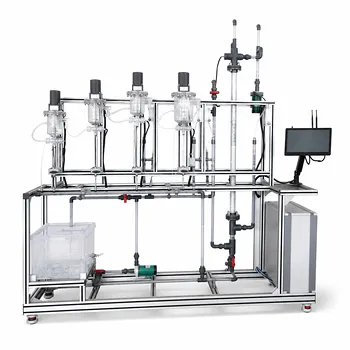
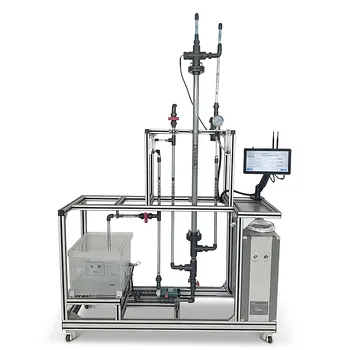
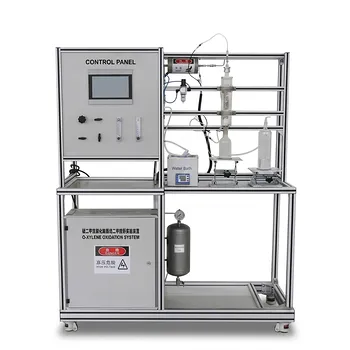
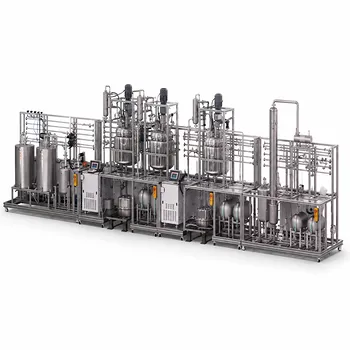
Mastering reaction kinetics and finding the sweet spot for parameters like LHSV requires precise, reliable equipment. LABPARK provides state-of-the-art Educational and Vocational Unit Operations Pilot Plants in chemical engineering, bioprocess & biotech, and environmental & water treatment.
Whether you are training the next generation of engineers in universities, conducting cutting-edge research in research institutes, or scaling up processes in enterprises, our systems are built to deliver accurate data and robust performance.
Contact our team today to find the perfect pilot plant solution for your facility!
Related Products
- Fixed Bed Gas Solid Catalytic Reaction Educational Pilot Plant
- Multi-Reactor Educational Pilot Plant for Reaction Engineering Unit Operations
- Residence Time Distribution and Reactor Flow Characteristics Determination Educational Pilot Plant
- Fixed-Bed Chemical Reaction and Gas Dust Tar Removal Unit Operations Pilot Plant
- Tubular Reactor Flow Characteristics Determination Educational Unit Operations Pilot Plant
People Also Ask
- How do reactor pilot plants safely study gas-solid reactions? Master kinetics with thermal & flow control.
- How does the Mears criterion evaluate transport resistance? Key Guide to Intrinsic Kinetics
- Fluidized vs. Fixed Bed Reactors: Comparing Heat & Complexity in Pilot Plants
- Why is a multibed configuration necessary for exothermic reactions? Optimize your pilot plant trajectory.
- How is the friction factor determined for fixed-bed pilot plants? Select the best pressure drop correlation.