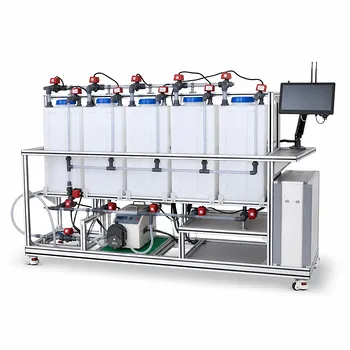
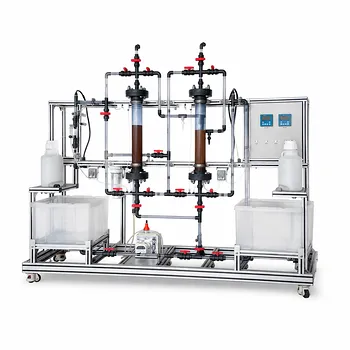
The controlled precipitation of ammonium chloride in a pilot plant is a direct lesson in applied thermodynamics. The key principles demonstrated are the temperature dependence of solubility (exploited during cooling crystallization) and the common‑ion effect (driven by salting‑out crystallization), both governed by the phase equilibrium of the ternary NH₄Cl–NaCl–H₂O system. These fundamental concepts are brought to life by monitoring supersaturation, activity coefficients, and supercooling, giving operators a complete picture of how thermodynamic forces shape crystal yield and quality.
The pilot plant reveals that selective NH₄Cl crystallization is not a single-step trick but a balance of two levers: reducing temperature to lower solubility, and increasing chloride ion concentration to shift the thermodynamic equilibrium. Mastering these levers—while managing supercooling and the limitations of simplified thermodynamic models—is the real takeaway for any engineer working with crystallization unit operations.
The Thermodynamic Foundation: Why NH₄Cl Crystallizes Selectively
The pilot plant’s design hinges on a fundamental contrast in solubility behavior within the NH₄Cl–NaCl–H₂O system. This contrast allows a single salt to be cleanly separated from a mixed solution.
The Phase Equilibrium of the NH₄Cl–NaCl–H₂O System
The system’s ternary phase diagram dictates which solid phase is stable at a given temperature and composition.
Because NH₄Cl solubility drops sharply with falling temperature while NaCl solubility stays nearly flat, cooling will push the solution into a region where only NH₄Cl precipitates.
The pilot plant makes this abstract diagram tangible, showing how a bulk liquid composition moves across phase boundaries to a pure NH₄Cl solid region.
Leveraging Temperature‑Dependent Solubility (Cooling Crystallization)
Cooling crystallization is the first thermodynamic handle.
The process cools the mother liquor to around 15°C, exploiting the large enthalpy of solution of NH₄Cl.
At the lower temperature, the saturation concentration of NH₄Cl decreases dramatically, generating supersaturation that drives nucleation and crystal growth.
The pilot plant demonstrates that precise temperature control is what translates a thermodynamic potential into a predictable mass of solid product.
The Common‑Ion Effect in Action (Salting‑Out Crystallization)
Salting‑out adds a second, independent thermodynamic lever: the common‑ion effect.
Introducing solid NaCl increases the chloride ion (Cl⁻) concentration in solution, a product ion of the NH₄Cl dissolution equilibrium (NH₄Cl(s) ⇌ NH₄⁺ + Cl⁻).
By Le Chatelier’s principle, the equilibrium shifts left, forcing more NH₄Cl out of solution even without further cooling.
This step teaches that ionic strength is just as powerful as temperature in manipulating solubility.
Controlling Supersaturation and Crystal Quality
Thermodynamic principles don’t just explain if crystallization happens—they define how well it happens. The pilot plant exposes the fine print of translating equilibrium theory into quality crystals.
Activity Coefficients and the Driving Force for Nucleation
Real solutions are non‑ideal, so the effective concentration is captured by the activity coefficient.
The true thermodynamic driving force for crystallization is the difference between the actual activity product and the solubility product.
By observing how activity changes with added NaCl or falling temperature, students learn that supersaturation is not just a concentration difference—it is a thermodynamic potential.
Accurate activity models prevent over‑ or under‑prediction of the crystallization window.
Supercooling: The Hidden Thermodynamic Trap
Supercooling occurs when a solution cools below its saturation temperature without forming crystals.
In the pilot plant, this metastable state can lead to sudden, uncontrolled nucleation, damaging crystal size uniformity.
The phenomenon is linked to the energy barrier for nucleation; without sufficient nucleation centers, the system resists phase change even when thermodynamically favored.
Operators combat this with controlled cooling rates, seeding, and agitation—techniques that bridge the gap between thermodynamic equilibrium and practical kinetics.
Thermodynamic Approximations and Their Impact on Yield Predictions
Educational pilot plants often compare predicted and actual yields, revealing the error in common assumptions.
For example, using Assumption A (ΔCp = 0) simplifies free‑energy calculations but systematically underestimates solubility.
This underestimation can lead to accidental early precipitation or flawed mass balances during a run.
The pilot plant forcibly connects this thermodynamic subtlety to real process outcomes, teaching that even small theoretical approximations can disrupt scale‑up.
Understanding the Trade‑offs and Pitfalls
Applying these thermodynamic principles without caution introduces risks. The pilot plant is an ideal environment to experience these trade‑offs safely.
The Risk of Uncontrolled Nucleation from Aggressive Salting‑Out
Adding solid NaCl too quickly creates massive local supersaturation.
This can trigger primary nucleation in an uncontrolled burst, producing fines and poor crystal habit.
The thermodynamic advantage of the common‑ion effect must be tempered by kinetic control to preserve product quality.
The Limits of Simplified Thermodynamic Models (Assumption A)
While Assumption A is computationally convenient, its systematic error can misguide process decisions.
In a pilot plant, relying on the underestimated solubility might lead to setting a target cooling temperature that is actually inside the spontaneous precipitation zone.
Awareness of this limitation encourages the use of more rigorous activity coefficient models or experimental validation.
Corrosion as an Indirect Thermodynamic Challenge
High chloride concentrations create an extremely corrosive environment.
The pilot plant uses equipment with plastic linings or anti‑corrosive coatings to survive the very conditions that enable salting‑out.
This reminds students that selecting materials compatible with the chosen thermodynamic pathway is just as critical as controlling the thermodynamics itself.
Making the Right Choice for Your Learning or Operational Goal
How you exploit these thermodynamic principles depends entirely on your objective. The pilot plant can be tuned to emphasize different lessons.
- If your primary focus is understanding phase behavior: Spend time mapping the NH₄Cl–NaCl–H₂O system, verifying that cooling alone hits a pure NH₄Cl region before any NaCl co‑precipitates.
- If your primary focus is maximizing crystal yield: Combine cooling and salting‑out sequentially, but control NaCl addition rate to avoid massive fines generation from local supersaturation peaks.
- If your primary focus is process robustness and scale‑up: Compare yield predictions using real activity coefficients against those from simplified (Assumption A) models to appreciate the safety margin you need.
- If your primary focus is crystal quality: Watch the cooling curve for supercooling arrests and implement seeding strategies to ensure nucleation occurs at the true thermodynamic saturation point, not after a dangerous metastable excursion.
Ultimately, the NH₄Cl pilot plant proves that thermodynamics is not just a set of textbook curves—it is the operating system of crystallization, and learning to read it is the difference between producing a predictable solid and an unsalable mess.
Summary Table:
| Crystallization Method | Key Thermodynamic Principle | Primary Control Parameter |
|---|---|---|
| Cooling Crystallization | Temperature-dependent solubility (solubility drops as temp decreases) | Cooling rate and target temperature (~15°C) |
| Salting-Out | Common-ion effect (adding NaCl shifts NH₄Cl equilibrium) | NaCl addition rate and ionic strength |
| Supercooling Control | Nucleation energy barrier and metastable zones | Seeding, agitation, and monitoring activity coefficients |
Bring Thermodynamic Principles to Life with LABPARK
Bridge the gap between textbook theory and hands-on chemical engineering. LABPARK provides state-of-the-art Educational and Vocational Unit Operations Pilot Plants in chemical engineering, bioprocess & biotech, and environmental & water treatment.
Designed specifically for universities, research institutes, and enterprises, our pilot systems empower students and researchers to master phase equilibria, crystallization kinetics, and process control in a safe, controlled environment.
Ready to elevate your laboratory training and research capabilities? Contact LABPARK today to explore our custom pilot plant solutions!
Related Products
- Multi Functional Membrane Crystallization Educational Unit Operations Pilot Plant
- Methane Cracking Educational Unit Operations Pilot Plant
- Multi-Functional Special Distillation Educational Pilot Plant
- Dual-Mode Rectification Pilot Plant for Practical Training Unit Operations
- Potassium Salt Thermal Dissolution and Crystallization Separation Educational Unit Operations Pilot Plant
People Also Ask
- Control Crystallization Pilot Plant Secondary Nucleation: 4 Key Adjustments
- Why is precise temperature control critical in crystallization pilot plants? Key to Scale-Up Success
- What key factors should be considered when configuring a crystallization unit operations pilot plant?
- What are the benefits of integrating online PAT tools like ATR-FTIR into crystallization unit operations pilot plants?
- How to use crystallization pilot plant agitation speed to identify diffusion vs reaction growth?