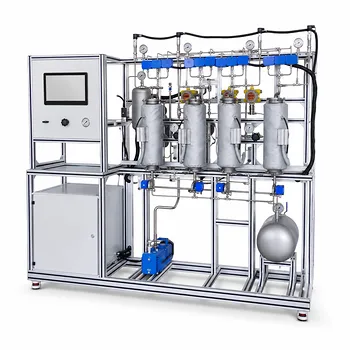
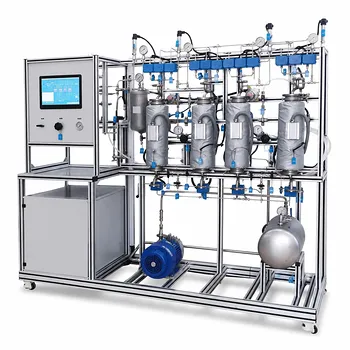
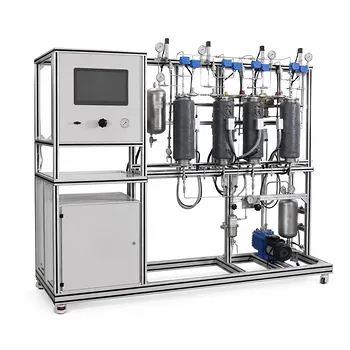
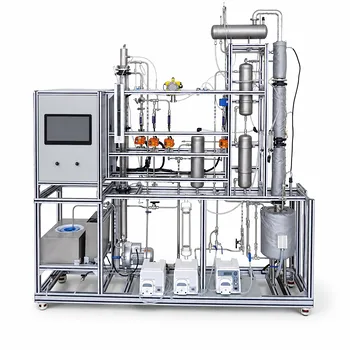
For process development, integrating supercritical carbon dioxide (scCO2) into pilot plants is not just a "green" alternative—it's a tactical upgrade that simultaneously improves mass transfer kinetics, eliminates toxic solvent residue, and simplifies downstream separation to a single step. The foundational advantage is a sharp reduction in process complexity: the tunable solvation power of scCO2 allows you to cut out multiple unit operations—like distillation columns for solvent recovery—replacing them with a simple pressure drop. This translates directly to safer operations, zero solvent contamination in the product, and significantly faster cycle times when compared to conventional liquid extraction or reaction systems.
The integration of supercritical CO2 into pilot plants fundamentally changes the optimization target. You shift from managing hazardous liquid waste streams and thermal degradation to precisely tuning pressure and temperature. This unlocks a unique combination of liquid-like solubility and gas-like mass transfer, enabling rapid, residue-free processing that is impossible with traditional organic solvents.
The Solvent-Free Separation Advantage
The most impactful process simplification comes at the end of the unit operation. In traditional pilot plants using volatile organic compounds (VOCs), the downstream separation stage is a major bottleneck.
Eliminating Thermal Degradation and Distillation
Conventional solvent recovery typically requires energy-intensive distillation, which not only exposes sensitive compounds to prolonged heat but also necessitates complex column infrastructure. Supercritical CO2 eliminates this bottleneck entirely. Because scCO2 solvates the target compound under pressure, returning the system to atmospheric pressure causes the CO2 to gasify and completely separate, leaving zero solvent residue. You replace a thermal separation unit with a simple pressure let-down valve.
Navigating the Solubility "Switch"
This separation mechanism works because scCO2 acts like an inert gas at room pressure, carrying no risk of toxic residue. This stands in stark contrast to chlorinated solvents like dichloromethane (CH2Cl2), which are notoriously difficult to remove fully and are carcinogenic. The ability to turn the solvent "off" instantly via depressurization is the core engineering advantage that reduces the total number of required unit operations in a process flow diagram.
Radical Enhancement of Mass Transfer
Traditional liquid-liquid extraction is limited by slow diffusion and high viscosity at the phase boundary. The physics of supercritical fluids change these fundamental limitations.
Gas-Like Viscosity Meets Liquid-Like Density
Supercritical CO2 possesses a density approaching that of a liquid, granting it substantial carrying capacity. Simultaneously, it maintains a viscosity and diffusivity more characteristic of a gas. This combination drastically improves mass transfer rates. In a pilot plant setting, this translates to faster extraction equilibriums and shorter process cycles. You are essentially pulling compounds out of a solid matrix with the speed of a gas but the strength of a liquid solvent.
Dynamic Operational Tuning
Unlike fixed liquid solvents, the dissolving power of scCO2 is a direct function of the pressure and temperature applied. A single pilot plant can simulate a range of solvent polarities simply by adjusting the back-pressure regulator or adding a small fraction of co-solvent. This allows researchers to dial in selectivity on the fly, isolating specific active compounds (like caffeine over coffee flavor precursors) without changing out the solvent supply chain.
Inherent Safety and Operational Integrity
Switching to scCO2 changes the hazard profile of the pilot plant, reducing administrative controls and infrastructure requirements associated with solvent management.
Elimination of VOCs and Combustible Dust
The primary reference notes a 60% to 80% reduction in VOC emissions, though in a well-designed closed-loop system, the reduction is effectively near total for the process itself. CO2 is non-flammable, non-toxic, and eliminates the explosion risks associated with organic solvent vapors. This removes the need for expensive explosion-proof electrical classifications and harsh solvent storage facilities in pilot plants, lowering capital and permitting hurdles.
Processing Thermosensitive Bioactives
The critical point of CO2 is near-ambient temperature (304.1 K or ~31°C). This makes it the default choice for bioprocess training and pharmaceutical research where thermal degradation is a primary concern. You can extract easily oxidized bioactive compounds, such as essential oils, vitamins, and antibiotics, with high throughput without sacrificing chemical integrity. You solve the heat degradation problem not through cooling, but through the thermodynamics of the solvent itself.
Understanding the Trade-offs
While the process advantages are substantial, these benefits introduce a distinct engineering challenge that must be managed in the pilot plant.
The Compression Energy Penalty
The primary hurdle is the energy-intensive compression required to maintain pressures above the critical threshold (73.8 bar). Achieving and sustaining these high pressures involves significant capital costs for compressors and power consumption. A rigorous techno-economic analysis during the pilot phase is essential to determine if the saved thermal energy from distillation offsets the added electrical load for compression. Pilot plant data on these pressure/temperature parameters is critical for calculating the actual viability of scaling up to production.
Making the Right Choice for Your Pilot Plant Goal
The value of integrating scCO2 depends entirely on what you are optimizing for in your unit operations studies. Choose your focus based on the following:
-
If your primary focus is greening your solvent lifecycle: Deploy scCO2 to completely eliminate toxic dichloromethane or other chlorinated solvents. You will gain maximum value by showcasing a zero-residue, zero-VOC process that doesn't require downstream purification.
-
If your primary focus is speed and mass transfer efficiency: Exploit the gas-like diffusivity of scCO2 to slash extraction cycle times. You should concentrate on optimizing the flow rate and pressure drop to maximize throughput in continuous-flow packed-bed reactors.
-
If your primary focus is extracting thermally sensitive, high-value compounds: Use scCO2 near its critical temperature to guarantee the chemical profile of your extract remains unchanged. The primary advantage here is the elimination of thermal degradation pathways.
By re-framing solvent separation as a pressure variable rather than a heat variable, supercritical CO2 technology fundamentally simplifies the chemical engineering process matrix.
Summary Table:
| Feature | Traditional VOC Solvents | Supercritical CO2 (scCO2) |
|---|---|---|
| Separation Method | Energy-intensive distillation | Simple pressure let-down valve |
| Solvent Residue | High risk (VOCs/chlorinated) | Zero residue (completely gasifies) |
| Mass Transfer | Slow diffusion & high viscosity | Rapid diffusion (gas-like viscosity) |
| Selectivity Tuning | Fixed solvent properties | Dynamic tuning via pressure/temperature |
| Safety & Hazards | High flammability & toxicity risks | Non-flammable & non-toxic |
Accelerate Your Process Scale-Up with LABPARK
Ready to integrate advanced supercritical fluid extraction or optimize your unit operations curriculum? LABPARK provides high-quality Educational and Vocational Unit Operations Pilot Plants tailored for chemical engineering, bioprocess & biotech, and environmental & water treatment disciplines.
We help universities, research institutes, and enterprises build flexible, safe, and highly precise pilot-scale systems that bridge the gap between theory and industrial practice.
Contact LABPARK today to discuss your pilot plant requirements and find the perfect configuration for your laboratory!
Related Products
- Supercritical High-Gravity Flash Evaporation Educational Unit Operations Pilot Plant
- Carbon Dioxide Adsorption and Capture Educational Unit Operations Pilot Plant
- Carbon Dioxide Capture and Utilization Educational Pilot Plant for Unit Operations
- Bench Scale Carbon Dioxide Capture Educational Unit Operations Pilot Plant
- Carbon Dioxide Absorption and Desorption Educational Pilot Plant for Carbon Capture Studies
People Also Ask
- How is the heat transfer area calculated for an evaporation unit operations pilot plant during experimental design? Guide
- How to select educational evaporator pilot plants for thermal & scaling solutions? Complete Guide
- What is the practical significance of Kb in pilot plant evaporation? Master process design.
- How do flash calculations relate to flash evaporation pilot plants? Bridge Theory and Practice
- How to Minimize Hazardous Inventory in Pilot Plants? Master Inherently Safer Design