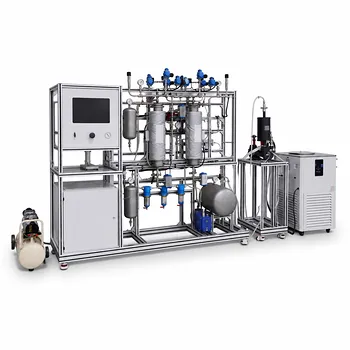
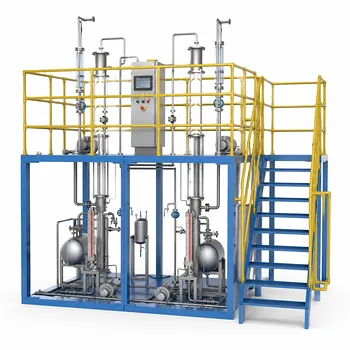
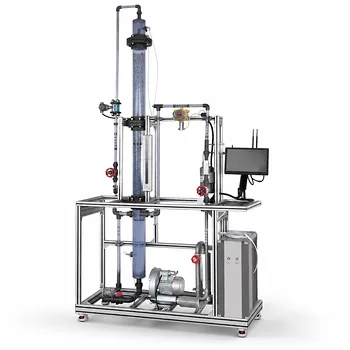
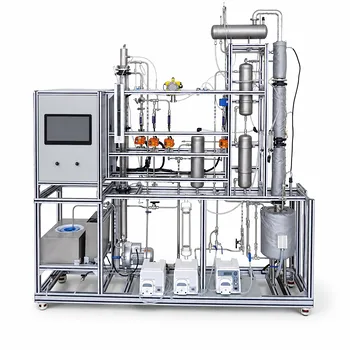
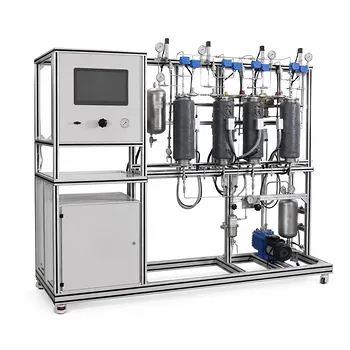
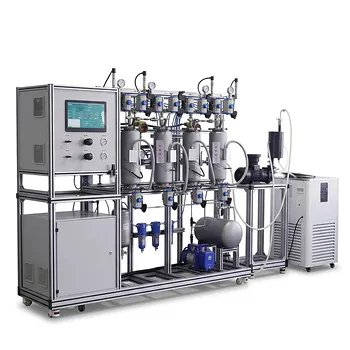
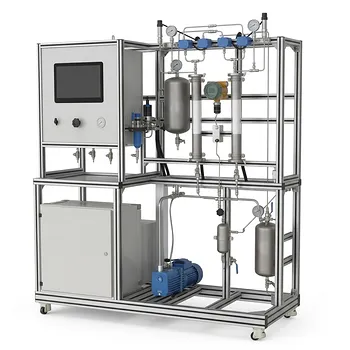
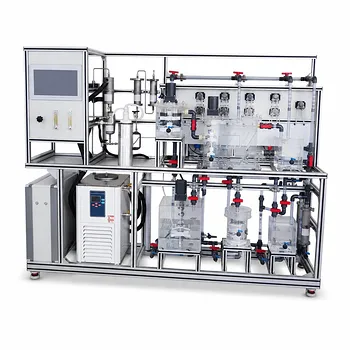
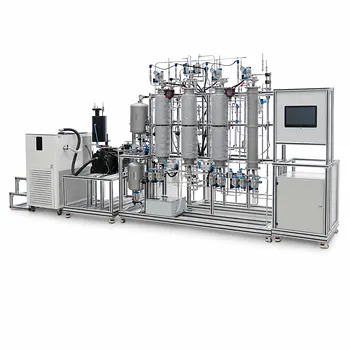
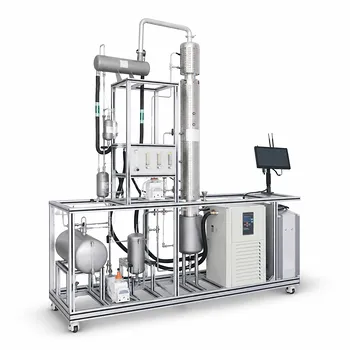
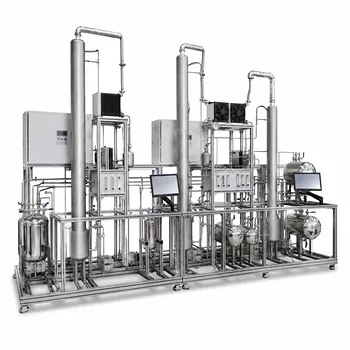
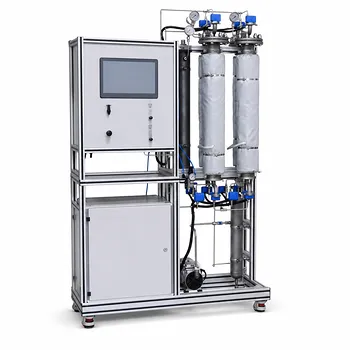
Heat input versus external solvent—these two competing principles define how distillation and gas absorption achieve separation, and pilot plants make those differences tangible. In distillation, you boil a liquid mixture to generate a counter-current vapor–liquid contact where components move in opposite directions based on volatility. Gas absorption skips the boiling: an external liquid absorbent is fed to the column, and the target solute transfers unidirectionally from the gas into that liquid, all while the system stays far below the solvent’s boiling point. Running both pilot plants side by side lets students measure how these operational differences change temperature profiles, mass transfer efficiency, and the need for downstream regeneration.
Gas absorption does not depend on the mixture’s own volatility to create a liquid phase. Instead, a lean solvent scrubs the solute in a single direction without vaporization, forcing the process to operate under a cold, liquid‑rich regime that ultimately requires an energy‑consuming stripping column to recover the absorbent.
How the Driving Force Differs: Volatility vs. Solubility
Pilot‑scale equipment turns abstract theory into visible operational choices. The most immediate difference students can grasp is what makes mass transfer happen.
Distillation Relies on Heat to Create Two Phases
A distillation pilot column has a reboiler that vaporizes part of the bottom liquid and a condenser that returns liquid reflux. This generates a counter‑current cascade where lighter components travel upward as vapor and heavier components move downward as liquid. Mass transfer is bidirectional: rectification enriches the lighter fraction, stripping the heavier one.
Because the liquid phase is created by condensing vapor, the column’s temperature profile marches from the boiling point of the bottom mixture to the condensing temperature at the top. Students can trace this gradient to see how relative volatility governs separation.
Absorption Introduces an External Liquid for Unidirectional Transfer
A gas absorption pilot plant has no reboiler or reflux. Lean solvent enters at the top, and a gas stream enters at the bottom. The solute dissolves into the liquid, so mass transfer moves only from gas to liquid. Students can verify this by measuring solute concentrations along the column: they drop in the gas phase but rise in the liquid, with no reversal.
This one‑way transfer fundamentally changes the temperature landscape. Because the solvent enters cold and the gas is often near ambient, the column operates well below the solvent’s boiling point, preventing significant vaporization. Students who compare distillation and absorption thermocouple readings will see a stark absence of a boiling‑point‑driven temperature gradient.
Operational Regimes You Can Compare on Pilot Plants
Beyond the basic driving force, pilot plants let students manipulate and measure key operational variables that reveal how the two unit operations behave differently under dynamic conditions.
Temperature Profiles and the Boiling Point Gap
In distillation, the column temperature is pinned between the boiling points of the components. Any change in feed composition or reflux ratio shifts the profile but stays tied to vapor–liquid equilibrium. In absorption, the temperature rise is small and comes mainly from heats of solution or reaction. Students can deliberately vary the liquid inlet temperature and observe that absorption efficiency changes with solubility, not with a shift in boiling points. This directly illustrates why absorption is the method of choice for recovering heat‑sensitive or non‑volatile compounds.
Pressure Drop, Flooding, and Hydraulic Limits
Both columns use packing or trays, but the liquid–gas interactions differ. In a distillation column, the liquid originates from internal condensation, so the liquid load is often linked to the vapor boil‑up. In an absorption column, liquid and gas flow rates are independent operational knobs. Using the pilot plant, students can push the liquid‑to‑gas ratio until flooding occurs, then measure the pressure drop across the packing. They learn that for a given packing, flooding onset depends on both phases’ flow rates and physical properties, not just vapor load.
Measuring Transfer Efficiency: HTU and NTU
The gas absorption pilot plant is ideally suited to teach Height of a Transfer Unit (HTU) and Number of Transfer Units (NTU). By varying gas and liquid flow rates, students measure inlet and outlet gas concentrations, then calculate NTU from the composition driving force and compare with the packed height to find HTU. This quantifies the separation difficulty—something that distillation students typically approach through the HETP concept but under constrained vapor–liquid equilibrium conditions.
The distillation pilot plant, by contrast, emphasizes reflux ratio and stage efficiency. Students can alter the reflux ratio and watch the top product purity change directly, reinforcing the idea that rectification relies on liquid returned to the column.
The Overlooked Necessity: Solvent Regeneration
One of the most critical operational differences that a standalone absorption pilot plant reveals is the need for a desorption (stripping) column. Unlike distillation, where the separated components are drawn off as products, absorption leaves the solute dissolved in the solvent.
Students who connect a stripping column to the absorption pilot plant see that regeneration demands an external energy input. For physical absorption, simply dropping the pressure may release the gas. For chemical absorption, thermal energy must break the chemical bonds—often the largest energy consumer in the entire process. A distillation pilot plant does not require this separate regeneration loop because the reboiler already provides the necessary energy for both vaporization and product withdrawal.
Physical vs. Chemical Absorption: A Learning Advantage Unique to Gas Absorption
The absorption pilot plant offers a dimension that distillation simply cannot match: the ability to switch between physical absorption and chemical absorption. With a single packed column, students can run water to physically absorb CO₂, then add an amine or alkaline solution to witness chemical absorption. The jump in outlet-gas purity and the exothermic temperature rise are immediate.
This comparison teaches:
- Physical absorption depends on pressure, temperature, and Henry’s law solubility.
- Chemical absorption increases capacity by reacting the solute, lowering equilibrium back‑pressure, and boosting mass transfer rates.
- Measuring gas concentrations at the column ends lets students compute the mass transfer enhancement factor and directly link kinetics to performance.
No distillation column can demonstrate such a radical shift in separation mechanism without changing the mixture itself.
Understanding the Trade-offs: When Each Operation Excels
Pilot plant studies are most valuable when they highlight practical constraints. Direct comparison teaches students to evaluate when one operation is preferable over the other.
- Energy profile: Distillation uses a single thermal energy input at the reboiler but must boil the entire mixture. Absorption often avoids boiling but may require substantial energy for solvent regeneration, especially for chemically reactive systems.
- Equipment complexity: A distillation column integrates separation and product purification in one unit with reflux. Absorption demands a second column for stripping, plus solvent handling, storage, and make‑up systems.
- Thermal degradation: Absorption runs cold, protecting heat‑sensitive materials and minimizing side reactions. Distillation’s high temperatures can degrade products or foul reboilers.
- Selectivity: Distillation excels for components with a wide volatility gap. Absorption shines for dilute solutes (e.g., acid gas removal) where a lean solvent can achieve deep removal without boiling massive volumes of carrier gas.
- Corrosion and solvent management: Chemical absorption may introduce corrosive electrolytes or solvent degradation products that pilot‑scale metallurgy must withstand—something absent in simple distillation.
How to Extract Maximum Learning from Pilot Plant Comparisons
Align your experiments with the core concepts you want to reinforce. Here are goal‑oriented recommendations for students and instructors using this equipment.
- If your primary focus is understanding thermodynamic driving forces: Run the distillation column and note the strong temperature gradient tied to boiling points, then switch to absorption and observe the near‑isothermal profile below the solvent’s boiling point.
- If your primary focus is mass transfer design: Use the absorption column to determine HTU and NTU at different liquid‑to‑gas ratios, then compare the concept to distillation’s HETP and stage‑based models.
- If your primary focus is overall process economics: Add the stripping loop to the absorption pilot plant and measure the energy input required for regeneration; contrast that with the reboiler duty of the distillation column for a similar separation target.
- If your primary focus is solvent selection and reaction engineering: Test physical and chemical absorption in the same packed column, measuring outlet concentrations and temperature rises to quantify the reactivity’s impact on mass transfer.
- If your primary focus is hydraulic operation and scale‑up: Run both columns up to flooding, record pressure‑drop curves, and see how independent liquid and gas flow adjustments in absorption differ from the coupled vapor–liquid flow in distillation.
By systematically comparing these units, students gain a practical, hands‑on understanding that the choice between distillation and gas absorption is not about one being “better” but about matching the separation’s thermal, chemical, and economic demands to the right operational principle.
Summary Table:
| Operational Feature | Gas Absorption | Distillation |
|---|---|---|
| Driving Force | Solute solubility in an external solvent | Relative volatility of the mixture components |
| Mass Transfer Direction | Unidirectional (gas to liquid solute transfer) | Bidirectional (counter-current vapor-liquid exchange) |
| Temperature Profile | Near-isothermal (operates below solvent boiling point) | Temperature gradient (from bottom boiling to top condensing) |
| Energy Requirement | High thermal energy needed for solvent regeneration | Continuous heat input at the reboiler for vaporization |
| Key Control Variables | Independent liquid and gas flow rates | Coupled vapor-liquid flows, reflux ratio |
| Design Metric | HTU (Height) & NTU (Number of Transfer Units) | HETP and fractional stage efficiency |
Bring Hands-On Chemical Engineering to Your Lab
Help your students and researchers master the complexities of mass transfer. LABPARK provides state-of-the-art Educational and Vocational Unit Operations Pilot Plants in chemical engineering, bioprocess & biotech, and environmental & water treatment.
Designed specifically for universities, research institutes, and enterprises, our pilot plants deliver realistic, real-world training environments to compare gas absorption, distillation, and other core processes safely and effectively.
Ready to upgrade your lab's educational capabilities? Contact LABPARK today to explore our pilot plant solutions and request a custom configuration.
Related Products
- Bench Scale Dual Column Gas Separation and Capture Educational Pilot Plant
- Absorption and Desorption Educational Unit Operations Pilot Plant
- Dual-Mode Gas Absorption and Desorption Unit Operations Training Pilot Plant
- Packed Bed Absorption Educational Unit Operations Pilot Plant
- Carbon Dioxide Absorption and Desorption Educational Pilot Plant for Carbon Capture Studies
People Also Ask
- What are the key thermodynamic considerations for gas mixture modeling? Expert Guide
- Why is Graham's Law critical for gas separation in pilot plants? Master Unit Operations Design
- Why Are Binary Interaction Parameters Critical for Gas Separation Pilot Plants? Avoid Costly Failures
- How does the separation mechanism of gas permeation differ from liquid membrane processes? Pilot Plant Guide
- Which membrane materials are commonly used in gas separation pilot plants, and how is membrane fouling typically managed?