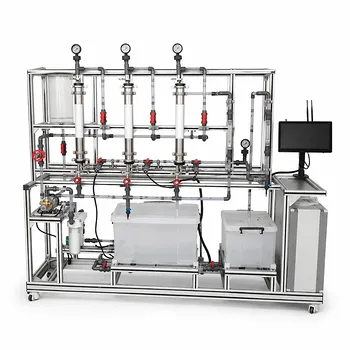
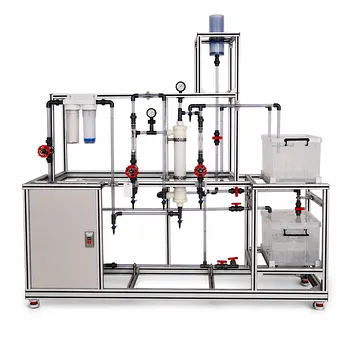
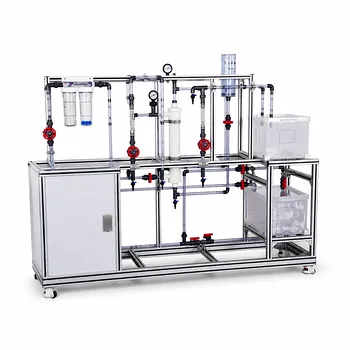
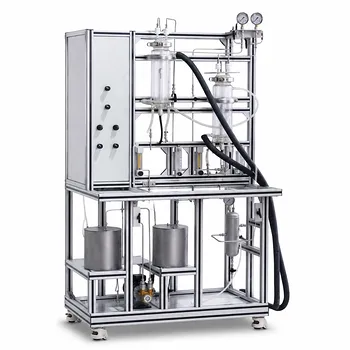
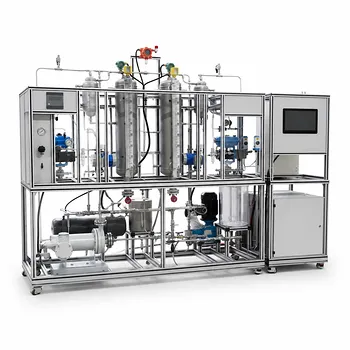
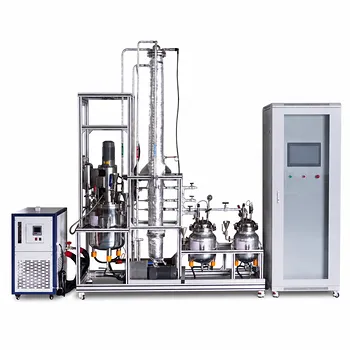
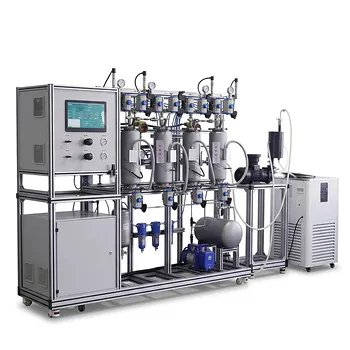
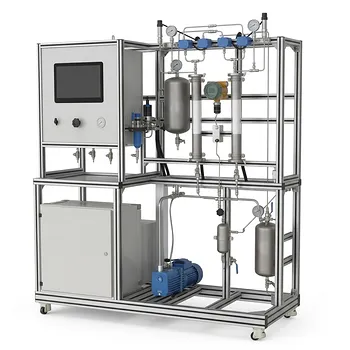
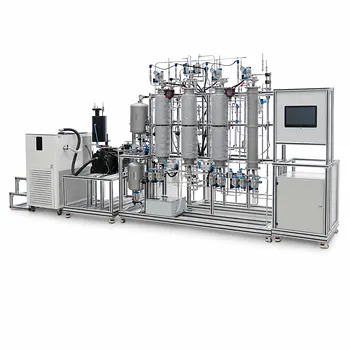
Operating a membrane separation pilot plant is a lesson in managing a delicate balance. The primary operational advantage is the ability to achieve high-purity, non-destructive separation at ambient temperatures with exceptional energy efficiency. However, you must constantly monitor inherent physical limitations: the system's relentless battle against membrane fouling, its sensitivity to aggressive chemicals, and the inevitable degradation of the membrane material itself. Your core mission is to learn how to sustain the advantage while mitigating these physical vulnerabilities.
The central insight for any student or researcher is that a membrane's performance is not static. The true value of a pilot plant experiment lies not just in running a successful separation, but in meticulously observing the dynamic decline in flux due to fouling and the chemical-physical boundaries of the polymer. The plant is a diagnostic tool for the membrane's health as much as it is a separation device.
The Inherent Process Advantages to Leverage
The appeal of membrane technology in research stems from its fundamental departure from energy-intensive thermal methods. Your pilot plant allows you to witness these thermodynamic and practical benefits directly.
Gentle, Non-Destructive Separation
Unlike distillation, membrane processes typically avoid thermal phase changes. This is the single most critical advantage to observe.
The plant operates at ambient or moderate temperatures. This makes it inherently ideal for heat-sensitive biomolecules in your research, such as protein solutions or dairy streams. You can isolate a target compound without chemically altering or thermally damaging its structure.
The mechanism is based on physical exclusion or differential transport. When you analyze your permeate, you are seeing the result of size exclusion or solubility differences, not a chemical transformation. This physical separation principle ensures product integrity, a non-negotiable factor in bioprocessing and pharmaceutical research.
The Efficiency and Scalability Paradox
Your pilot plant will demonstrate a unique operational characteristic that defies conventional engineering economics: a linear scaling path.
Energy consumption is demonstrably low. Since the process doesn't require raising massive volumes of liquid to their boiling point, the primary energy demand comes from pumping fluids and overcoming the feed-side pressure. You can directly correlate the electrical power draw of the pump with the clean permeate produced.
Scalability is modular, not physical. You will observe that simply building a larger single membrane module is not the industrial path. Instead, the pilot plant teaches you that scale-up is achieved by numbering-up—arranging multiple modules in series or parallel. This confirms the near-unity scale-up factor, meaning data from a single lab-scale module is highly predictive of a single industrial module's performance.
The Physical Limits You Must Manage
The advantages are only sustainable if you can actively manage three primary constraints. Your research protocol should be built around monitoring these failure modes.
The Relentless Onslaught of Membrane Fouling
Fouling is the most immediate and visible operational challenge. It is the progressive deposition of material on the membrane surface or within its pores, and your pilot plant's instrumentation is designed to reveal it.
Monitoring the pressure drop is the primary diagnostic. As a foulant layer forms, the hydraulic resistance increases. You will observe a gradual decline in permeate flux if the transmembrane pressure (TMP) is held constant, or a rising pressure drop across the module if the flux is fixed. This real-time data teaches the direct cost of fouling on productivity.
You can classify fouling mechanisms in your experiments. By changing your synthetic or real feed stream, you can induce and study four distinct categories: organic fouling from macromolecules and proteins, inorganic scaling from mineral salts, biofouling from microbial colonies, and particulate fouling from colloidal matter. The electrostatic and hydrophobic interactions between the feed constituents and the membrane are the root causes you can investigate.
Navigating Chemical Compatibility Boundaries
The membrane is not just a physical sieve; it is a chemically active barrier with strict tolerances. A mistake in feed chemistry is a rapid route to catastrophic module failure.
Polymeric membranes have a fatal flaw with harsh chemicals. You must carefully check chemical resistance charts before introducing extreme pH streams, strong oxidizing agents, or organic solvents. Polymeric chains in the membrane can swell, dissolve, or crack when exposed to substances like ketones, aromatics, or strong acids, permanently destroying selectivity.
Material selection is a critical research variable. When your separation target demands chemically aggressive conditions, the pilot plant lesson is to abandon standard polymers. The research then pivots to evaluating inherently resistant materials like ceramics, glass, or sintered metals, accepting the trade-off in cost and mechanical fragility.
The Irreversible Dimension of Membrane Aging
Your pilot plant will also demonstrate that membranes are consumable items with a finite, and often short, operational lifespan.
Flux and selectivity drift independently over time. Even with perfect cleaning protocols, physical and chemical degradation occurs. Polymeric chains can compact under sustained high pressure, reducing flux irreversibly. Pore structures can degrade chemically, causing a slow loss of selectivity that only becomes apparent through meticulous sample analysis.
Maintenance and replacement must be integrated as a core process variable. You learn that calculating long-term operating costs requires a realistic projection of membrane module replacement frequency. A pilot plant trial that doesn’t account for this degradation cycle provides a falsely optimistic view of process economics.
Understanding the Critical Trade-offs in Practice
Running the pilot plant is an exercise in balancing opposing forces. You gain nothing by maximizing one parameter if it catastrophically harms another.
The recovery-purity-energy triangle is your core research subject. By manipulating the feed pressure and the pressure ratio, you can directly observe the trade-offs. A higher pressure ratio boosts water recovery but demands significantly more energy from the compressor or vacuum pump and can accelerate fouling by concentrating foulants at the membrane surface.
Sweeping operational adjustments reveal these limits. When you alter the feed flow distribution, you might improve mass transfer and reduce fouling, but at the cost of a higher pressure drop along the module. Your ability to find the precise operating sweet spot—where acceptable flux meets target purity without triggering immediate fouling—is the ultimate skill the pilot plant is designed to teach.
How to Monitor for Success in Your Pilot Plant
The operational data you choose to prioritize should align directly with your research or educational objective. The plant is a versatile platform, but its purpose must be defined.
- If your primary focus is studying fouling mechanisms: Track the pressure drop and normalize the permeate flux continuously, and design cleaning-in-place (CIP) protocols that target specific foulant categories by observing the flux recovery after chemical washes.
- If your primary focus is optimizing energy efficiency: Record the specific energy consumption per volume of permeate and systematically vary the process temperature and feed pressure to find the lowest energy point that still meets separation targets.
- If your primary focus is scaling up a sensitive bioprocess: Operate at minimal transmembrane pressure to preserve macromolecule integrity and demonstrate the linear scalability of the membrane area, validating that lab-scale performance data is directly transferable to a multi-module industrial system.
The membrane pilot plant is not just a device to separate components; it is an experimental landscape where every observed limitation provides a deeper insight than every unexamined advantage.
Summary Table:
| Operational Factor | Key Advantages | Physical Limitations & Risks | What to Monitor |
|---|---|---|---|
| Process Efficiency | Low energy consumption, modular scalability | Irreversible membrane aging over time | Specific energy consumption, flux decline |
| Product Quality | Gentle, non-destructive physical separation | Membrane fouling (organic, biological, mineral) | Transmembrane pressure (TMP), permeate flux |
| Material Integrity | Ambient/moderate temperature processing | Chemical incompatibility (swelling, degradation) | Feed chemistry, pH, solvent exposure |
Optimize Your Lab's Membrane Research with LABPARK
Ready to equip your students and researchers with hands-on membrane separation experience? LABPARK provides state-of-the-art Educational and Vocational Unit Operations Pilot Plants in chemical engineering, bioprocess & biotech, and environmental & water treatment. Designed specifically for universities, research institutes, and enterprises, our pilot plants deliver precise process control, reliable performance tracking, and robust educational value.
Contact our experts today to find the perfect pilot plant solution for your lab!
Related Products
- Multifunctional Membrane Separation Educational Pilot Plant with Ultrafiltration, Nanofiltration, Reverse Osmosis
- Ultrafiltration Membrane Separation Educational Pilot Plant
- Multi-Functional Membrane Separation Educational Pilot Plant for Unit Operations Lab
- Hollow Fiber Ultrafiltration Membrane Separation Educational Pilot Plant
- Photocatalytic Membrane Separation and Degradation Unit Operations Pilot Plant
People Also Ask
- How do PEI, PVDF, and PSU membranes compare in pilot plants? Find the best fit.
- Pervaporation vs. Vapor Permeation: Handling Suspended Solids in Membrane Pilot Plants
- What are the trade-offs of polymer vs inorganic membranes in teaching pilot plants? Key laboratory comparison.
- What are the advantages of membrane separation in pilot plants? Efficient Organic Vapor Recovery
- How can operators optimize operating conditions and cleaning protocols in membrane separation pilot plants to mitigate fouling?