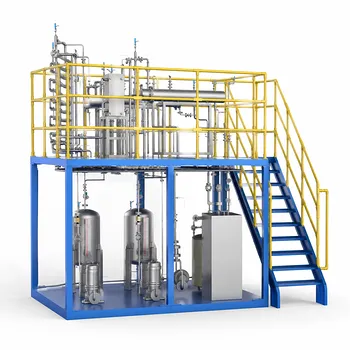
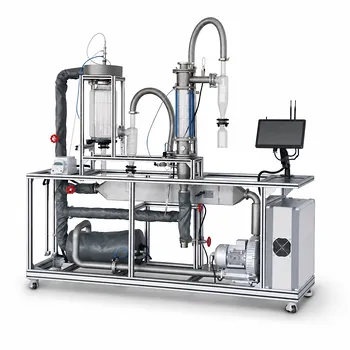
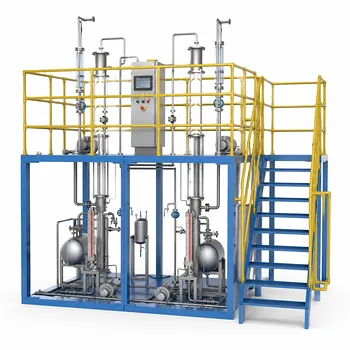
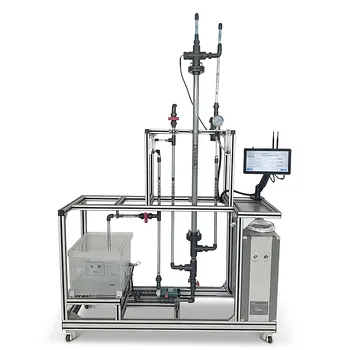
The single greatest advantage of integrating Model Predictive Control (MPC) into a unit operations pilot plant is that it stops being just a piece of equipment and becomes a true testbed for the most critical skill in modern process engineering: managing complex, interconnected systems.
<question_to_answer> What are the key educational and operational advantages of integrating Model Predictive Control (MPC) into multivariable unit operations pilot plants, such as distillation columns? </question_to_answer>
<content_strategy> No specific content strategy provided. </content_strategy>
<primary_reference> Integrating Model Predictive Control (MPC) into unit operations pilot plants provides significant advantages for both research and vocational training. MPC is uniquely suited for complex, multivariable processes with large time delays and interactive loops, which are typical in unit operations like distillation. Unlike traditional PID, MPC uses a predictive model to forecast future process outputs, utilizes feedback correction to minimize error caused by model mismatch or external disturbances, and applies rolling optimization to handle physical constraints on inputs and outputs. This allows students and researchers to gain hands-on experience with advanced control strategies that reflect modern industrial control room environments. </primary_reference>
<supplementary_references> Reactive distillation combines chemical reaction and product separation within a single column. In educational and vocational pilot plants, this configuration demonstrates several key chemical engineering advantages: (1) it overcomes chemical equilibrium limitations by continuously removing products from the reaction zone, (2) it improves energy efficiency by directly utilizing the heat of reaction to drive the distillation process, and (3) it reduces capital costs by consolidating reaction and separation into a single vessel. Typical applications demonstrated on such pilot equipment include the synthesis of methyl tert-butyl ether (MTBE) and ethyl acetate.
In multi-stage chemical engineering pilot plants where the output of one unit operation serves as the feed for the next (such as two distillation columns in series), a uniform control system is used to balance the conflicting control requirements of liquid level and flow rate. Instead of keeping the liquid level strictly constant, uniform control allows both the liquid level in the first vessel and the outflow feed rate to the second vessel to fluctuate slowly within allowable limits. This buffers flow variations, prevents sudden surges or interruptions in feed to downstream unit operations, and ensures steady-state operation of the entire pilot plant. </supplementary_references>
Summary Table:
| Feature / Benefit | Traditional PID Control | Model Predictive Control (MPC) |
|---|---|---|
| System Handling | Manages single-variable loops individually | Solves complex, multivariable interactive loops |
| Process Response | Reactive adjustment based on past error | Predictive forecasting of future process outputs |
| Constraint Handling | Difficult to manage physical limits dynamically | Systematically manages input and output constraints |
| Educational Value | Basic loop tuning concepts | Hands-on experience with modern industrial control rooms |
Bring Modern Industrial Control to Your Laboratory
At LABPARK, we equip universities, research institutes, and enterprises with state-of-the-art Educational and Vocational Unit Operations Pilot Plants across chemical engineering, bioprocess & biotech, and environmental & water treatment. By integrating advanced technologies like Model Predictive Control (MPC), our pilot plants provide students and researchers with a true testbed for managing complex, interconnected industrial systems.
Ready to elevate your training and research capabilities? Contact LABPARK today to discover our custom engineering solutions!
Related Products
- Multimodal Absorption and Desorption Pilot Plant for Unit Operations Training
- Multi-Modal Distillation Unit Operations Training Pilot Plant
- Comprehensive Multi-Modal Heat Transfer Unit Operations Pilot Plant for Engineering Training
- Multi-Reactor Educational Pilot Plant for Reaction Engineering Unit Operations
- Multi Pump Fluid Transport Process Piping Unit Operations Training Pilot Plant
People Also Ask
- How do predictive thermodynamic models integrate into pilot plants? Bridging Theory and Practice
- Which cross-validation strategy should be selected for pilot plant time-series & batch data? Avoid Data Leakage
- How can process control schemes be configured to teach basic and advanced control?
- Why Use Center Points in Process Analyzer Calibration? Key Benefits Explained
- How does polyphosphate hydrolysis affect scale and corrosion in pilot plants? Essential Monitoring Guide