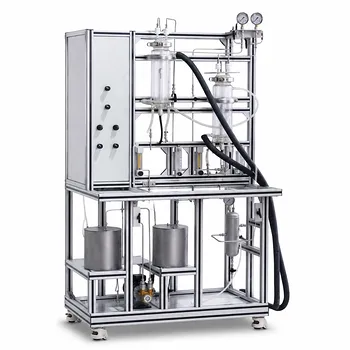
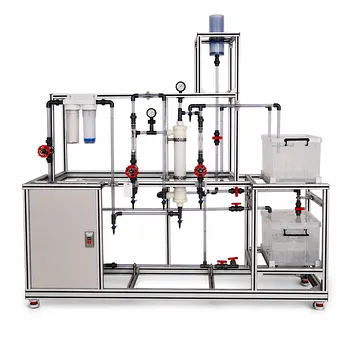
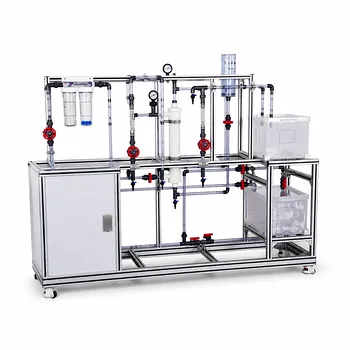
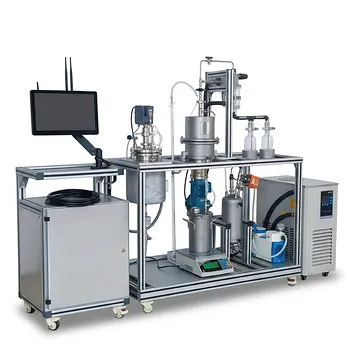
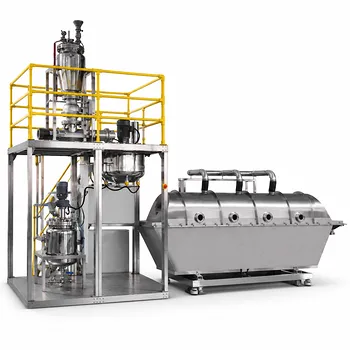
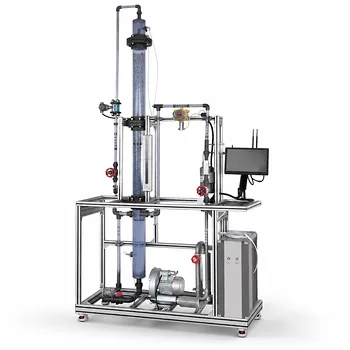
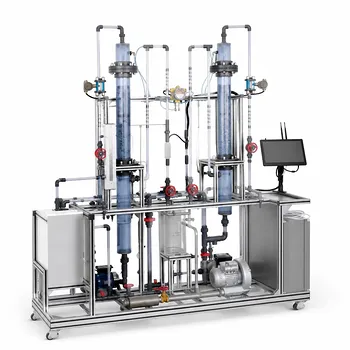
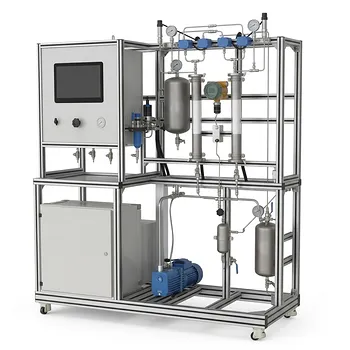
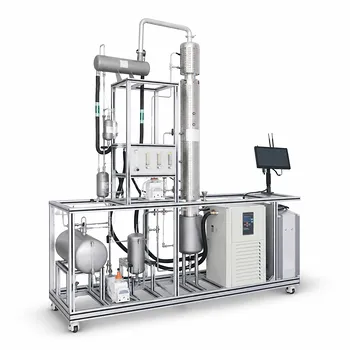
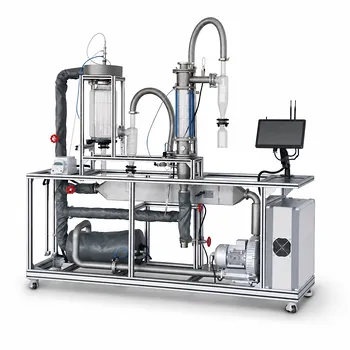
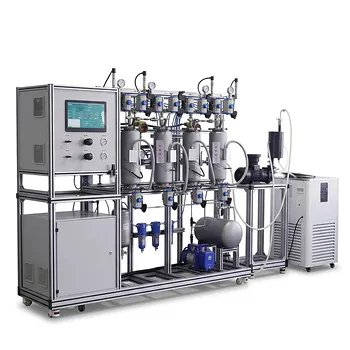
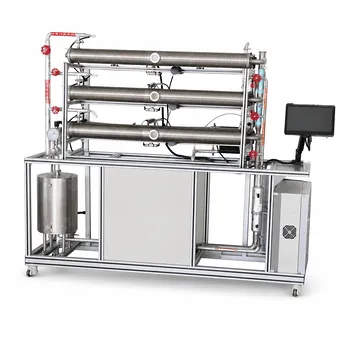
When you step up to a membrane-based pervaporation pilot plant, you’re directly engaging with a separation process driven by a chemical potential gradient. Students operating these units quickly learn that the core driving force is the difference in partial vapor pressure between the liquid feed and the vacuum–permeate side. The transport mechanism they must analyze is the solution-diffusion model, where a component’s ability to separate hinges on its solubility in the membrane material and its ability to diffuse through it. This means separation is not a simple sieve but a delicate balance of molecular affinity and mobility, governed squarely by Fick’s law of diffusion.
The fundamental puzzle of a pervaporation pilot plant is to understand and manipulate the partial pressure gradient that pushes molecules through a dense membrane—and to see that the real separation magic happens inside the membrane’s polymer matrix via sorption, diffusion, and desorption. Mastering these concepts lets students move from textbook theory to controlling flux and selectivity with real knobs like temperature, vacuum level, and membrane chemistry.
The Solution-Diffusion Mechanism: The Heart of Pervaporation
In dense membranes—the most common type studied on pilot units—the transport process is not a simple flow through pores. Instead, the solution-diffusion mechanism operates in three sequential steps, each of which becomes a leverage point for analysis.
Step 1: Preferential Sorption at the Feed Side
The liquid feed mixture contacts the upstream membrane surface. Components with higher physical-chemical affinity for the membrane material are preferentially absorbed. This sorption step is driven by thermodynamic compatibility—the more a molecule “likes” the polymer, the more it concentrates at the surface, creating a steep concentration gradient.
Step 2: Diffusion Through the Polymer Matrix
Once inside the membrane, the absorbed molecules must travel through the free volume between polymer chains. This diffusion follows Fick’s first law: the flux is proportional to the concentration gradient. Diffusivity depends on the size and shape of the molecule and the mobility of the polymer chains, which is why operating temperature is such a powerful control lever. Students can see that even if two components sorb equally, the one that diffuses faster will dominate the permeate.
Step 3: Desorption as Vapor on the Permeate Side
At the downstream face, the low partial pressure—maintained by a vacuum pump—causes the permeating molecules to instantly vaporize and leave the membrane. Desorption is fast under proper vacuum conditions, so this step rarely limits the overall rate. However, if non-condensable gases accumulate, transport resistance builds, and students must learn to sweep or condense them away.
Creating the Driving Force: Practical Levers in the Pilot Plant
The driving force is a partial vapor pressure gradient between the hot liquid feed and the cold, low-pressure permeate. Students analyze two primary strategies to maximize this gradient, both of which can be demonstrated and quantified on the pilot plant.
Lever 1: Increasing Feed Temperature
Raising the temperature significantly boosts the vapor pressure of the target component on the feed side, exponentially increasing the driving force. But there’s a limit: if the boiling point is approached, feed pump cavitation becomes a real risk. The pilot plant teaches students a practical fix—pressurizing the feed line to raise the boiling point, allowing higher temperatures without vapor locks.
Lever 2: Lowering Permeate Partial Pressure
Using a vacuum pump is the most direct way to slash pressure on the permeate side. The subtlety students learn is that as the feed becomes depleted of the target component late in a batch run, the partial pressure difference shrinks. To sustain flux, the pilot plant can demonstrate a Combo Mode: start with vacuum only, then introduce an inert gas (like nitrogen) purge near the end to sweep the permeate and maintain a low vapor partial pressure even when the feed concentration is tiny.
Condensation and Gas Management
The most practical method to keep permeate pressure low is direct condensation under vacuum. Typically, condensation temperatures between +10 °C and –20 °C are used. Students must also contend with non-condensable gases that accumulate and create transport resistance; these must be removed. The alternative—using an inert sweep gas without condensation—is generally avoided in chemical engineering because it requires recycling huge gas volumes and adds diffusive resistance through the porous support of composite membranes, lowering overall flux.
Understanding the Trade‑offs in Pervaporation Pilot Operation
No analysis is complete without confronting the real‑world compromises that influence membrane life, energy cost, and data interpretation.
Temperature vs. Membrane Swelling
Higher temperatures boost flux, but also increase membrane swelling. In pervaporation, a liquid feed directly contacts the dense membrane, causing much more swelling than in vapor or gas permeation. Excessive swelling can change the polymer’s free volume and permanently alter selectivity, so students must balance temperature gains against membrane stability.
Membrane Material: Performance vs. Practicality
Polyvinyl alcohol (PVA) is a workhorse, but it often needs crosslinking with glutaraldehyde to improve thermo‑mechanical stability and selectivity. Inorganic membranes offer outstanding chemical and thermal resistance, yet they are fragile and expensive. The pilot plant becomes a sandbox for weighing these factors—a membrane with perfect selectivity is useless if it dissolves in the feed or breaks under vacuum.
Sweep Gas Inefficiency
While an inert gas sweep can maintain driving force, it’s rarely a first choice in pilot‑scale instruction. The porous support layer of composite membranes adds a concentration polarization layer when using a sweep gas, reducing flux. Students learn that condensation under vacuum is almost always the cleaner, more industrially relevant method to study.
Feed Pressure and Phase Integrity
The feed liquid is kept under a few bars of pressure to remain liquid at the operating temperature. Too little pressure and premature boiling inside the module destroys the separation. Too much pressure without understanding membrane mechanical limits can deform the material. Students are trained to verify that the membrane is compatible with the solvent and that no chemical attack occurs—otherwise, all transport data becomes meaningless.
How to Apply This to Your Pilot Plant Study
What you choose to prioritize as a student or operator determines which driving force and transport aspects you emphasize. Use the following goals to structure your experimental plan.
- If your primary focus is maximizing permeation flux: Raise the feed temperature as high as practical while pressurizing the feed to suppress cavitation, and run a clean vacuum with efficient condensation to keep permeate pressure minimal.
- If your primary focus is understanding selectivity fundamentals: Hold operating conditions steady and systematically vary feed composition. Map the sorption and diffusion contributions by analyzing permeate composition and comparing with pure-component solubility and diffusivity data.
- If your primary focus is energy efficiency and process design: Practice the Combo Mode—vacuum at the start, then a short nitrogen purge at the end—and measure energy consumption versus flux to learn when switching strategies makes economic sense.
- If your primary focus is membrane material lifetime: Run long-duration tests with aggressive solvents and track how swelling or chemical attack alters flux and selectivity. Crosslink or switch to more inert materials only after quantifying degradation.
By treating the pervaporation pilot plant as a system where solubility, diffusivity, and vapor pressure gradients all dance together, you turn abstract chemical potential differences into a tangible, tunable separation process—exactly the skill that sets apart a knowledgeable operator from a theoretical observer.
Summary Table:
| Step / Lever | Transport & Driving Force Mechanism | Key Operational Impact |
|---|---|---|
| 1. Sorption | Preferential thermodynamic affinity at the feed side | Initiates selective chemical separation |
| 2. Diffusion | Molecular movement through polymer free volume (Fick's Law) | Highly dependent on feed temperature |
| 3. Desorption | Rapid phase change to vapor at the low-pressure side | Maintained via vacuum and condensation |
| 4. Temperature Lever | Increases feed-side vapor pressure exponentially | Boosts flux; requires pressure to prevent cavitation |
| 5. Vacuum Lever | Minimizes permeate-side partial pressure | Drives continuous molecular transport |
Enhance Your Chemical Engineering Curriculum with LABPARK
Bridge the gap between theoretical thermodynamics and hands-on process control. LABPARK provides state-of-the-art Educational and Vocational Unit Operations Pilot Plants in chemical engineering, bioprocess & biotech, and environmental & water treatment. Specifically designed for universities, research institutes, and enterprises, our pilot plants empower students and researchers to master membrane separation, heat transfer, and fluid dynamics in a safe, controlled environment.
Contact LABPARK today to discuss your laboratory configuration and request a quote!
Related Products
- Multi-Functional Membrane Separation Educational Pilot Plant for Unit Operations Lab
- Multi Functional Membrane Crystallization Educational Unit Operations Pilot Plant
- Alkaline Membrane Water Electrolysis Educational Pilot Plant Unit Operations Training System
- Photocatalytic Membrane Separation and Degradation Unit Operations Pilot Plant
- Ultrafiltration Membrane Separation Educational Pilot Plant
People Also Ask
- What are the key differences in membrane configurations? Choose the Right Unit Operations Pilot Plant
- How Do Pervaporation, Vapor, and Gas Permeation Differ in Pilot Plants? Key Comparison
- What are the advantages of membrane separation pilot plants? Energy-saving process intensification.
- Pervaporation vs. Vapor Permeation: Handling Suspended Solids in Membrane Pilot Plants
- How do PEI, PVDF, and PSU membranes compare in pilot plants? Find the best fit.