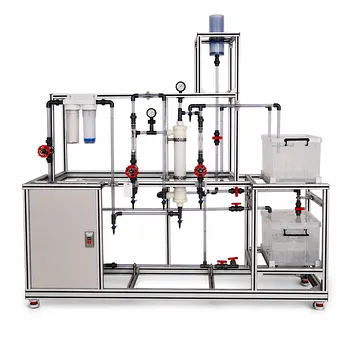
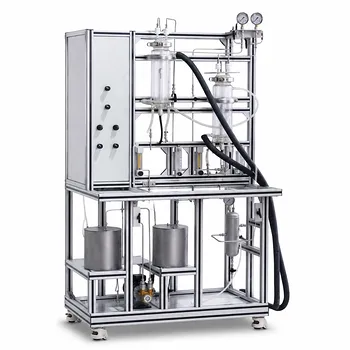
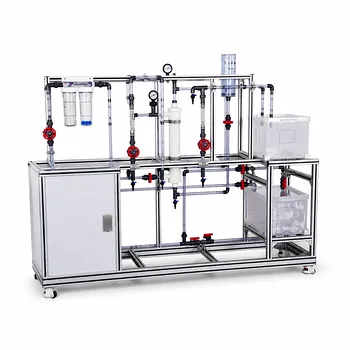
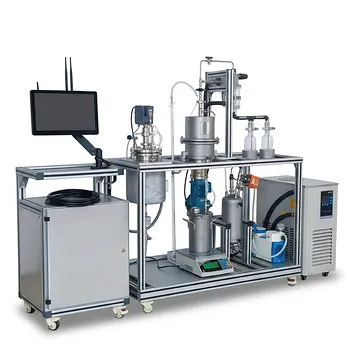
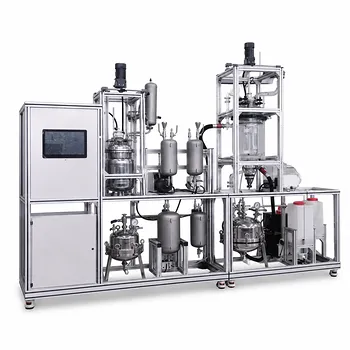
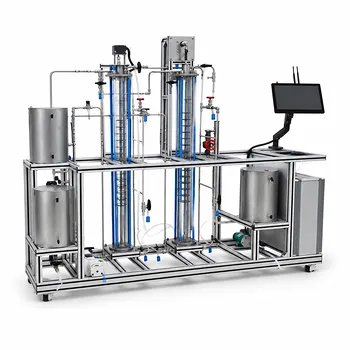
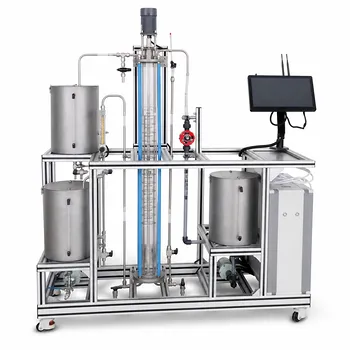
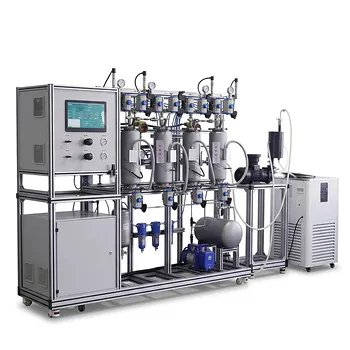
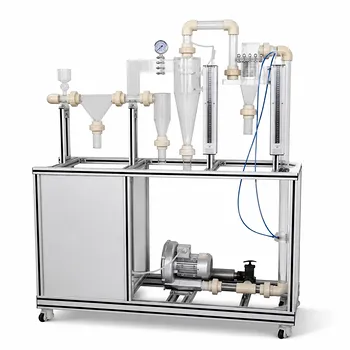
The key to success lies not in choosing the "best" technology, but in selecting the pilot plant that most faithfully teaches the critical relationship between fundamental thermodynamic drivers and practical operational limits. When evaluating unit operations pilot plants for advanced separation technologies, your primary focus must move beyond simple performance specs to a holistic assessment of safety, material compatibility, and the system’s ability to make invisible physical principles tangible. The ultimate goal is to bridge the gap between theoretical chemistry and the unforgiving reality of industrial-scale operations.
The central challenge in advanced separation piloting is managing extremes—whether it's the high pressure of supercritical fluids or the physical fragility of membranes. A successful selection and operational strategy hinges on matching the inherent thermodynamic separation mechanism of the technology to the specific vulnerabilities of your target molecule and the constraints of your operating environment.
The Overarching Principles of Pilot Plant Selection
Before diving into specific technologies, you must evaluate a set of universal criteria. These factors determine not only if the plant will work, but if it can serve as a true learning tool for process development.
Safety as a Pedagogical Foundation
Safety is not just a regulatory hurdle; it’s the core design parameter. This is especially critical for supercritical fluid extraction (SFE), where the entire process operates above the critical point of the solvent.
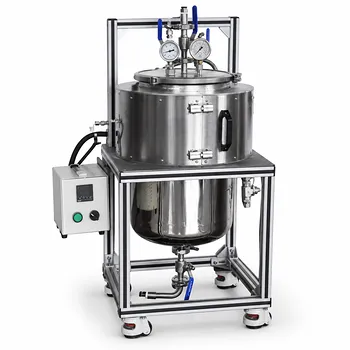
For carbon dioxide, the most common SFE solvent, this means maintaining conditions above 31 °C and 73.8 bar. The pilot plant must have robust pressure ratings and safety relief systems. Trainees need to directly observe and control these high-pressure environments to understand the phase diagram intimately. An unsafe plant fails as a teaching tool.
Material Compatibility and Chemical Resistance
The "advanced" nature of these separations often involves aggressive or unusual chemical environments. You must carefully match the construction materials of the pilot plant with the feed stream.
In membrane separation, this is a prominent failure point. Polymeric membranes have limited chemical resistance across wide pH ranges and to organic solvents. Selecting a feed chemical incompatible with the membrane material will destroy it. Similarly, SFE systems must use seals and gaskets that can withstand supercritical CO2 without swelling or degradation. The plant must be a testbed for material science as much as for process engineering.
Bridging Scalability and Observability
The defining purpose of a pilot plant is to generate data that scales. The unit must be large enough to overcome wall effects and mimic industrial fluid dynamics, yet small enough to allow granular manipulation of process variables.
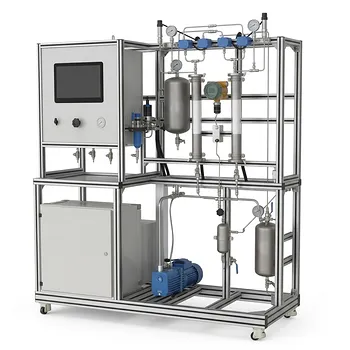
You need clear instrumentation to monitor key parameters. In SFE, operators must adjust temperature and pressure to directly tune the solvent's density and thus its solvating power. In membrane units, monitoring the pressure drop across the module serves as a direct proxy for fouling accumulation. A pilot plant that doesn't make these metrics visible fails in its primary mission.
Technology-Specific Considerations for Operation
Once the universal principles are met, your focus must narrow to the physics governing each separation method. Operating a unit successfully means exploiting its strength while actively managing its inherent weakness.
Mastering Supercritical Fluid Extraction
The operational heart of an SFE pilot plant lies in controlling the solvent’s thermodynamic state. Because it is neither a true liquid nor a true gas, a supercritical fluid exhibits hybrid properties that you can manipulate in real-time.
- Parameter Sensitivity: The density of a supercritical fluid is massively sensitive to pressure. Small changes near the critical point lead to large shifts in solvent power, allowing for razor-sharp fractionation. Operators learn to use this to selectively precipitate target compounds, like separating delicate unsaturated fatty acids (EPA/DHA) without thermal degradation.
- Mass Transfer Advantages: The supercritical state delivers gas-like diffusivity and liquid-like density. This enables rapid, deep extraction from complex matrices, leaving no toxic solvent residues. The key operational lesson is optimizing the depressurization step to recover a pure extract while minimizing energy consumption.
Navigating Membrane Separation Processes
Membrane systems offer elegant simplicity and unmatched energy efficiency for heat-sensitive products, but their operational life is a constant battle against physical laws.
- Exploiting the Key Advantage: These systems operate at ambient temperatures, making them irreplaceable for bioprocessing. In a pilot plant, this translates to separating proteins or dairy products without denaturing them or causing thermal damage.
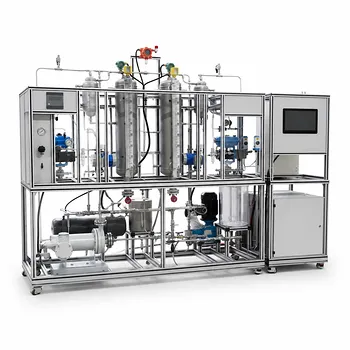
- Managing Fouling: This is the core operational challenge. Fouling causes a gradual decline in permeate flux, which you must teach operators to diagnose by tracking pressure drops. The operational protocol must include rigorous cleaning cycles and pre-filtration strategies.
- Understanding Finite Lifespan: Unlike a steel distillation column, membranes are consumable items. They degrade chemically and mechanically. The curriculum must integrate the economics of regular replacement and maintenance directly into the techno-economic analysis.
Understanding the Trade-offs and Limitations
A definitive advisory must account for what a technology cannot do, as well as what it can. Ignoring these limitations leads to failed experiments and poor investment decisions.
Conventional vs. Modern Extraction Philosophy
Choosing between a legacy system like Soxhlet and a modern unit like Pressurized Liquid Extraction (PLE) is a choice about your core objective.
- Conventional Systems: These units excel at teaching fundamental separation principles with visible, slow-paced processes. The trade-off is immense: they require prolonged extraction times and large volumes of organic solvents, making them costly and environmentally unfriendly for routine chemistry.
- Modern Systems (PLE, MAE): These offer drastically shorter extraction times and minimal solvent use, aligning with green chemistry goals. The trade-off here is pedagogical. Their speed and automation can obscure the fundamental principles, turning the process into a "black box" if not programmed to reveal its internal logic.
The Specificity Principle in Separation
No single pilot plant can separate everything. The selection is entirely dependent on the phase and nature of the target.
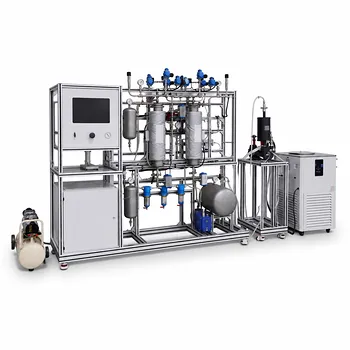
If you are treating a liquid waste stream containing dissolved ions, a membrane or ion-exchange pilot plant is logical. If that same stream contains suspended solids, a centrifuge or hydrocyclone is the correct choice. Attempting to use one to solve the problem of the other is a fundamental process design error that a well-architected pilot program must demonstrate clearly.
Making the Right Choice for Your Goal
Your selection must be a strategic match between the technology's operational envelope and your specific development focus. Here is how to align your choice with your primary objective:
- If your primary focus is training industrial operators: Prioritize a supercritical fluid pilot plant with a comprehensive, transparent safety interlock system. Its ability to visually demonstrate a phase diagram under pressure is an unparalleled pedagogical tool.
- If your primary focus is biopharmaceutical or food product development: Select a membrane or SFE pilot plant. These allow you to process high-value, heat-sensitive biomolecules without thermal or chemical degradation, preserving product integrity.
- If your primary focus is green chemistry and process intensification: Opt for a modern PLE or MAE unit over a conventional Soxhlet system. The direct demonstration of reduced solvent and energy footprints provides the critical data for sustainable life-cycle assessments.
- If your primary focus is broad environmental separations training: Build a suite that includes both membrane and physical separation units. This allows users to directly compare energy efficiency and selectivity when tackling mixed-phase waste streams, from dissolved ions to suspended solids.
The right pilot plant transforms abstract physical laws into controllable, observable business advantages; your task is to choose the instrument that reveals exactly what you need to see.
Summary Table:
| Technology | Core Mechanism | Key Challenge | Best Application |
|---|---|---|---|
| Supercritical Fluid Extraction (SFE) | Density tuning via temp/pressure | High-pressure safety & depressurization | Heat-sensitive extractions (e.g., EPA/DHA) |
| Membrane Separation | Ambient physical filtration | Fouling management & membrane lifespan | Bioprocessing & dairy without denaturation |
Advance Your Lab's Capabilities with LABPARK
Bridge the gap between theoretical chemistry and industrial practice. LABPARK designs and delivers high-performance Educational and Vocational Unit Operations Pilot Plants across chemical engineering, bioprocess & biotech, and environmental & water treatment.
Whether you are a university training the next generation of engineers, a research institute testing novel separations, or an enterprise scaling up production, our systems offer the safety, visibility, and scalability you need to succeed.
Contact our engineering experts today to find the perfect pilot plant solution for your facility!
Related Products
- Ultrafiltration Membrane Separation Educational Pilot Plant
- Multifunctional Membrane Separation Educational Pilot Plant with Ultrafiltration, Nanofiltration, Reverse Osmosis
- Multi-Functional Membrane Separation Educational Pilot Plant for Unit Operations Lab
- Photocatalytic Membrane Separation and Degradation Unit Operations Pilot Plant
- Hollow Fiber Ultrafiltration Membrane Separation Educational Pilot Plant
People Also Ask
- Pervaporation vs. Vapor Permeation: Handling Suspended Solids in Membrane Pilot Plants
- How do PEI, PVDF, and PSU membranes compare in pilot plants? Find the best fit.
- Isotropic vs. Anisotropic Membranes: How to Choose the Best Pilot Plant Modules
- Why Use a Membrane Separation Pilot Plant vs. Lab Testing? Avoid Costly Scale-Up Failures
- How do membrane pilot plants demonstrate synthetic vs biological membrane advantages?