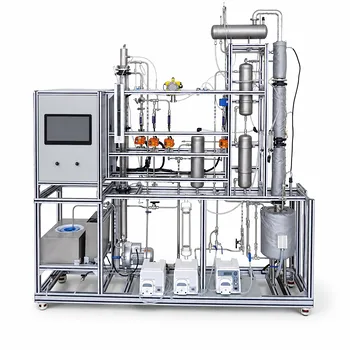
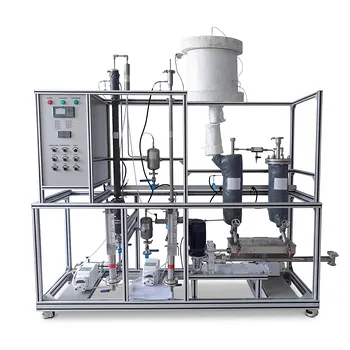
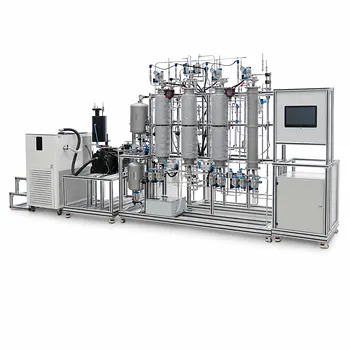
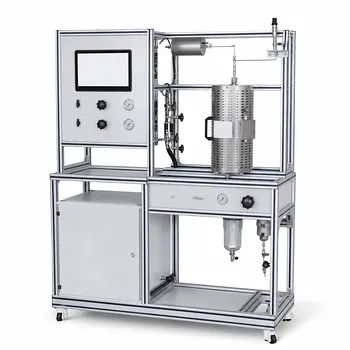
The core chemical reactions in coal gasification are the endothermic water-gas reaction (C + H₂O ⇌ CO + H₂) and the Boudouard reaction (CO₂ + C ⇌ 2CO). To manage the intense energy demands of these reactions, a gasification pilot plant must be designed as a precisely controlled thermal system. It must balance these heat-consuming reactions with the heat generated from exothermic combustion (C + O₂ → CO/CO₂) without letting the system spiral out of control. This is achieved through specialized reactor configurations, sophisticated feed systems, and multi-zone temperature management that together allow researchers to study and optimize the complex gas-solid thermodynamics at a manageable scale.
The central challenge of coal gasification is a thermal balancing act. A pilot plant must safely and precisely couple the rapid heat release of combustion with the slower, heat-hungry gasification reactions to produce a stable, high-quality syngas. Its design is not just about containing reactions, but about actively managing their competing thermodynamic forces.
The Chemistry: A Tale of Two Reaction Types
The transformation of solid coal into gaseous fuel is not a single reaction. It is a complex network where endothermic and exothermic reactions compete and depend on each other.
The Heat-Consuming Core: Endothermic Gasification
The desired product, syngas (a mixture of primarily CO and H₂), is formed by reactions that devour heat. These are the fundamental processes a pilot plant is built to study.
The primary reaction is the water-gas, or steam gasification, reaction. Solid carbon in the coal reacts directly with steam (H₂O) to produce carbon monoxide and hydrogen. This reaction absorbs a tremendous amount of energy (approximately 118-131 kJ/mol, depending on the source), making it highly endothermic.
The second key reaction is the Boudouard, or carbon dioxide gasification, reaction. Here, carbon dioxide reacts with hot carbon to produce carbon monoxide. This reaction is even more endothermic than the steam reaction (approximately 162-172 kJ/mol). It's a critical pathway for CO production, especially in environments with high CO₂ concentrations.
Without a continuous, intense heat source, these reactions will rapidly quench. The temperature will plummet, reaction kinetics will grind to a halt, and syngas production will stop.
The Heat-Generating Engine: Exothermic Combustion
The pilot plant must generate the massive heat load for gasification internally and controllably. This is the role of oxidation, or combustion.
Partial and full combustion of the coal itself provides the thermal driving force. By introducing a controlled, sub-stoichiometric amount of oxygen or air, a portion of the coal is burned. The formation of CO (ΔH ≈ -111 kJ/mol) and CO₂ (ΔH ≈ -394 kJ/mol) releases the energy required to heat the remaining coal, the steam, and to drive the endothermic gasification reactions.
This creates an autothermal process. The exothermic and endothermic reactions are thermally integrated within the same reactor vessel. The pilot plant’s design is fundamentally about managing this intimate and potentially unstable coupling. The net thermal output is a careful balance between the heat released by oxidation and the heat absorbed by gasification.
Designing a Pilot Plant for Thermodynamic Control
A pilot plant is a precision instrument. Its design features are the physical answers to the thermodynamic challenges. Every component is chosen to master the heat, flow, and material dynamics.
Mastering Heat: Thermal Management in the Reactor Zone
The reactor is a thermodynamic battlefield. The design must prevent heat loss and measure heat gain with extreme accuracy.
Robust thermal insulation is non-negotiable. Because the endothermic reactions demand such high temperatures (typically 800°C-1200°C+), any heat lost to the environment is a direct loss in process efficiency. High-performance insulation ensures that the heat from the oxidation zone is effectively transferred to the gasification zone, not the laboratory air. This is essential for stable autothermal operation.
High-temperature, multi-zone temperature monitoring is critical for control and research. A single thermocouple is useless. A pilot plant needs thermocouples positioned at multiple points along the reactor's height and radius. This creates a precise temperature profile. A researcher can directly observe the hot spot in the combustion zone, the temperature gradient in the gasification zone, and the effect of changing the oxygen-to-steam ratio on that profile. This data is the key to understanding reaction kinetics and thermal integration.
Controlling the Balance: Precision Feed and Flow Systems
The operator influences the thermodynamics through the feed inputs. The plant’s design must allow for their precise manipulation.
Alternating or dynamic feed systems for steam and oxygen/air are essential. The most fundamental control strategy is adjusting the ratio of these two gasifying agents. Increasing the oxygen feed rate accelerates combustion, raising the reactor temperature to drive the endothermic reactions faster. Increasing the steam feed rate boosts hydrogen production via the water-gas reaction but cools the bed. A pilot plant’s mass flow controllers and steam generators must be capable of rapid, repeatable changes in gas flow and ratio.
Configurable feed points allow for the study of staged gasification. Some designs introduce coal and oxygen together in one zone for rapid heating, followed by a downstream steam injection point. This separation allows a researcher to study the kinetics of the Boudouard reaction and the water-gas reaction in series, providing deeper insight into how carbon conversion efficiency and syngas composition are affected by isolated thermal events that are normally coupled together.
Shaping the Thermodynamic Environment: Reactor Configuration
The physical way solids and gases contact each other is a primary design feature that dictates the thermal and kinetic landscape of the reaction.
The choice between a fluidized bed, fixed (moving) bed, and entrained flow reactor defines the process. A fluidized bed offers excellent mixing and a uniform temperature profile, making thermal management simpler and preventing hotspots. A countercurrent fixed bed creates a sharp thermal gradient where gas is cooled by incoming coal, which is a highly efficient but more complex heat recovery scheme. An entrained flow reactor operates at very high temperatures with short residence times, favoring rapid conversion and high CO yields. A pilot plant must be flexible enough to simulate these different thermodynamic environments.
The allothermal vs. autothermal distinction is a fundamental design choice. In an autothermal design, the heat source (partial oxidation) is inside the reactor, as described, leading to CO/CO₂ dilution of the syngas. In an allothermal design, the reactor is heated externally, and the gasification reaction is driven purely by steam. This avoids product dilution with combustion gases, yielding a much higher H₂ and CH₄ content. A pilot plant capable of demonstrating both methods is invaluable for studying the direct trade-off between thermal efficiency and syngas purity.
Understanding the Trade-offs
No single pilot plant design or operational strategy is perfect. The art of gasification research involves navigating fundamental conflicts.
- Syngas Quality vs. Autothermal Simplicity: An autothermal process using air is simpler but produces a syngas diluted with nitrogen. Using pure oxygen solves this but at a significant cost and safety complexity. An allothermal process produces the purest syngas but requires a complex and expensive external heat source, making it less scalable for commercial applications. The pilot plant must help operators quantify this cost-quality trade-off.
- Kinetic Rate vs. Thermodynamic Equilibrium (The Shift Reaction Conflict): The water-gas shift reaction (CO + H₂O ⇌ CO₂ + H₂), a mild exothermic reaction, is central to adjusting the H₂/CO ratio. Thermodynamically, low temperatures favor higher H₂ and CO₂ yields. Kinetically, however, the reaction rate is far too slow at low temperatures. This forces the use of catalysts (like Fe-Cr for high-temperature shift at 300-530°C), where one must accept a higher residual CO concentration (3-4%) for a practical reaction rate. A pilot plant reactor with a dedicated shift stage must feature multi-zone temperature control to teach this specific optimization problem.
- Carbon Conversion vs. Thermal Stability: Pushing for 100% carbon conversion by injecting more oxygen creates an immense amount of heat. This can easily lead to ash melting (slagging) and a dangerous runaway reaction. The pilot plant control system must prioritize thermal stability, teaching students to find the maximum sustainable operating point rather than simply chasing theoretical conversion limits.
Making the Right Choice for Your Research Goal
The configuration of a gasification pilot plant should directly align with the educational or research objective. The design features must serve the specific learning outcome.
- If your primary focus is fundamental kinetics and heat integration: Choose a pilot plant with extensive, multi-zone temperature and pressure monitoring, capable of dynamic changes to steam, air, and oxygen feed ratios. An autothermal fluidized bed is excellent for demonstrating the direct coupling between oxidation and gasification reactions.
- If your primary focus is syngas composition optimization: Select a plant that can operate in both autothermal and allothermal modes. This allows for a direct, controlled comparison of how oxygen input (or its absence) shifts the product gas profile among H₂, CO, CH₄, and CO₂, teaching advanced energy and mass balances.
- If your primary focus is catalyst performance and downstream processing: Ensure the pilot plant has a post-gasification, multi-zone fixed-bed reactor stage for the water-gas shift reaction. This is the essential tool for studying the kinetic vs. thermodynamic trade-off in H₂ maximization and learning about industrial catalyst behavior.
Precise thermal control is the language of gasification, and a well-designed pilot plant is the ultimate translator, converting chemical thermodynamics into tangible, measurable knowledge.
Summary Table:
| Reaction Name | Chemical Equation | Thermodynamic Type | Key Role/Impact |
|---|---|---|---|
| Water-Gas Reaction | C + H₂O ⇌ CO + H₂ | Endothermic (absorbs heat) | Primary syngas generator; requires high heat input. |
| Boudouard Reaction | CO₂ + C ⇌ 2CO | Endothermic (absorbs heat) | Critical pathway for carbon monoxide production. |
| Combustion (Oxidation) | C + O₂ → CO/CO₂ | Exothermic (releases heat) | Serves as the internal thermal engine to drive gasification. |
| Water-Gas Shift | CO + H₂O ⇌ CO₂ + H₂ | Exothermic (mild) | Used to adjust and optimize the H₂/CO ratio in syngas. |
Scale Up Your Research with LABPARK Pilot Plants
Optimizing complex thermodynamic processes like coal gasification requires precise engineering and reliable equipment. LABPARK provides state-of-the-art Educational and Vocational Unit Operations Pilot Plants in chemical engineering, bioprocess & biotech, and environmental & water treatment designed specifically for universities, research institutes, and enterprises.
Whether you need advanced multi-zone thermal control, dynamic feed systems, or flexible reactor configurations, LABPARK delivers tailored solutions to match your research objectives.
Contact our engineering experts today to discover how we can enhance your laboratory's capabilities!
Related Products
- Fixed-Bed Chemical Reaction and Gas Dust Tar Removal Unit Operations Pilot Plant
- Dual-Mode Gas Absorption and Desorption Unit Operations Training Pilot Plant
- Micro-Scale Gas-Solid Catalytic Reaction Educational Pilot Plant
- Fixed Bed Gas Solid Catalytic Reaction Educational Pilot Plant
- Fluidized Bed Gas Solid Catalytic Reaction Educational Pilot Plant
People Also Ask
- When to transition from PID to adaptive control in pilot plants? Key process indicators.
- How do deviations in estimating latent heat impact pilot plant thermal systems? Avoid hardware mis-sizing.
- Why Compare Predicted and Experimental Excess Enthalpy? Key to Accurate Pilot Plant Scale-up
- Why Use PTFE & Hastelloy in Chemical Pilot Plants? Prevent Corrosion & Ensure Safety
- How to study gasification in pilot plants? Compare exit gas composition & efficiency