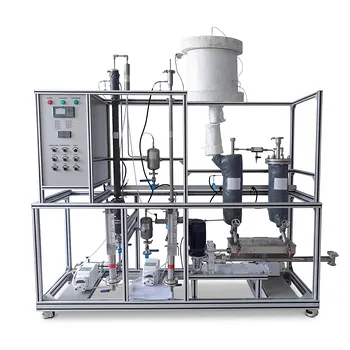
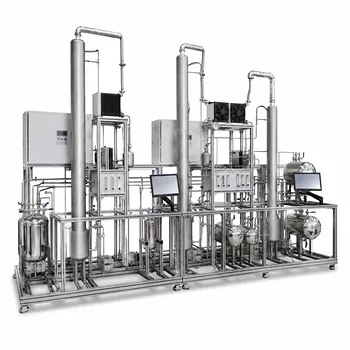
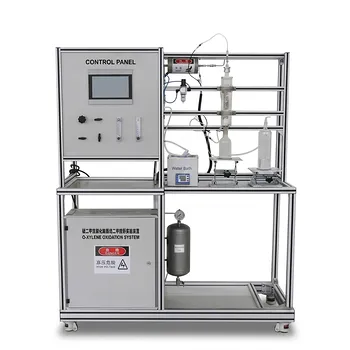
The key considerations boil down to seamlessly integrating electrolytic hydrogen with purified CO₂ and a high-performance catalyst in a single pilot-scale loop. When studying the co-synthesis of methanol from green H₂ and CO₂ in a unit operations pilot plant, the focus shifts from syngas ratio adjustment to the direct optimization of three interconnected domains: the purity and ratio of the gas feeds, the catalyst’s activity and selectivity, and the precise control of reaction temperature and pressure. This setup bypasses the traditional water-gas shift step, allowing you to isolate the catalytic hydrogenation of CO₂ and directly validate process viability under industrially relevant, carbon‑neutral conditions.
The traditional approach used the water-gas shift reaction to balance H₂/CO ratios, releasing fossil carbon in the process. A green methanol pilot plant changes the paradigm. The central challenge becomes feeding a stoichiometric mixture of green hydrogen and captured CO₂ to a catalyst that can achieve >95% selectivity at moderate pressures, while the entire unit operation chain—electrolysis, CO₂ purification, reaction, and separation—is evaluated as one cohesive, energy‑integrated system.
Deconstructing the Core Process Levers
Feedstock Purity and the H₂/CO₂ Ratio Must Be Engineered, Not Just Set
Green hydrogen from water electrolysis already arrives with high purity, but the CO₂ stream rarely does. The primary reference stresses that CO₂ purification is a critical step, as trace sulfur compounds, oxygen, or residual amines from capture can poison the methanol synthesis catalyst. You must therefore characterize the impurity profile of your CO₂ source and compare it against the catalyst’s poison tolerance limits. This is often where pilot plants excel—allowing you to insert extra guard beds or solvent wash steps and directly measure catalyst deactivation rates over hundreds of hours.
Stoichiometrically, methanol synthesis from CO₂ proceeds via CO₂ + 3H₂ ⇌ CH₃OH + H₂O. This demands a H₂:CO₂ molar ratio of 3:1. Yet the supplementary references highlight that pilot-scale gas mixing units let you deliberately perturb this ratio to study the effect of excess hydrogen (which improves kinetics but raises recycle rates) or CO₂-lean conditions (which push the reaction towards the reverse water-gas shift and CO formation). Real-time mass flow control and online gas chromatography thus become non-negotiable process considerations.
Catalyst Selectivity Defines the Product Spectrum and Purity Target
The primary reference gives a striking benchmark: catalyst selectivity can reach 98%, yielding methanol with 99.5% purity. In a pilot plant, this performance is never assumed—it is the variable you manipulate. You need to evaluate how the catalyst’s intrinsic selectivity for methanol versus byproducts (such as CO, dimethyl ether, or higher alcohols) responds to changes in space velocity, temperature, and the partial pressure of water produced in the reaction. A key hands-on benefit of pilot plants is the ability to run controlled experiments where you intentionally vary gas composition to map out selectivity contours, thereby identifying the catalyst’s stability window before scaling up.
Reaction Temperature and Pressure: Driving the Kinetics, Respecting the Equilibrium
The hydrogenation of CO₂ to methanol is an exothermic, volume‑reducing reaction. Thermodynamics favor methanol formation at high pressures and low temperatures, but kinetics require a minimum activation temperature. The primary reference explicitly names the optimization of reaction temperatures and pressures as a central consideration. In a pilot plant, you need tight control over the reactor’s axial temperature profile because hot spots will not only reduce local selectivity but can sinter the catalyst. Simultaneously, pressure drops across the bed must be monitored to ensure that the intended operating pressure (often 20–80 bar) is maintained throughout the catalyst zone, directly linking pump/compressor performance to chemical outcome.
Integrated Unit Operations: Absorption, Electrolysis, and Reactor as One System
The supplementary references expand the scope beyond the reactor. To truly study co-synthesis, your pilot plant must string together three core unit operations:
- An electrolysis stack for on-demand green hydrogen, where fluctuations in power load can cause H₂ flow variability.
- A CO₂ capture module (typically an amine-based absorption/desorption loop) that delivers a purified gas stream—and whose energy and solvent stability become part of your mass and energy balance calculations.
- The catalytic synthesis reactor itself, which acts as the system’s heart.
The key chemical process consideration here is feedback and integration: how does the purity of the regenerated CO₂ from the desorber affect catalyst longevity? How do heat recovery streams from the exothermic reactor offset the thermal energy demand of the desorber? The supplementary references stress evaluating heat integration, solvent degradation, and reactor yield under varying conditions, all of which a well-designed unit ops pilot plant can answer.
Understanding the Trade-offs
Purity vs. Energy Penalty in CO₂ Purification
A high-purity CO₂ stream protects the catalyst but demands a deeper regeneration step in the capture unit, increasing the thermal energy required for the desorber. In a pilot plant, you will directly observe this trade-off by measuring both the steam consumption of the desorber and the corresponding catalyst deactivation rate over time. If the energy penalty makes the overall process carbon-positive, alternative capture solvents or low-temperature purification methods become your next research targets.
Single-Pass Conversion vs. Recycle Load
Achieving high conversion per pass requires pushing the reaction to near-equilibrium, which often means moving to very high pressures or lower space velocities. However, operating at low space velocity limits throughput. The supplementary references emphasize that pilot plants let you study kinetics explicitly, so you can decide whether to target high single-pass conversion (minimizing downstream separation) or accept a lower conversion and implement a gas recycle loop. Each path affects compressor sizing, energy balance, and the accumulation of inert gases like nitrogen or methane that may slip in with the CO₂.
Catalyst Stability vs. Process Flexibility
A highly selective catalyst often has a narrow operating window in temperature and feed composition. The primary reference’s 98% selectivity achievement likely came at a specific, tightly controlled set of conditions. Pilot plant studies must probe how deviations—such as a temporary drop in H₂ purity from an intermittent renewable source—affect the catalyst’s structural stability and whether any deactivation is reversible. This reveals whether your process can handle real-world, dynamic green hydrogen supply.
Making the Right Choice for Your Pilot Plant Study
The ideal experimental conditions are dictated by the specific research or scale‑up question you are answering. Use the facility’s integrated unit operations to focus on the following:
- If your primary focus is catalyst screening and kinetic modeling: Prioritize a highly purified CO₂ feed and precise temperature control. Run systematic matrices of temperature, pressure, and H₂/CO₂ ratio while keeping the CO₂ capture loop at a constant, high-purity output to decouple catalyst effects from feed variability.
- If your primary focus is process integration and energy optimization: Deliberately vary the CO₂ capture regeneration depth to produce feeds of different purities and measure the cascade of effects on reactor performance, solvent stability, and net heat exchange. Map the complete mass and energy balance across electrolysis, capture, and synthesis.
- If your primary focus is dynamic operation with intermittent green hydrogen: Implement a buffer storage and blending system between the electrolyzer and the reactor. Study transient responses—catalyst temperature excursions, product quality drift—to verify that the control scheme can maintain the target H₂/CO₂ ratio and purge strategies during startup or load-following episodes.
Ultimately, a unit operations pilot plant for green methanol co-synthesis is not just a reactor on a bench; it is a miniature, interconnected chemical complex. By intentionally probing the interdependencies between feedstock preparation, catalytic chemistry, and downstream separation, you build the confidence needed to scale this carbon‑negative pathway from a laboratory curiosity to an industrial reality.
Summary Table:
| Key Consideration | Process Challenge | Control Strategy |
|---|---|---|
| Feedstock Purity & Ratio | Catalyst poisoning (sulfur/amines) & H₂:CO₂ ratio imbalance | Implement guard beds, real-time mass flow control, and online GC |
| Catalyst Selectivity | Byproduct formation (CO, DME) & deactivation | Optimize space velocity, temperature windows, and water partial pressure |
| Reaction Temp & Pressure | Exothermic hot spots & reactor pressure drops | Monitor axial temperature profiles and maintain 20–80 bar pressure |
| System Integration | Fluctuating H₂ feed & heat integration mismatches | Use buffer storage and integrate reactor heat with the CO₂ desorber |
Accelerate Your Green Engineering Research with LABPARK
Transitioning from laboratory chemistry to carbon-neutral industrial scaling requires robust, interconnected pilot-scale data. LABPARK provides state-of-the-art Educational and Vocational Unit Operations Pilot Plants in chemical engineering, bioprocess & biotech, and environmental & water treatment.
Designed specifically for universities, research institutes, and enterprises, our systems offer:
- Precise Process Control: Real-time monitoring of temperature, pressure, and gas ratios to ensure catalyst stability.
- Seamless Integration: Modular designs that connect electrolysis, gas purification, and catalytic reaction loops.
- Scalable Learning & Research: The ideal platform for kinetic modeling, solvent evaluation, and hands-on vocational training.
Ready to elevate your research capabilities? Contact LABPARK today to explore our custom pilot plant solutions!
Related Products
- Carbon Dioxide Hydrogen Methanol Synthesis Educational Unit Operations Pilot Plant
- Methanol Synthesis and Catalyst Performance Evaluation Educational Unit Operations Pilot Plant
- Carbon Dioxide Hydrogenation Methanol Synthesis Educational Unit Operations Pilot Plant
- Methane Cracking Educational Unit Operations Pilot Plant
- Steam Methane Reforming Hydrogen Production and Purification Educational Pilot Plant
People Also Ask
- How do temp & pressure affect methanol synthesis pilot plants? Optimize equilibrium and catalyst performance.
- Why is a purge system necessary when operating a gas recirculation loop in a methanol synthesis pilot plant? (Guide)
- Why do modern methanol pilot plants operate at lower pressures? Catalyst & Feed Requirements Explained
- What are the operational requirements for catalyst activation? Safe Methanol Pilot Plant Operation
- Why is the chemical plant startup schedule crucial? De-risk scale-up with pilot plants.