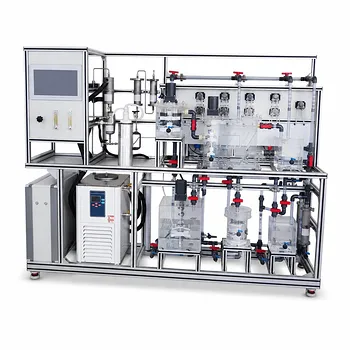
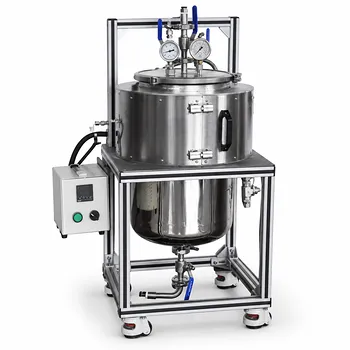
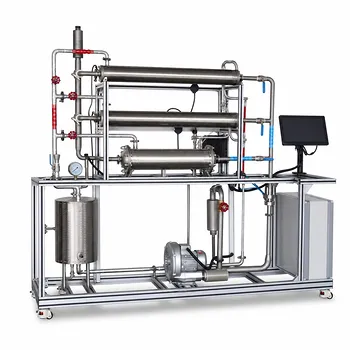
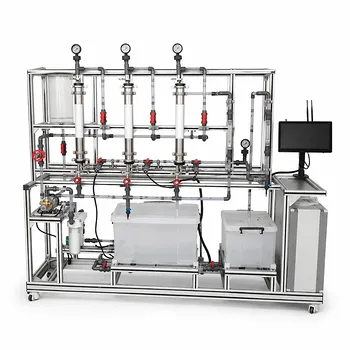
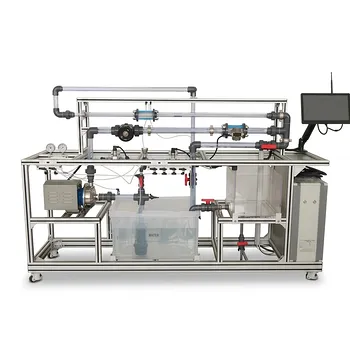
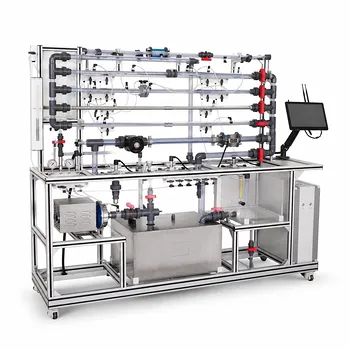
The definitive wet chemistry workflow for boiler scale analysis hinges on two classic precipitation and titration procedures. Magnesium is isolated as magnesium hydroxyquinolate via 8-hydroxyquinoline (oxine) for gravimetric determination, while calcium is precipitated as calcium oxalate and subsequently quantified through a redox titration with potassium permanganate.
Mastering these analytical procedures on a unit operations pilot plant transforms theoretical chemistry into industrial competence. It’s not just about learning the steps; it's about controlling the very parameters—pH, temperature, and residence time—that dictate purity and yield, directly mirroring real-world water treatment challenges.
A Deep Dive into the Core Chemical Procedures
The accurate determination of calcium and magnesium in boiler scale is foundational to industrial water management. These are not foolproof procedures; their success relies on meticulous technique and an understanding of potential interferences.
The Gravimetric Determination of Magnesium
The goal here is to selectively precipitate magnesium in a form that is pure, easily filterable, and of a known, stable composition upon drying.
- The Principle of Selective Precipitation: Magnesium is precipitated from a solution of dissolved boiler scale as magnesium hydroxyquinolate (
Mg(C9H6ON)2 · 2H2O). The reagent, 8-hydroxyquinoline (oxine), forms chelated metal complexes that are often insoluble, making it a versatile, though not perfectly selective, precipitant. - Why Gravimetric Analysis Matters: Once the yellow-green magnesium hydroxyquinolate precipitate is formed, it's filtered out, washed, and dried to a constant weight. This direct measurement of mass offers a high degree of accuracy that is independent of a standard solution, making it a definitive reference method.
The Volumetric Determination of Calcium
Quantifying calcium requires a different strategy, first isolating it and then capitalizing on its chemistry for a precise titration.
- The Classic Double Precipitation: Calcium is first precipitated as calcium oxalate (
CaC2O4 · H2O). Dissolving this precipitate in acid releases the oxalate ion in a quantity stoichiometrically equivalent to the original calcium. This step is critical because it amplifies the signal and separates calcium from other matrix components. - The Permanganate Redox Reaction: The liberated oxalic acid solution is then titrated with a standard solution of potassium permanganate (
KMnO4). The reaction is autocatalytic, and the distinct pink endpoint makes for a sharp visual transition, but temperature control is vital to prevent side reactions.
Navigating the Pitfalls of the Analysis
These sequential precipitations are powerful, but they are also prone to predictable errors that can completely invalidate the results if overlooked.
- The Problem of Co-precipitation: The most significant source of error is co-precipitation. During the initial calcium oxalate precipitation, magnesium oxalate can contaminate the calcium precipitate, leading to a falsely high calcium value and a falsely low magnesium result. Managing solution pH and precipitation rate is key to minimizing this.
- The Challenge of Iron Interference: Iron is a common component in boiler scale and a notorious interfering substance. It can co-precipitate with both magnesium and calcium and will also react with the permanganate titrant. It must be removed or masked before the analysis begins for the results to be meaningful.
How Pilot Plants Forge Competence Beyond the Bench
Knowing the procedure in a pristine lab is one thing; executing it in a dynamic, scaled-down industrial environment is the bridge to true mastery. Unit operations pilot plants dismantle the illusion that a chemical reaction exists in isolation.
Connecting Analytical Chemistry to Industrial Scale-Up
The primary reference correctly positions the pilot plant as the essential link between bench-top chemistry and industrial processes. The analytical procedures are the diagnostic tools that prove whether that link is understood.
- From Glassware to Reactors: In a lab beaker, mixing is perfect and heat transfer is instantaneous. In a pilot-scale mixing reactor, a student discovers the reality of dead zones, temperature gradients, and blending times. To successfully precipitate magnesium oxinate in a 50-liter stirred tank, they must directly apply Reynolds numbers and residence time distribution theory, or risk a product that is slime instead of easily filterable crystals.
- Controlling the Critical Process Parameters: The analytical result is a direct report card on process control. A low yield in the calcium oxalate precipitation didn't happen by accident. It forces the student to investigate: was the pH control loop too slow? Did a local hot spot during digestion cause the precipitate to partially re-dissolve? The pilot plant makes these parameter-impurity relationships tangible.
Mastering Separation and Purification Techniques
The unit operations in the supplementary references—filtration, membrane separation, and crystallization—are not afterthoughts to the chemistry. They are the procedure at scale.
- From Sintered Glass to Filter Presses: The gravimetric magnesium determination depends entirely on quantitative filtration. A pilot-scale filter press or a cross-flow filtration unit turns this single lab step into a fluid dynamics problem. Students must optimize pressure differentials and filter media selection, directly applying principles of mass and momentum transfer to ensure their analytical sample is truly representative of the entire batch.
- Integrating Real-Time Analytical Technology (PAT): The modern industrial shift, as noted in the supplementary references, is towards PAT. A pilot plant equipped with turbidity sensors can track the magnesium hydroxide flocculation in real-time. This teaches the student that the "end" of the precipitation isn't just a set time, but a physical state, automating the decision-making that a chemist does visually on the bench.
Validating the Theory with Physical Phenomena
The value of the pilot plant is that it confronts students with non-idealities that are absent from simulation software but dominate real-world outcomes.
- Observing Transport Phenomena: The supplementary references highlight the importance of heat, mass, and momentum transfer. A student running a pilot-scale crystallizer to purify boiler water treatment chemicals will observe how impeller speed affects crystal size distribution and purity—directly impacting the efficacy of a future scale inhibitor. The analytical procedure for hardness is what quantifies this.
- Understanding Process Control Strategies: The goal isn't just to run a batch; it's to produce consistent quality. By programming a control loop to dose the oxine precipitant based on a pH setpoint, a student directly confronts the difference between simple feedback control and more advanced cascade or feed-forward strategies, learning how a control decision made an hour ago dictates the final purity of the magnesium oxinate cake.
Understanding the Trade-offs and Practical Limitations
Achieving an accurate analytical result from a pilot-scale run is a balancing act of priorities. There is no perfect, universal solution.
- Purity vs. Throughput: In the gravimetric magnesium determination, washing the precipitate more thoroughly improves purity but increases the risk of peptization (the precipitate turning colloidal and passing through the filter), leading to mass loss. Students must empirically find the wash water volume that balances acceptable purity with acceptable yield.
- Energy Cost vs. Separation Efficiency: As the supplementary references suggest, separating close-boiling mixtures by distillation alone is energy-intensive. A student tasked with purifying a process stream might discover that a hybrid approach—using a chemical reaction step to remove a persistent contaminant before a pilot-scale distillation—is more economically sound than adding ten theoretical plates to a column. The analytical lab confirms contaminant levels, providing the economic justification for the integrated process design.
- The Model-Reality Gap in Validation: Pilot plants are used to validate models. The core learning is when the model fails. An MMSP simulation might predict a 99.5% recovery in a liquid-liquid extraction column. The pilot plant yields 95%. The student’s investigation into this gap—discovering an unforeseen flow maldistribution or a surfactant effect from a trace impurity—is the most profound learning moment, one that builds the instinct for troubleshooting under uncertainty.
Making the Right Choice for Your Educational Goal
The pilot plant scope should match the specific educational outcome. The analytical procedures for calcium and magnesium provide the quantitative lens for evaluating success.
After defining the learning objectives, apply these recommendations:
- If your primary focus is mastering fundamental analytical chemistry: Ensure the pilot plant includes a well-equipped quality control station. The emphasis should be on performing the classic calcium permanganate titration and magnesium oxinate precipitation on process samples, directly correlating operational errors with compromised analytical results.
- If your primary focus is industrial process design and scale-up: Select a pilot plant configurable with different filtration and reactor technologies. The learning goal is to design the post-precipitation processing sequence that delivers the required purity for the magnesium oxinate cake at scale, making the analytical result a true release criterion.
- If your primary focus is modern process automation and PAT: Prioritize a pilot plant with inline sensors, programmable logic controllers (PLCs), and data historians. Use the calcium and magnesium analysis as the reference method to build and validate a chemometric model that predicts hardness in real-time from spectroscopic or turbidity data.
- If your primary focus is bridging theory and economic reality: Choose an integrated pilot plant that combines a chemical reaction step with a physical separation unit. The goal is for students to discover the economic trade-offs—using chemical precipitation to cheaply remove the bulk hardness before a polishing ion-exchange step—and justify their decisions with the analytical data they generate.
By consistently referencing these classical analytical procedures, the pilot plant ceases to be just a collection of steel and sensors; it becomes a proving ground for the chemical engineer's ability to diagnose, execute, and optimize.
Summary Table:
| Target Analyte | Analytical Method | Key Reagents | Pilot Plant Unit Operations & Focus |
|---|---|---|---|
| Calcium ($Ca^{2+}$) | Volumetric (Redox Titration) | Calcium oxalate, Potassium permanganate ($KMnO_4$) | Reactor temperature control, pH adjustment, mass transfer |
| Magnesium ($Mg^{2+}$) | Gravimetric Determination | 8-hydroxyquinoline (oxine) | Filtration, crystallization, PAT (turbidity sensors), cake washing |
Bridge the Gap Between Chemistry Theory and Industrial Scale-Up
Transform textbook knowledge into practical engineering competence with LABPARK. We design and manufacture advanced Educational and Vocational Unit Operations Pilot Plants tailored for chemical engineering, bioprocess & biotech, and environmental & water treatment.
Specially built for universities, research institutes, and enterprises, our pilot plants allow students and researchers to master crucial separation, purification, and process control techniques in a safe, scaled environment.
Ready to elevate your training and research capabilities? Contact LABPARK today to discuss your laboratory requirements!
Related Products
- Continuous Sieve-Plate Distillation Pilot Plant for Unit Operations Laboratory Education
- Steam Methane Reforming Hydrogen Production and Purification Educational Pilot Plant
- Methanol Synthesis and Catalyst Performance Evaluation Educational Unit Operations Pilot Plant
- Supercritical High-Gravity Flash Evaporation Educational Unit Operations Pilot Plant
- Liquid-Liquid Mass Transfer Coefficient Determination Educational Pilot Plant
People Also Ask
- Why is vacuum operation capability an essential feature for a distillation unit operations pilot plant? Unlock Efficiency
- How to select the right activity coefficient model (Wilson, NRTL, UNIQUAC) for distillation pilot plants?
- How does catalyst water concentration affect distillation pilot plant design? Key separation train choices.
- What are the primary reflux ratio control strategies? Master Distillation Unit Operations
- How can real-time carbon number prediction improve distillation pilot plants? Optimize control.