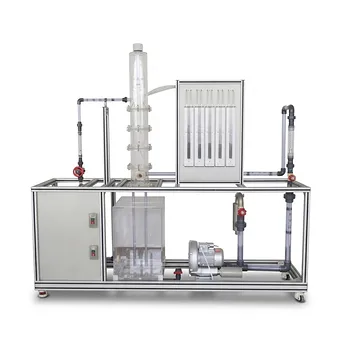
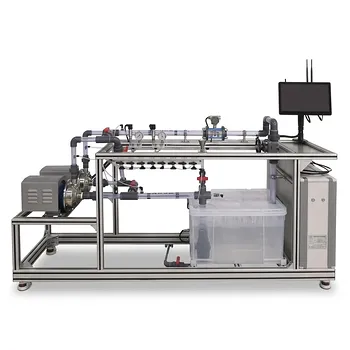
Tall stirred pilot plants with multiple impellers deliver superior gas utilization, higher interfacial area, narrower residence time distribution, and greater heat transfer area per volume—all while protecting shear-sensitive cells through reduced agitation speed. These hydrodynamic features make them uniquely valuable for bioprocess and biotech training, enabling students to observe and measure fundamental phenomena that directly translate to industrial scale‑up.
The real teaching power of a multi‑impeller tall tank lies not just in its ability to run a fermentation, but in how clearly it reveals the interplay of mixing, mass transfer, and shear. It turns abstract concepts—like kLa and blending time—into visible, measurable events, giving trainees an intuitive grasp of bioreactor behavior.
The Hydrodynamic Edge: How Multi-Impeller Tall Tanks Improve Mixing and Dispersion
A single, short vessel with one impeller can mix and sparge, but it hides the complexities that dominate real‑world bioreactors. Tall, multi‑impeller configurations bring those complexities to the surface in a controlled, repeatable way.
Enhanced Gas Utilization and Interfacial Area
Multiple impellers divide the liquid column into axially staged zones, re-dispersing gas bubbles as they rise.
This repeated dispersion dramatically increases the gas‑liquid interfacial area (a) compared to a single‑impeller system at the same total power input. Higher interfacial area boosts oxygen transfer rate (OTR), a parameter that students can directly calculate from dissolved oxygen and off‑gas measurements.
Because gas is consumed more effectively, overall gas utilization improves, reducing sparge rates needed to sustain a given dissolved oxygen setpoint. That alone is a compelling lesson in process efficiency.
Narrower Residence Time Distribution
A tall multi‑impeller vessel approximates a cascade of mixed zones, not a single ideally mixed pot.
This segmented flow yields a narrower residence time distribution (RTD)—the liquid moves more like a plug flow with limited back‑mixing while still maintaining good local mixing. For training, a tighter RTD means that nutrient and product concentration profiles change predictably along the height, allowing students to sample at different ports and see the gradient firsthand.
Understanding RTD is crucial when teaching continuous culture or fed‑batch strategies, and a tall pilot plant makes that concept concrete rather than mathematical.
Increased Heat Transfer Capability
Metabolic heat removal is a classic scale‑up bottleneck. A tall vessel naturally provides a higher jacket heat transfer area per unit volume than a squat tank.
With multiple impellers promoting radial mixing near the wall, the overall heat transfer coefficient is maintained across the entire jacket surface. Trainees can perform energy balances, measure temperature gradients, and see how cooling capacity directly impacts maximum achievable cell density—all without needing an over‑sized vessel.
Protecting Shear-Sensitive Cultures Through Gentle, Efficient Mixing
Biotech processes often involve mammalian cells, filamentous fungi, or plant cells that cannot withstand intense shear. The multi‑impeller tall tank is an excellent platform for teaching shear management.
Lower Impeller Speeds for Equivalent Gas Dispersion
To achieve full gas dispersion—where bubbles are broken and distributed throughout the liquid—a single‑impeller vessel must be spun at high tip speeds.
In contrast, a multi‑impeller configuration distributes the power input across several impellers, each operating at a lower rotational speed. The result is equivalent gas dispersion at significantly lower average shear rates, a concept that is easily demonstrated by running the pilot plant at different impeller numbers and measuring bubble size distributions offline.
This directly shows trainees why commercial cell‑culture bioreactors use multiple low‑shear impellers rather than a single high‑shear Rushton turbine.
Real-World Training: Visualizing Shear Profiles and Dead Zones
With transparent pilot‑scale columns, students can inject dye or tracer particles and watch how the flow patterns change between one, two, or three impellers.
They can identify stagnant zones where mixing fails, compare shear‑stress estimates from torque measurements, and correlate these with cell viability assays. Such hands‑on observation cements an intuitive understanding that CFD simulations alone cannot provide.
Power Consumption and Scale-Up Insights in Multi-Impeller Systems
One of the most counter‑intuitive lessons a trainee learns is that adding a second impeller does not simply double the power draw. The tall pilot plant becomes a laboratory for power‑number experiments.
Non-Linear Power Draw: The Interaction Effect
Fluid dynamic interference between closely spaced impellers reduces the total power demand. Practical data show:
- At spacing ratios ((S/d)) around 1.5 to 2, two impellers draw only 1.4 to 1.5 times the power of a single impeller.
- Three impellers grouped similarly draw roughly (2 \times P), not (3 \times P).
- A general estimation for (m) impellers is (P_m = P[1 + 0.6(m - 1)]).
Students can measure motor torque, validate this relationship, and discover how geometric factors (clearance, diameter, spacing) influence power input. This builds the engineering judgment needed to predict full‑scale motor sizing, a task that often surprises newcomers to bioprocess design.
Using Pilot Data to Predict Full-Scale Behavior
By varying impeller spacing and number, trainees can mimic the axial staging found in industrial deep‑tank fermenters (often 20‑40 meters tall). They can generate their own scale‑down/scale‑up correlations for mixing time, gas hold‑up, and mass transfer coefficient kLa, then compare them with published correlations.
Such exercises demystify the notion that “scale‑up is a black art” and replace it with a structured methodology rooted in measurable hydrodynamics.
Understanding the Trade-Offs
No equipment configuration is perfect, and an honest training platform must also teach the limitations.
A tall multi‑impeller pilot plant involves higher capital cost, more complex cleaning‑in‑place (CIP) and sterilization procedures, and the possibility of axial dissolved oxygen or pH gradients if impeller zoning is too strong. In some high‑viscosity fermentations, mixing time in the top‑bottom direction can still be long despite multiple impellers.
These challenges are valuable teaching moments. Trainees learn how to detect and mitigate zone isolation, how to design impeller combinations (e.g., axial‑flow + radial‑flow) that balance shear and circulation, and why vessel aspect ratio is a design variable, not a given.
How These Advantages Translate to Effective Biotech Training
The true value of a tall multi‑impeller pilot plant emerges when it is used as a curriculum tool, not just a production mimic.
Building Intuition for Gas‑Liquid Mass Transfer (kLa)
Trainees can manipulate sparge rate, agitator speed (in steps with multiple impeller combinations), and media properties. They measure kLa using the dynamic gassing‑out method and see directly how interfacial area and turbulence affect oxygen delivery. The data sets they generate form the basis for mass transfer correlations they will use throughout their careers.
Exploring Mixing Time and Homogeneity
Conducting acid‑base tracer runs with pH probes at multiple heights reveals mixing time (t₉₅) and highlights dead zones. Students learn the impact of adding or removing an impeller, changing the direction of pumping, or altering baffle configuration—exactly the kind of troubleshooting skills required in process development.
Studying the Impact of Shear on Cell Viability
Running parallel experiments with a single high‑speed impeller versus multiple lower‑speed impellers, while keeping kLa constant, lets students isolate shear as an independent variable. They can then correlate viability and productivity with a measurable shear index (e.g., Energy Dissipation Rate per cell).
This kind of investigation turns textbook warnings about “shear sensitivity” into data‑driven conclusions.
Bridging Batch to Continuous Processing Concepts
The narrower residence time distribution and axial staging of a tall tank make it an excellent platform for introducing continuous culture (chemostat) and perfusion modes. Students can observe how changing dilution rate affects concentration profiles along the column, a lesson that directly connects to the advantages of continuous processing—enhanced safety, stable product quality, and reduced downtime—often cited as key drivers in modern biomanufacturing.
Making the Right Choice for Your Training Goals
A tall stirred pilot plant with multiple impellers is not a one‑size‑fits‑all solution, but its educational strengths are unmatched when you align the equipment with your learning objectives.
- If your primary focus is teaching gas‑liquid mass transfer fundamentals: Use the multi‑impeller tall tank to run systematic kLa experiments at varying gas flow rates and agitation speeds, demonstrating how interfacial area and turbulence each contribute to oxygen transfer.
- If your primary focus is shear management in cell culture: Leverage the ability to achieve equivalent gas dispersion at lower tip speeds, and design direct comparison studies that connect impeller configuration to cell viability and productivity.
- If your primary focus is scale‑up and power consumption: Treat the pilot plant as a modular test bed where impeller count, spacing, and geometry can be changed to build power‑number relationships that predict full‑scale motor sizing.
- If your primary focus is bridging batch to continuous operations: Use the vessel’s narrow residence time distribution and multiple sampling ports to teach steady‑state concentration profiles, nutrient gradients, and perfusion‑mode benefits.
When you root biotech training in the tangible hydrodynamics of a tall multi‑impeller system, you give students a lasting framework for tackling the real variability and scale‑up challenges they will face in industry.
Summary Table:
| Feature / Parameter | Multi-Impeller Tall Tank Advantage | Educational & Training Value |
|---|---|---|
| Gas Utilization & OTR | Repeated dispersion boosts interfacial area and OTR | Hands-on measurement of $k_L a$ and oxygen transfer |
| Residence Time (RTD) | Narrower RTD (plug-flow approximation) | Visualizing concentration profiles and gradients |
| Shear Management | Equivalent dispersion at lower impeller speeds | Safe cultivation of shear-sensitive cells |
| Power & Scale-up | Non-linear power draw & simulated axial staging | Validating scale-up/scale-down correlations |
Elevate Your Bioprocess Training with LABPARK
Ready to bring industrial-scale bioprocess concepts into your laboratory? LABPARK provides state-of-the-art Educational and Vocational Unit Operations Pilot Plants in chemical engineering, bioprocess & biotech, and environmental & water treatment.
We help universities, research institutes, and enterprises bridge the gap between theory and practice by offering customizable, high-performance pilot plants designed for hands-on learning.
- Enhance Student Learning: Provide an intuitive, visual understanding of fluid dynamics, mass transfer, and scale-up.
- Industry-Ready Training: Prepare students and operators with equipment that closely mimics commercial-scale bioreactors.
- Reliable Support & Customization: Benefit from expert engineering guidance tailored to your curriculum needs.
Contact LABPARK today to discuss how our bioprocess pilot plants can transform your training program!
Related Products
- Multi-Stage Stirred Tanks in Series Residence Time Distribution and Mixing Performance Determination Educational Pilot Plant
- Multi-Reactor Educational Pilot Plant for Reaction Engineering Unit Operations
- Multi Functional Catalytic Reaction and Reactor Evaluation Educational Unit Operations Pilot Plant
- Multi Pump Fluid Transport Process Piping Unit Operations Training Pilot Plant
- High-Gravity Emulsification and Mass Transfer Educational Pilot Plant
People Also Ask
- How does MRF model impeller rotation in CFD? Key Boundary Conditions Explained
- How can a CSTR pilot plant demonstrate reactor staging? Visualize volume savings.
- How does steady-state multiplicity affect the operation and safety of exothermic reactions within a CSTR pilot plant? - Guide
- What parameters to monitor transitioning from Batch to CSTR? Master Pilot Plant Setup
- Why is temperature regulation via a cooling jacket a critical feature in CSTR pilot plants used for laboratory training?