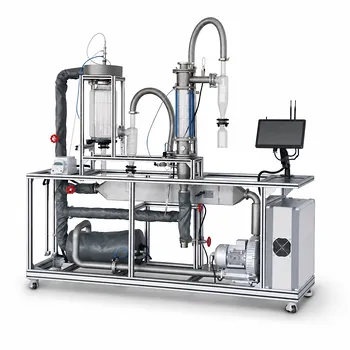
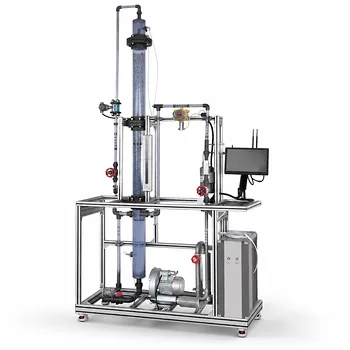
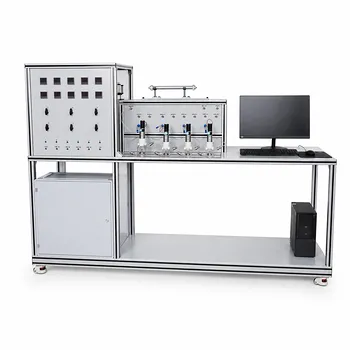
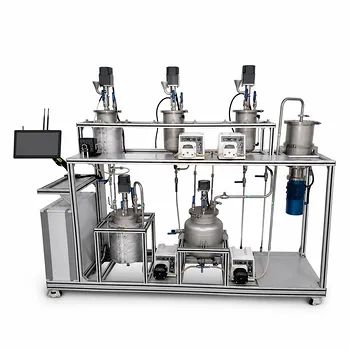
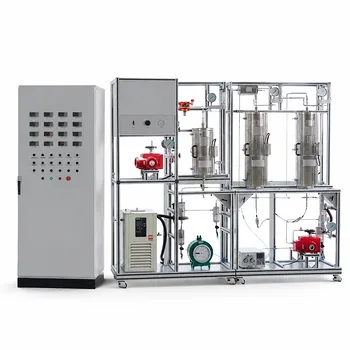
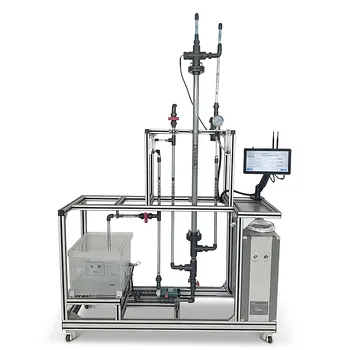
When you want to move beyond textbook theory and truly internalize how solid fuels convert into syngas, nothing replaces a fluidized bed reactor pilot plant. For educators and researchers, this platform transforms abstract thermodynamic equations and reactor design principles into tangible, observable phenomena. It directly reveals how manipulating variables like the steam-to-oxygen ratio or operating pressure controls the final synthesis gas composition and overall process efficiency.
While the surface benefit of a gasification pilot plant is teaching unit operations, its deeper educational value lies in validating complex hydrodynamic and thermodynamic models against reality. It is the ultimate tool for bridging the gap between idealized chemical equations and the chaotic, heat-and-mass-transfer-limited reality of industrial gasification.
How a Pilot Plant De-Risks Process Understanding
A gasifier is more than a chemical reaction; it is a delicate balance of fluid dynamics, heat transfer, and stoichiometry. A pilot plant uniquely isolates these variables for study.
The Foundation: Visualizing Fluidization Dynamics
Traditional fixed-bed textbooks cannot easily demonstrate the "boiling liquid" behavior of solids. In a pilot-scale Winkler-type gasifier, the fluidization process becomes instantly visible and measurable.
You can physically observe how pulverized coal or biomass transitions from a fixed bed to a bubbling fluidized state. By precisely tracking the pressure drop across the bed against increasing gas velocity, researchers can experimentally determine the minimum fluidization velocity (( u_{mf} )), directly linking the drag force equation to a physical measurement. This bridges the gap between the Ergun equation and reality.
Mapping the Temperature Profile
Gasification reactions are fiercely endothermic and exothermic simultaneously. A pilot plant equipped with strategically placed thermocouples demonstrates why the fluidized bed is chosen for its thermal stability.
Researchers can study non-slagging operation modes up close. You learn how internal heat exchangers maintain near-isothermal conditions, a critical lesson in preventing ash melting. By measuring temperature uniformity throughout the bed, you prove why this reactor type avoids the "hot spots" that destroy catalyst activity and disrupt thermodynamics.
Decoding the Syngas Blueprint
The core purpose of gasification research is to engineer a specific synthesis gas. A pilot plant reveals exactly how the input levers control the output.
The Steam-to-Oxygen Ratio Trade-off
This is where theoretical chemistry meets harsh economic reality. The plant allows for a systematic manipulation of the steam and oxygen feeds to reveal a critical performance curve.
By increasing the steam-to-oxygen molar ratio, you immediately witness a shift in syngas quality, moving from a CO-rich gas to a H₂-rich gas. However, the pilot plant’s energy balance system provides the critical counterpoint: thermal efficiency drops significantly as more energy is diverted to generating excess steam. This single experiment teaches the irreplaceable lesson that optimal chemistry often clashes with optimal engineering efficiency.
The Thermodynamics of Applied Pressure
Moving from ambient to pressurized operation in the pilot plant unlocks the next level of gasification science. This setup demonstrates unique thermodynamic advantages that cannot be replicated in a simple CSTR simulator.
Researchers can validate how elevated pressure directly shifts chemical equilibrium to favor direct methane formation, a critical pathway for Synthetic Natural Gas (SNG) production. Furthermore, by producing syngas already at high pressure, the plant illustrates the massive energy savings achieved by avoiding downstream compression for methanol or ammonia synthesis. It turns the abstract concept of "oxygen heat load" reduction into a measurable kilowatt saving.
Understanding the Trade-offs
No definitive technical guide is complete without acknowledging the intrinsic weaknesses of the technology. A pilot plant does not just showcase strengths; it is a controlled environment to study and mitigate catastrophic failure modes.
- Catalyst Attrition and Elutriation: While the fluidized state is excellent for mass transfer, it causes relentless particle friction. The plant reveals how expensive catalysts literally grind down into fines and are carried out of the reactor. This is particularly critical when researching processes involving noble metals, where replacement costs can determine a project’s viability.
- Gas Bypassing and Backmixing: Unlike the plug flow ideal, a pilot plant exposes the messy reality of bubbling beds. Students witness how fast-moving bubbles breach the bed, bypassing the solids entirely and slashing conversion rates. They also measure the extent of gas backmixing, learning why a fluidized bed often deviates from ideal reactor performance.
- Operational Instabilities: Beyond the textbook models, the pilot plant reveals problematic regimes like slugging and channeling. This forces researchers to troubleshoot particle size distributions and gas distributor designs to prevent catastrophic bed collapse or inefficient contact patterns.
Making the Right Choice for Your Goal
The decision to invest time in a pilot-scale fluidized bed study depends entirely on your research or educational objective. The value derived is directly proportional to your need to observe the "unmodelable."
- If your primary focus is validating a kinetic reactor model: Use the pilot plant to isolate particle-scale dynamics. Focus on measuring pore diffusion, ash layer diffusion, and the progression of the reaction front to validate the shrinking core or grain model against real-time gas composition data.
- If your primary focus is process economics and syngas optimization: The pilot plant is your mandatory proving ground. Use it to chart the definitive energy penalty of high steam ratios and to identify the exact pressure level that maximizes your desirable product yield while minimizing downstream compression costs.
- If your primary focus is catalyst longevity research: A bench-scale fixed bed will not suffice. The fluidized pilot plant is essential to quantify the mechanical resilience of your support material and to develop separation systems (like cyclones) capable of capturing elutriated fines for a continuous circulation loop.
Ultimately, the fluidized bed pilot plant transforms gasification from a black-box mystery into a system of decipherable physical rules, giving you the confidence to design, scale-up, and troubleshoot processes grounded not just in math, but in material reality.
Summary Table:
| Key Focus Area | What the Pilot Plant Validates | Critical Trade-off / Challenge Addressed |
|---|---|---|
| Fluidization Dynamics | Minimum fluidization velocity ($u_{mf}$) & Ergun equation | Channeling, slugging, and bed instability |
| Thermal Stability | Isothermal operation and prevention of ash melting | Catalyst deactivation from localized hot spots |
| Syngas Composition | Steam-to-oxygen ratio & pressure effects on yield | Thermal efficiency drop vs. H₂ generation optimization |
| Catalyst Performance | Mechanical resilience & cyclone separation efficiency | Particle attrition, gas bypassing, and elutriation |
Bring Industrial Reality to Your Lab with LABPARK
Bridging the gap between textbook theory and physical reality requires robust, high-performance equipment. LABPARK provides premium Educational and Vocational Unit Operations Pilot Plants in chemical engineering, bioprocess & biotech, and environmental & water treatment.
Tailored for universities, research institutes, and enterprises, our pilot plants empower your students and researchers to validate thermodynamic models, optimize gasification processes, and gain hands-on operational experience.
Ready to elevate your research and engineering training? Contact LABPARK today to discover the perfect pilot plant solution for your lab!
Related Products
- Fluidized Bed Gas Solid Catalytic Reaction Educational Pilot Plant
- Two-Dimensional Fluidization Hydrodynamics Educational Pilot Plant for Unit Operations Training
- Multi-Reactor Educational Pilot Plant for Reaction Engineering Unit Operations
- Fixed-Bed Chemical Reaction and Gas Dust Tar Removal Unit Operations Pilot Plant
- Fixed Bed Gas Solid Catalytic Reaction Educational Pilot Plant
People Also Ask
- Why is the bed height-to-diameter ratio (L/dt) critical? Fluidized bed pilot plant selection guide.
- How is the minimum fluidization velocity (U_mf) determined and utilized? A Unit Operations Guide
- How does the Mears criterion evaluate transport resistance? Key Guide to Intrinsic Kinetics
- How do reactor pilot plants safely study gas-solid reactions? Master kinetics with thermal & flow control.
- How do pilot plants demonstrate fluidized-bed reactor advantages over fixed-bed? Find Out Now