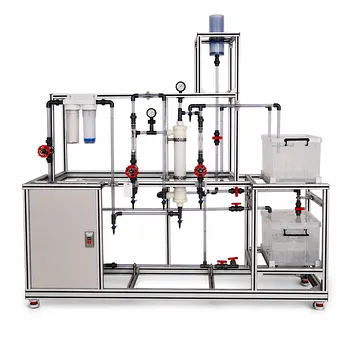
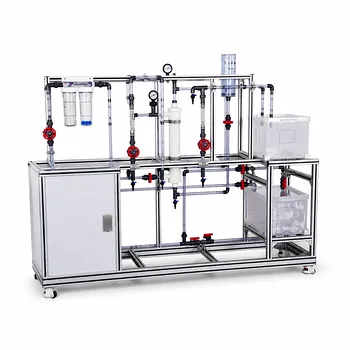
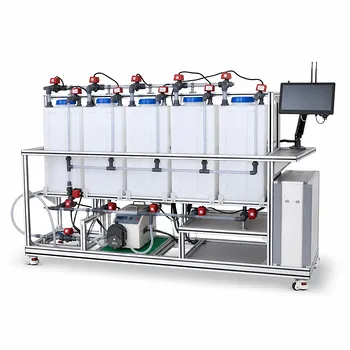
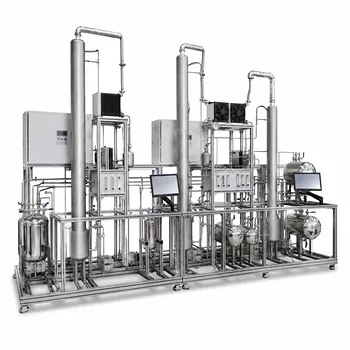
The primary, practical advantage is protection and precision. Integrating Ultrafiltration (UF) as a pre-treatment stage physically shields the more sensitive and expensive downstream Nanofiltration (NF) or Reverse Osmosis (RO) membranes from rapid fouling by suspended solids, colloids, and bacteria. This sequential barrier approach allows a pilot plant to achieve the high-efficiency removal of dissolved contaminants like divalent ions and organic compounds that UF alone cannot accomplish, while also enabling researchers to independently optimize cleaning cycles and energy consumption for each stage.
The core value of a UF-NF/RO hybrid pilot plant is not just about hitting a water quality target; it’s about creating a resilient, observable system. By separating the physical removal of particulates (the "what" UF does) from the molecular separation of dissolved substances (the "why" NF/RO are used), operators gain the empirical data needed to model full-scale feasibility, control irreversible fouling, and balance the trade-off between product purity and energy expenditure.
Deconstructing the Step-Wise Protection Mechanism
The single most common failure point in membrane systems is not the membrane itself tearing, but its surface becoming blocked. This is why integration is fundamental to operational viability. In a pilot setting, you are not just filtering water; you are testing the limits of a physical barrier system.
The Physical Gatekeeper: How UF Shields NF/RO
Ultrafiltration operates with asymmetric membranes featuring a pore size between 1 and 20 nm. This creates a physical sieve that effectively captures macromolecules (with a molecular weight >500 Da), colloidal particles, and bacteria. By placing this barrier first, you are mechanically preventing a viscous cake layer from forming on the NF/RO surface.
Without UF pre-treatment, the tight, dense polymeric structure of an RO membrane (pore size ~0.1–1 nm) would act as a depth filter, trapping larger particles within its matrix. This leads to irreversible pore plugging that chemical cleaning cannot easily restore. The UF stage absorbs this particulate load, ensuring the downstream NF/RO membrane only interacts with the dissolved solids it was designed to reject.
Defining the Separation Boundaries
The integration clarifies the scientific distinction between the stages. UF targets turbidity and pathogens, but cannot reject dissolved salts.
- The UF Stage: Removes suspended solids, viruses, and large organic colloids under a moderate driving pressure of 0.1 to 0.5 MPa.
- The NF/RO Stage: Handles the molecular separation. NF selectively rejects divalent ions (like calcium and magnesium) and organic compounds in the 200–1000 Da range. RO goes further, utilizing high pressure (2–10 MPa) to reject essentially all dissolved solids, including monovalent salts and heavy metals.
This division of labor means you are not wasting the hydraulic pressure of the RO pump on solids that could have been removed with a low-pressure pump upstream.
Research and Educational Optimization in Unit Operations
Pilot plants are designed for observation and data harvesting. A hybrid array transforms the unit from a simple demonstration into a versatile research tool for optimizing separation efficiency and energy consumption.
Mapping Fouling and Flux in Real-Time
The primary reference highlights the need to study "the optimization of energy consumption under low-pressure operations." In an integrated setup, you can measure the trans-membrane pressure (TMP) and flux decline independently for the UF stage versus the NF/RO stage. By varying the UF cleaning frequency, a student can precisely quantify how the silt density index (SDI) of the UF permeate impacts the rate of biofouling and scaling on the downstream RO membrane over time.
Exploring High-Recovery Configurations
Integrated pilot plants allow for the study of advanced hybrid systems. A standard seawater RO unit might hit a recovery ceiling of about 50% due to osmotic pressure limits. By piping the concentrate from the RO unit to a downstream membrane crystallizer or a secondary NF brine treatment stage, the pilot plant can demonstrate recovery rates reaching up to 90%. This teaches the principles of zero liquid discharge (ZLD) and circular water economy within a single controlled environment.
Understanding the Trade-offs and Critical Control Points
While the benefits of integration are substantial, the complexity and operating cost increase. A trusted advisor must highlight that a hybrid system is not automatically a better system; it requires precise hydraulic balancing.
The Pressure and Energy Cascade
Every membrane barrier introduces a pressure drop. While UF operates efficiently at a low pressure (0.1–0.5 MPa), the RO pump must often generate high pressure (2–10 MPa). If the UF membrane fouls and thus reduces its permeate output, the RO high-pressure pump risks cavitation or dead-heading. Integrated pilot plants, therefore, force the operator to master PID control loops and buffer tank level management between stages—skills essential for industrial scale-up.
The Chemical Compatibility Conflict
A common pitfall is ignoring chemical carryover. If you chemically clean the UF membrane with an oxidizer like chlorine to kill bacteria, you must completely neutralize it before the water contacts the polyamide RO membrane. Chlorine tolerance is a fundamental material difference; the pilot plant must incorporate redox potential (ORP) sensors and dechlorination dosing points between the UF and RO stages to prevent catastrophic membrane degradation.
Recovery vs. Scaling Risk
Integrating NF/RO to increase purity naturally concentrates the rejected salts on the membrane surface. While UF removes the organic "food" for biofilm, it does not remove dissolved ions. The high rejection of divalent ions by NF (90–98%) makes it particularly susceptible to precipitation of calcium carbonate or sulfate on the downstream side. The operator must balance the desire for high water recovery against the critical scaling threshold where anti-scalants become necessary.
Making the Right Choice for Your Pilot Program
How you configure the integration depends entirely on your specific teaching or research goal. The modularity of an environmental pilot plant allows you to bypass or engage specific stages.
- If your primary focus is desalination research: Run the full UF-RO sequence to study the relationship between feed water quality (silt density), osmotic pressure dynamics, and specific energy consumption at high pressure.
- If your primary focus is selective softening and organic removal: Utilize the UF-NF pathway to experiment with selective monovalent-by-divalent ion passage, demonstrating how to remove hardness and dissolved organic carbon without the excessive energy needed for RO.
- If your primary focus is bioprocess or protein purification: Configure the system as MF-UF to simulate cell clarification followed by product concentration, noting that NF is generally the endpoint for the molecular weight range of active biological compounds (200–1000 Da).
Ultimately, the integration of these stages is about visibility and control. It provides the distinct separation boundaries necessary to move a process from theoretical flux calculations to a reliable, tangible water treatment strategy.
Summary Table:
| Stage | Pore Size / MWCO | Operating Pressure | Target Contaminants |
|---|---|---|---|
| Ultrafiltration (UF) | 1–20 nm (>500 Da) | 0.1–0.5 MPa | Suspended solids, macromolecules, bacteria, pathogens |
| Nanofiltration (NF) | 1–2 nm (200–1000 Da) | 0.5–2.0 MPa | Divalent ions (hardness), organic compounds |
| Reverse Osmosis (RO) | ~0.1–1 nm (<200 Da) | 2.0–10.0 MPa | Monovalent salts, heavy metals, dissolved solids |
Elevate Your Water Treatment Research with LABPARK
Are you looking to optimize membrane filtration workflows or train the next generation of environmental engineers? LABPARK designs and delivers premium Educational and Vocational Unit Operations Pilot Plants tailored for universities, research institutes, and enterprises.
Our advanced systems cover chemical engineering, bioprocess & biotech, and environmental & water treatment, providing your students and researchers with hands-on control over multi-stage membrane integration (UF, NF, and RO), real-time data acquisition, and fouling management.
Ready to build a highly adaptable pilot plant for your laboratory? Contact our expert team today to discuss your custom project specifications!
Related Products
- Multifunctional Membrane Separation Educational Pilot Plant with Ultrafiltration, Nanofiltration, Reverse Osmosis
- Multi-Functional Membrane Separation Educational Pilot Plant for Unit Operations Lab
- Ultrafiltration Membrane Separation Educational Pilot Plant
- Hollow Fiber Ultrafiltration Membrane Separation Educational Pilot Plant
- Electrochemical Water Treatment Educational Unit Operations Pilot Plant
People Also Ask
- Pervaporation vs. Vapor Permeation: Handling Suspended Solids in Membrane Pilot Plants
- How do PEI, PVDF, and PSU membranes compare in pilot plants? Find the best fit.
- What are the trade-offs of polymer vs inorganic membranes in teaching pilot plants? Key laboratory comparison.
- How can operators optimize operating conditions and cleaning protocols in membrane separation pilot plants to mitigate fouling?
- What are the advantages of membrane separation in pilot plants? Efficient Organic Vapor Recovery