Precision without complexity. In natural gas processing pilot plants, the corresponding-states method provides high-accuracy predictions of thermodynamic properties while sidestepping the intricate multi‑parameter fitting that analytical equations of state demand. By anchoring calculations to a well‑characterized reference substance (like methane) and using only a few fundamental parameters, it yields K‑values and excess enthalpies for gas mixtures with near‑experimental precision and faithfully reproduces the critical region.
By replacing dozens of empirically tuned parameters with a theoretically grounded reference‑based framework, the corresponding‑states method delivers safer extrapolation, simpler extension to new components, and an intuitive teaching tool—all while maintaining accuracy that rivals far more complex analytical equations of state.
Why Predominantly Simple Models Often Excel in Gas Processing Pilot Plants
The Principle That Simplifies Complex Mixtures
The corresponding‑states method expresses the pressure‑volume‑temperature (p‑V‑T) behavior of any target fluid in terms of a well‑studied reference fluid and the target’s critical constants.
This scaling principle eliminates the need to build a separate equation of state from scratch for every mixture.
In a pilot plant handling methane‑ethane or methane‑nitrogen separations, the target components are structurally similar to the reference. The method then predicts phase equilibrium and excess properties with remarkable fidelity because it rests on a physical correspondence, not on a purely empirical curve‑fit.
The Reference‑Substance Advantage for Accuracy
By using a single, high‑accuracy reference fluid (e.g., methane) whose properties are exhaustively measured, the method transfers that precision to the target mixture.
The result: K‑values and excess enthalpies can be reproduced almost within experimental error, even in the difficult near‑critical region.
Analytical equations of state—such as the Benedict‑Webb‑Rubin (BWR) family—typically require 8 to 20 adjustable parameters per pure component, fitted against a large body of p‑V‑T and calorimetric data. The corresponding‑states approach avoids this heroic data‑fitting effort entirely, leaning instead on a proven physical principle.
Extrapolation and Extension Without Re‑fitting
One of the greatest practical weaknesses of analytical equations of state is that they are only reliable inside the range of the data used to fit them.
The corresponding‑states method, being more closely tied to molecular‑based theory, allows safer extrapolation to new temperature and pressure regions.
Extending the method to a new component is straightforward: you need only its critical temperature, critical volume, and—when the molecule is not perfectly spherical—the acentric factor (ω).
No new large‑scale experimental campaigns or multi‑parameter regressions are necessary, which is a decisive advantage in a pilot‑plant environment where operational windows frequently shift.
Temperature‑Independent Binary Constants
For mixtures, the method employs binary interaction constants that remain independent of temperature.
This feature sharply reduces the experimental effort required to characterize a new gas mixture and makes the model robust when pilot‑plant conditions drift.
In contrast, many analytical equations of state require temperature‑dependent binary parameters, adding another layer of data collection and fitting that can become impractical in an educational or exploratory pilot‑plant setting.
An Educational Bridge to Theory
In unit operations pilot plants, one of the hidden goals is to connect hands‑on operation with foundational thermodynamics.
The corresponding‑states method excels as a pedagogical tool, letting students directly compare classical analytical thermodynamics with conformal solution theories during real separation runs.
Because the method’s logic is transparent—relating every fluid back to a single measurable reference—it reinforces physical understanding while still delivering numbers accurate enough for process evaluation and safety assessments.
Recognizing the Method’s Boundaries
Where the Corresponding‑States Framework Loses Precision
The approach works best for non‑polar and slightly polar molecules whose acentric factors are less than roughly 0.25—typical of lower hydrocarbons and cryogenic fluids found in natural gas processing.
Fluids with strong hydrogen bonding or large dipoles (water, ammonia, alcohols, lower amines) show deviations that cannot be captured by a single acentric parameter, making the classical corresponding‑states method unreliable for those substances.
In such cases, alternative thermodynamic models or modified equations of state become necessary. The method’s predictive power is therefore context‑dependent: it is a precision instrument for gas processing, not a universal solution for all chemical engineering pilot plants.
Transport Properties Need a Gentle Correction
Standard corresponding‑states formulations often fail to predict transport properties (viscosity and thermal conductivity) for non‑conformal mixtures, especially at high densities.
However, research‑grade modifications—incorporating density‑dependent correction factors based on the Modified Enskog Theory—can restore accuracy without wholesale replacement of the thermodynamic framework.
This means that even for sizing heat exchangers and piping in a natural gas pilot plant, a refined corresponding‑states approach can remain viable, provided operators are aware of the required corrections.
Making the Right Choice for Your Pilot Plant
Every thermodynamic tool occupies a niche, and the best choice depends on your specific goals.
- If your primary focus is educational insight and model transparency: The corresponding‑states method allows students to link operational data directly to molecular theory, making it the clear winner for teaching unit operations in gas processing.
- If your primary focus is rapid, reliable predictions for non‑polar gas mixtures: The method’s ease of extension and minimal fitting requirements make it more practical than wrestling with a BWR‑type equation that demands per‑component tuning.
- If your primary focus is handling mixtures that contain polar substances: The classical corresponding‑states method reaches its limits here; you will need to adopt an analytical equation of state with specialized mixing rules or a completely different thermodynamic model.
For natural gas processing pilot plants—where fluids are predominantly simple, non‑polar hydrocarbons—the corresponding‑states method offers a rare combination of theoretical depth, numerical accuracy, and operational simplicity that analytical equations of state seldom match.
Summary Table:
| Feature | Corresponding-States Method | Analytical Equations of State (EoS) |
|---|---|---|
| Parameters Needed | Few fundamental constants ($T_c$, $V_c$, $\omega$) | 8 to 20 adjustable parameters per component |
| Fitting Effort | Low (anchored to a reference fluid like methane) | High (requires extensive empirical data fitting) |
| Extrapolation | Safe (theoretically grounded) | Unreliable outside the fitted data range |
| Binary Constants | Temperature-independent | Often temperature-dependent |
| Best Suited For | Non-polar & slightly polar mixtures | Polar mixtures (with specialized mixing rules) |
Optimize Your Unit Operations with LABPARK
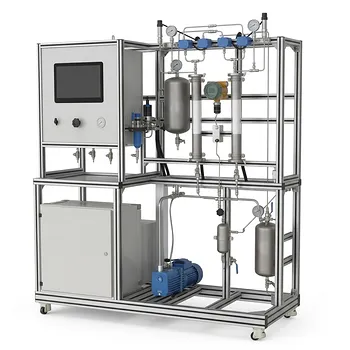
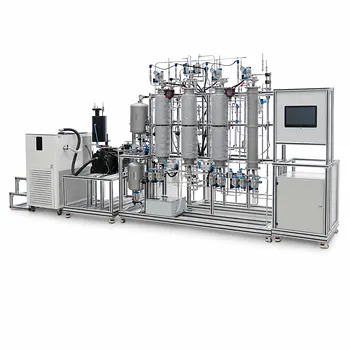
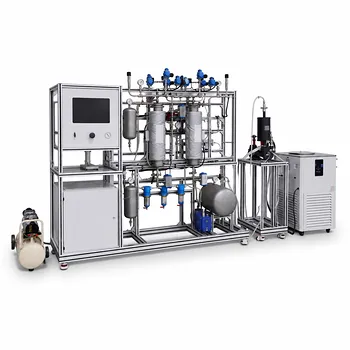
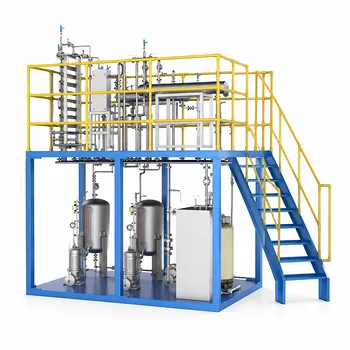
Are you looking to bridge the gap between thermodynamic theory and hands-on engineering? LABPARK provides premium Educational and Vocational Unit Operations Pilot Plants across chemical engineering, bioprocess & biotech, and environmental & water treatment.
Designed specifically for universities, research institutes, and enterprises, our pilot plants empower students and researchers to analyze fluid properties and master complex separations with confidence.
Contact LABPARK today to explore our customizable pilot plant solutions and elevate your training and research capabilities!
Related Products
- Natural Product Extraction Unit Operations Training Pilot Plant
- Multimodal Absorption and Desorption Pilot Plant for Unit Operations Training
- Multi Pump Fluid Transport Process Piping Unit Operations Training Pilot Plant
- Fixed-Bed Chemical Reaction and Gas Dust Tar Removal Unit Operations Pilot Plant
- Dual-Mode Rectification Pilot Plant for Practical Training Unit Operations
People Also Ask
- How to Demo Solubility Sensitivity in SFE Pilot Plants? Practical Thermodynamics
- How do pilot plants differentiate physical vs chemical extraction? Enhance Chemical Engineering Training
- How are HTU and NTU applied to determine extraction column height? Guide to Pilot Plant Scaling
- Why use split-plot designs in pilot plants instead of CRD? Optimize process parameters effectively.
- What are the limitations of acentric factor models? Avoid pilot plant errors with polar fluids.