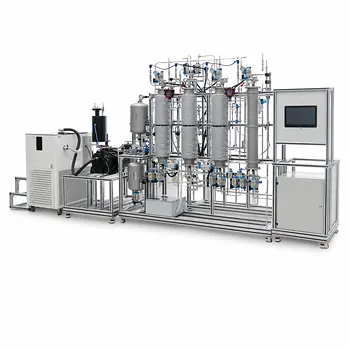
When you need to manage hazardous air pollutants in a pilot plant, the most commonly integrated technologies are condensers, cold traps, gas scrubbers, and thermal oxidizers. These devices, connected directly to the process train, capture, neutralize, or destroy toxic vapors, mists, and particulates. In more specialized setups, catalytic reactors, selective catalytic reduction (SCR) units, and photocatalytic stages are also deployed to address nitrogen oxides (NOx), volatile organic compounds (VOCs), and ultra-fine particulate matter.
The real art of pilot plant emission control lies not in picking a single device, but in layering complementary unit operations – physical separation, chemical scrubbing, and thermal or catalytic destruction – to handle the specific cocktail of pollutants while meeting strict safety and regulatory benchmarks.
The Foundation: Physical Separation and Capture
Before any chemical treatment, pilot plants rely on physics to knock down the highest-concentration pollutants.
How Condensers and Cold Traps Reduce the Load
Condensers cool the process gas stream, causing high-boiling-point vapors to liquefy. This simple step drastically reduces the volume of hazardous material entering downstream equipment. Cold traps go further, using very low temperatures to freeze out volatile substances that would otherwise slip through.
Why Knockout Drums Matter in Two-Phase Flow
When the discharge contains both liquid and gas, a knockout drum becomes non-negotiable. It uses gravity to separate the phases, preventing liquid slugs from damaging scrubbers or flares. This also teaches students a fundamental industrial safety practice: separating flammables before thermal treatment.
Chemical Neutralization with Scrubbing Systems
When the hazard is acidic, caustic, or highly soluble, absorption-based devices take centre stage.
Gas Scrubbers for Acid Gases and Highly Toxic Vapors
Wet scrubbers bring the gas stream into intimate contact with a scrubbing liquid. For pollutants like hydrochloric acid or chlorine, a caustic scrubber neutralizes the acid into harmless salts. The primary reference highlights scrubbers as a core unit operation, and supplementary data confirm their mandatory use for highly toxic effluents.
Integrating Multi-Stage Scrubbing in Pilot Units
A single scrubber often isn’t enough. A well-designed pilot plant may use a series of scrubbers with different chemistries to sequentially remove acid gases, then water-soluble VOCs. This staged approach mirrors full-scale industrial installations and gives researchers precise control over removal efficiency.
Thermal Oxidation for Complete Destruction
For organic pollutants that cannot be scrubbed, fire is the answer.
Thermal Oxidizers: High-Temperature Conversion to CO₂ and Water
Thermal oxidizers heat the contaminated air to 750–1,000 °C, breaking down complex organic molecules into carbon dioxide and water vapour. This is the go-to solution for a broad spectrum of hazardous air pollutants, as noted in the primary reference.
Operating Considerations at Pilot Scale
Pilot-scale oxidizers demand careful attention to residence time and temperature uniformity. Because volumes are small, heat recovery becomes crucial for energy viability. The exhaust must also be routed to a safe dispersion point, often after passing through a high stack, to ensure any trace combustion by-products are safely diluted.
Advanced Catalytic and Photocatalytic Systems
When the pollutant load is persistent or requires precise kinetic study, catalytic methods unlock deeper learning and finer control.
Selective Catalytic Reduction (SCR) for NOx Abatement
SCR units inject a reductant – typically ammonia – over a catalyst to convert nitrogen oxides into harmless nitrogen and water. In a pilot plant, students can manipulate gas flow rate, temperature, and inlet NOx concentration to model industrial compliance. Testing different catalyst substrates and washcoats turns the unit into a live research reactor.
Photocatalytic Reactors and Nanostructured Filters
Environmental pilot plants increasingly feature UV-photocatalytic stages where a semiconductor like titanium dioxide (TiO₂) breaks down VOCs and NOx under light. These setups also incorporate nanostructured filters – using carbon nanotubes or nanofibres – to capture particulate matter with extremely high efficiency. This fusion of photocatalysis and advanced filtration helps students grasp how surface area and mass transfer dictate reaction rates.
Understanding the Trade-Offs in Pilot Plant Emission Control
No single technology ticks every box. The best choice is always a balance.
- Energy intensity: Thermal oxidisers can consume significant fuel; heat integration is essential but adds complexity.
- Chemical handling: Scrubbers require safe storage and disposal of scrubbing liquors, which can be corrosive or hazardous themselves.
- Catalyst deactivation: SCR and photocatalytic surfaces foul over time from soot or poisoning, demanding regular regeneration or replacement.
- Pressure drop: High-efficiency filters and deep scrubber beds can choke the gas flow, demanding larger blowers and careful hydraulic design.
- Capital vs. operating cost: A condenser is cheap to build but may not reach the required removal efficiency, pushing cost downstream to more expensive thermal or catalytic units.
Making the Right Choice for Your Pilot Plant Goal
Selecting the appropriate emission control train depends entirely on what you aim to study or accomplish.
- If your primary focus is regulatory compliance and undergraduate education: Build around the core quartet – condenser, cold trap, scrubber, thermal oxidizer – to demonstrate every major principle of physical, chemical, and thermal treatment in one compact line.
- If your primary focus is advanced catalyst or materials research: Integrate an SCR unit and a UV-photocatalytic reactor with interchangeable catalyst beds and real-time gas analysis, so you can generate kinetic data and screen new nanomaterials.
- If your primary focus is handling acutely toxic or corrosive gases: Make a caustic scrubber the heart of the system, backed by redundant knockout drums and a high-dispersion stack, to prioritize fail-safe operation above all else.
- If your primary focus is energy-efficient destruction of low-concentration VOCs: Combine a recuperative thermal oxidizer with a fixed-bed catalytic reactor downstream to achieve high destruction efficiency at lower temperatures.
Mastery of pilot plant emission control is about building a resilient, layered defence that matches the hazard profile – and that’s exactly what turns a well-designed experiment into a reliable, real-world lesson.
Summary Table:
| Technology | Primary Function | Best Suited For |
|---|---|---|
| Condensers & Cold Traps | Physical separation via cooling | High-concentration, volatile vapors |
| Wet Gas Scrubbers | Chemical neutralization & absorption | Acidic, caustic, or highly soluble gases |
| Thermal Oxidizers | High-temperature thermal destruction | Broad spectrum of organic VOCs |
| SCR & Photocatalytic | Catalytic abatement and conversion | NOx and persistent organic pollutants |
Build a Safer, Compliant Engineering Lab with LABPARK
Looking to equip your academic or research facility with state-of-the-art pilot plants? LABPARK provides premium Educational and Vocational Unit Operations Pilot Plants in chemical engineering, bioprocess & biotech, and environmental & water treatment.
We help universities, research institutes, and enterprises integrate advanced emission controls—from gas scrubbers to catalytic reactors—ensuring hands-on learning and research are conducted safely and efficiently.
Contact LABPARK today to discuss your project requirements and receive a custom solution!
Related Products
- Bench Scale Carbon Dioxide Capture Educational Unit Operations Pilot Plant
- Methane Cracking Educational Unit Operations Pilot Plant
- Carbon Dioxide Absorption and Desorption Educational Pilot Plant for Carbon Capture Studies
- Bench Scale Dual Column Gas Separation and Capture Educational Pilot Plant
- Carbon Dioxide Hydrogen Methanol Synthesis Educational Unit Operations Pilot Plant
People Also Ask
- What unit operations are critical for CCUS training pilot plants? Build hands-on engineering expertise.
- What are the differences between post- and pre-combustion carbon capture training pilot plants?
- How can pilot plants show tail gas vs flue gas CO2 capture differences? Key educational insights.
- How do temperature variations affect CO2 transport models in pilot plants? Model vs Reality
- How does operating pressure influence the transition between absorption and desorption in a CO2 pilot plant?