Selecting an equation of state (EOS) over an activity coefficient model is fundamentally a decision driven by pressure and the proximity to the critical region. You should choose an EOS when your chemical engineering pilot plant operates at high pressures, processes light hydrocarbon mixtures, or ventures close to the critical point of the mixture—conditions where the liquid and vapor phases begin to behave similarly. In these regimes, an EOS provides a single, self-consistent mathematical framework for both phases, eliminating the need for arbitrary standard states and the mathematical singularities that cripple activity coefficient models.
The central takeaway is that the choice hinges on phase behavior: EOS models excel when the system is near its critical region or at high pressure, offering seamless treatment of both vapor and liquid; activity coefficient models dominate in low-to-moderate pressure systems rich in polar, hydrogen-bonding, or large molecules, where liquid-phase non-idealities are the primary concern.
The Thermodynamic Divide: When to Choose EOS
The Critical Region and High-Pressure Mandate
Equations of state are, by design, functions of pressure, volume, and temperature. This makes them the natural choice for systems operating at a high reduced pressure or near the mixture’s critical point. In the critical region, the distinction between liquid and vapor phases vanishes, and the very concept of an activity coefficient—which requires a clear reference liquid state—breaks down entirely.
An EOS circumvents this by not relying on standard states. It models both phases with the same continuous function. For a pilot plant studying natural gas liquids or supercritical extraction, this is not a convenience; it is a necessity.
Handling Light Hydrocarbon Mixtures
For mixtures of non-polar, small molecules such as methane, ethane, and propane, cubic equations like Peng-Robinson (PR) or Soave-Redlich-Kwong (SRK) offer remarkable accuracy and computational simplicity. Their parameters are derived from pure-component critical properties and acentric factors, using mixing rules with only a few binary interaction parameters.
These systems are often encountered in gas processing pilot plants. The EOS framework directly calculates the compressibility factor and vapor-liquid equilibria (VLE) that are essential for sizing separators and predicting compressor work. The internal consistency of an EOS prevents the physically impossible results that can arise from stitching together disparate vapor and liquid models.
The Structural Limitation of Activity Coefficients
Activity coefficient models like Wilson or NRTL are designed to correct for liquid-phase non-ideality. They assume a liquid phase exists and that its fugacity can be referenced to a pure liquid standard state. This approach becomes practically unusable when the temperature exceeds the critical temperature of a component, because a hypothetical liquid standard state must be invented, adding significant uncertainty and complexity.
For a pilot distillation column separating light hydrocarbons at moderate to high pressure, EOS methods avoid this problem entirely. They handle sub- and supercritical components within the same algebraic framework, making them the default choice for simulations that must remain robust across a wide range of operating scenarios.
Why the Choice Matters in a Pilot Plant Setting
Accuracy of Heat and Material Balances
In a unit operations pilot plant, an incorrect thermodynamic model cascades directly into flawed heat and mass balance calculations. An EOS that fails to predict liquid densities accurately will yield incorrect reboiler and condenser duties, while a poorly chosen activity model will misrepresent VLE, leading to incorrect stage counts in a distillation column.
The goal of the pilot plant is to generate data that scale reliably. Using an EOS for a high-pressure system ensures the compressibility factor, enthalpy, and fugacity are all thermodynamically consistent with one another. This internal consistency is what allows a student or researcher to compare simulated results directly to physical measurements without introducing non-physical correction factors.
Validating Theory Against Real Data
Pilot plants serve as a bridge between theory and industrial scale. When operating a gas-phase reactor or a high-pressure separator, the measured PVT data naturally align with the EOS framework. Students can directly compute the compressibility factor Z from experimental pressure, volume, and temperature, and then benchmark it against the chosen EOS.
This direct feedback loop is invaluable. If the simulation uses an activity coefficient model for a high-pressure vapor phase, the disconnect between the model’s assumptions and the physical reality becomes a source of confusion rather than education. The model’s limitations obscure the real equipment performance.
Understanding the Trade-offs and Pitfalls
The Challenge of Polar and Complex Molecules
The most significant limitation of classical cubic EOS is their difficulty with highly polar compounds, electrolytes, and large molecules like polymers. The simple mixing rules that work for hydrocarbons fail to capture hydrogen bonding or strong dipole moments. For a pilot plant treating wastewater or performing a bioprocess separation—systems full of polar, hydrogen-bonding species at low pressure—an EOS would be the wrong tool, often yielding nonsensical VLE predictions without extensive and complex modifications.
Sensitivity to Mixing Rules
While EOS methods are elegant for light hydrocarbons, their predictive power in wider-range mixtures hinges critically on the chosen mixing rules and binary interaction parameters. A poorly chosen mixing rule can skew results as much as a flawed activity model. This sensitivity teaches an important lesson: an EOS is not a black box. It requires physical insight to select the correct combination rules, and its results must always be scrutinized against physical pilot plant data.
The Middle-Ground Reality
The choice is not always absolute. In some cases, a hybrid approach—an EOS for the vapor phase and an activity model for the liquid phase—is used. However, for a pilot plant operating near the critical region, even this hybrid fails because the two models become disconnected at the very point where phase distinction disappears. The single EOS approach is thus not just better but essential when the process path crosses the critical locus or operates at a high reduced pressure.
Making the Right Choice for Your Pilot Plant Application
Your selection must align with the specific chemistry and operating window of your unit. Use the following goal-based guide to direct your decision.
- If your primary focus is high-pressure gas processing or supercritical fluid studies: Choose a cubic EOS like Peng-Robinson or SRK. Its ability to handle both phases with one consistent equation, without standard states, is mandatory for accurate simulation of compressors, expanders, and near-critical separations.
- If your primary focus is low-pressure distillation of strongly non-ideal liquid mixtures: Use an activity coefficient model such as NRTL or Wilson. These models are specifically calibrated to account for the composition-dependent liquid-phase non-idealities that dominate these systems.
- If your primary focus is an educational pilot plant exploring thermodynamic limitations: Run both models. Compare EOS predictions against activity coefficient predictions for the same column, and validate them against your physical measurements to understand firsthand how pressure and polarity dictate model failure.
Selecting the right thermodynamic framework is the foundation upon which all subsequent process calculations are built; make the choice that matches the physical reality your pilot plant is designed to explore.
Summary Table:
| Feature / Condition | Equations of State (EOS) | Activity Coefficient Models |
|---|---|---|
| Operating Pressure | High pressure & near-critical regions | Low-to-moderate pressure |
| Mixture Component Types | Non-polar, light hydrocarbons (e.g., natural gas) | Polar, hydrogen-bonding, complex molecules |
| Phase Modeling | Single framework for both vapor & liquid | Focuses on liquid-phase non-idealities |
| Key Pilot Plant Uses | Gas processing, supercritical extraction | Distillation of polar solvents, bioprocesses |
Optimize Your Pilot Plant Simulations with LABPARK
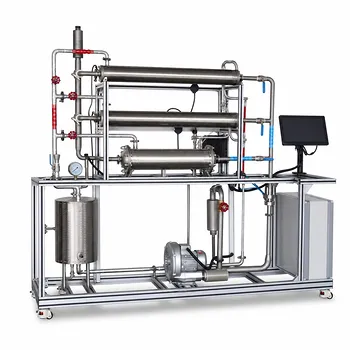
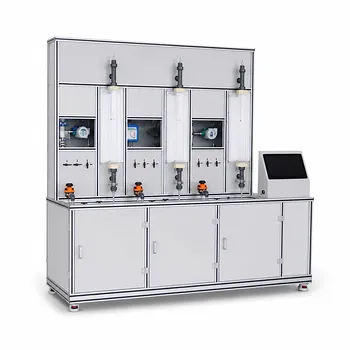
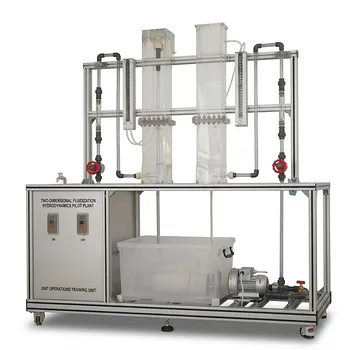
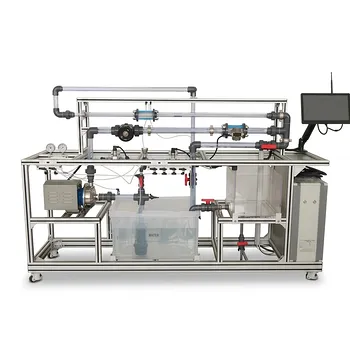
Building reliable simulations starts with the right thermodynamic models—and the right physical hardware to validate them. LABPARK provides state-of-the-art Educational and Vocational Unit Operations Pilot Plants in chemical engineering, bioprocess & biotech, and environmental & water treatment.
Designed specifically for universities, research institutes, and enterprises, our pilot plants help students and researchers bridge the gap between thermodynamic theory (like EOS and activity models) and real-world physical data.
Ready to elevate your engineering department or research facility with robust, scale-ready systems?
👉 Contact LABPARK today to discuss your specific pilot plant requirements!
Related Products
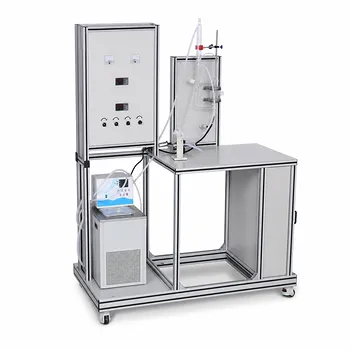
- Binary System Vapor Liquid Equilibrium Data Determination Educational Unit Operations Pilot Plant
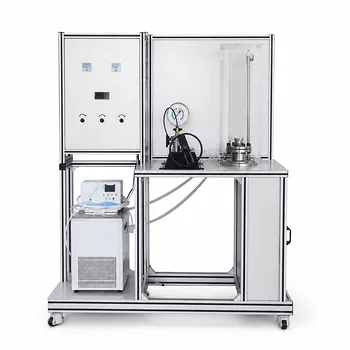
- Carbon Dioxide PVT Curve Determination Educational Unit Operations Pilot Plant
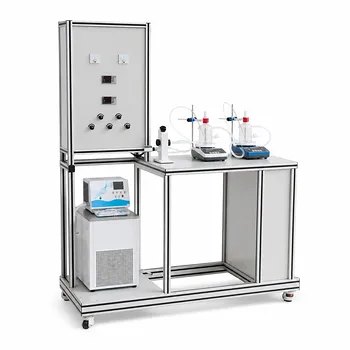
- Ternary Liquid-Liquid Equilibrium Educational Pilot Plant
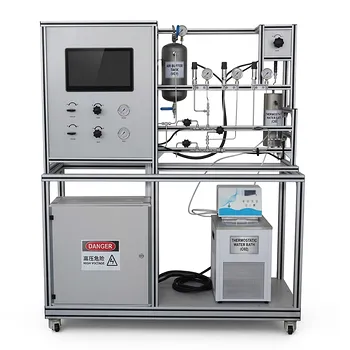
- Throttling Effect Determination Educational Unit Operations Pilot Plant
- Bernoulli Equation Demonstration Unit Operations Pilot Plant
People Also Ask
- Why correlate VLE pilot plant data using Wilson, NRTL, and UNIQUAC? Achieve Accurate Column Scale-Up
- For VLE Experiments: Fugacity vs. Activity Coefficient Method Selection Criteria
- How do pilot plants assist in teaching & researching non-ideal VLE? Bridge Theory & Physical Validation
- How to Model VLE for Supercritical & Unstable Components? Pilot Plant Methods
- Why is accurate VLE data critical? Optimize Unit Operations & Process Scale-Up