The periodic trend of ionization energy is far more than a chart on the wall—it’s the atomic fingerprint that decides how stubbornly a heavy metal clings to an ion-exchange resin in your pilot plant. Transition metals, with their characteristically higher ionization energies, form cations with greater charge density than alkali metals. This fundamental property directly governs resin selectivity, the ease of electrochemical reduction, and the aggressiveness of the regeneration chemistry needed to strip the column clean.
The core takeaway: higher ionization energy across the d‑block creates tightly‑held, densely charged cations that bind avidly to exchange sites. That strong affinity is a powerful advantage for deep removal but a significant operational challenge when it’s time to regenerate the bed. Every pilot‑plant decision—from resin choice to current density—flows from this simple periodic truth.
From Ionization Energy to Charge Density: The Atomic Root of Selectivity
How Ionization Energy Shapes the Metal Cation
Ionization energy measures the energy required to rip an electron from a neutral atom. Across the period, the effective nuclear charge climbs, pulling electrons closer and jacking up the energy needed to remove them. For transition metals, this leap means they lose their outer s‑electrons (and sometimes d‑electrons) to form cations that are smaller, more highly charged, and far more polarizing than the soft, singly charged ions of Group 1.
That combination—small radius plus a +2 or +3 charge—creates a cation with exceptionally high charge density. It’s this charge density that dictates how strongly the ion interacts with the negatively charged functional groups inside an ion-exchange bead.
The Cationic Form that Actually Reaches the Column
Step-wise ionization energies also tell you the stable oxidation state that will dominate in your wastewater. The gigantic jump from the first to the second ionization energy in sodium locks Na⁺ in place. A more gradual ramp through several ionization steps allows transition metals to appear as Fe²⁺/Fe³⁺, Cr³⁺, or Ni²⁺. Pilot-plant operators must know which species is present because it changes the equivalent of exchange capacity consumed per ion and shifts the pH window where precipitation competes with ion exchange.
Ion Exchange in Practice: Binding, Selectivity, and Regeneration
Why Transition Metals Bulldoze Their Way onto the Resin
Strong-acid cation resins, the workhorses of heavy metal removal, carry fixed sulfonate groups that prefer counter-ions with higher valence and smaller hydrated radius. The elevated charge density of transition‑metal cations strips away hydration water more easily, allowing the naked or partially hydrated ion to approach the fixed sulfonate site intimately.
This gives the familiar selectivity sequence: Pb²⁺ > Cu²⁺ > Zn²⁺ ≈ Ni²⁺ > Ca²⁺ > Mg²⁺ > Na⁺. Even in a salty brine loaded with Na⁺, a resin column will preferentially grab lead or copper. The pilot plant exploits this sequence to polish trace metals from a matrix dominated by harmless alkali ions.
Regeneration: The Price You Pay for Strong Affinity
Strong binding makes regeneration tough. The same electrostatic grip that captures Ni²⁺ or Cu²⁺ demands high‑concentration acid (3‑8% HCl or H₂SO₄) and extended contact to push the equilibrium backward. In a pilot run, you’ll see the regeneration elution curve tail on for many bed volumes. This is the direct cost of high ionization energy: more chemical consumption, more hazardous waste, and longer downtimes. Knowing the ionization trend lets you predict that a bed saturated with calcium will regenerate sweetly compared with one loaded by copper, and you can stagger your cycles accordingly.
Using Coordination Chemistry to Break the Grip
When resin selectivity becomes too strong, an entirely different approach—coordination chemistry—can rescue the process. The supplementary reference on recovering zinc illustrates the principle: adding ammonia to a mixed Zn/Mg precipitate selectively forms the soluble [Zn(NH₃)₄]²⁺ complex, leaving Mg(OH)₂ untouched. In ion-exchange circuits, complexing agents can out‑compete the resin’s functional groups, allowing selective elution of one metal while leaving others behind. This tactic works because the stability of the complex is itself rooted in the metal’s charge density and electronic structure—factors that trace right back to ionization energy.
The Electrochemical Connection: Ionization Energy and Reduction Potential
Why You Need Extra Voltage for Heavy Metals
In electrochemical polishing cells and integrated electrodialysis units, removal depends on reducing the aqueous cation to its metallic form. A metal with a high ionization energy holds its electrons tenaciously, giving it a more negative standard reduction potential. You must push the cathode to a more cathodic potential (or increase current density) to overcome that thermodynamic reluctance.
This is exactly why treating a nickel‑laden stream with a combined ion‑exchange/electrodialysis pilot unit demands careful tuning of the applied electric field. The membrane stack accelerates nickel migration, but if the driving voltage is too low, the high‑ionization‑energy Ni²⁺ will not plate efficiently, and the process will look sluggish compared with treating, say, a silver solution.
Electrochemical Pretreatments for Problematic Oxidation States
Chromium exemplifies why ionization energy alone isn’t the whole story—oxidation state matters enormously. Hexavalent chromium, Cr(VI), is a toxic oxyanion (chromate) that behaves nothing like a cation. Before ion exchange can even apply, the pilot plant must chemically or electrochemically reduce Cr(VI) to Cr(III). That Cr(III) cation, with its high charge density (+3), then binds extremely tightly to cation resin. Here, the periodic trend’s lesson is that once you’ve created the cationic species, capture is near‑certain, but you better have an acid regeneration plan ready for the strongly held trivalent ion.
Understanding the Trade-offs
The Strength‑Regeneration Dilemma
High ionization energy metals give you deep removal but brutal regeneration. In a pilot campaign, this manifests as:
- Longer mass‑transfer zone and earlier breakthrough if you under‑design the column.
- Progressive fouling when regeneration is incomplete, reducing the working capacity over many cycles.
- Higher chemical costs and waste volumes, which can erase the economic benefit of targeting a valuable metal for recovery.
Selectivity Conflicts in Mixed Streams
A real wastewater stream rarely contains a single heavy metal. The resin will always prefer the highest‑charge‑density cation first. If your goal is to recover, say, nickel separately from zinc, you must either stage multiple columns to exploit the selectivity sequence or use selective elution with complexing agents. Both strategies add capital and complexity. Understanding the periodic trend allows you to model these separations rather than being blindsided by them.
The Electrochemical Energy Penalty
Using electrodialysis or electrowinning in tandem with ion exchange to close the loop on metals like nickel is elegant, but it ties your energy bill directly to the ionization energies of the target metals. Piloting the system is essential to find the minimum practical current density that gives acceptable current efficiency without wasting electricity on side reactions like water splitting.
Making Atomic Trends Work for Your Pilot Plant
How you deploy this knowledge depends squarely on what the pilot is trying to prove or the problem it’s solving.
- If your primary focus is deep removal to meet tight discharge limits: Design for the worst‑case high‑charge‑density cation (Pb²⁺, Cu²⁺). Oversize the resin bed slightly and budget for aggressive, high‑concentration acid regeneration. The strong binding guarantees the treated effluent stays clean.
- If your primary focus is resource recovery of a valuable heavy metal: Use the selectivity sequence to your advantage. Capture the target metal first on a dedicated column, then use an electrochemical electrodialysis step to plate it out while regenerating the acid. The high ionization energy of the metal ensures it stays on the resin until you deliberately strip it.
- If your primary focus is handling a mixed metal wastewater with changeable oxidation states: Install a pretreatment stage to convert troublesome species (e.g., reducing Cr(VI) to Cr(III) or preventing sulfide precipitation of Hg) before the ion-exchange columns. This prevents resin fouling and guarantees the predictable, high-affinity capture that high ionization energy promises.
When you run a wastewater treatment pilot plant, the periodic table isn’t abstract—it’s a diagnostic tool. Reading the ionization energy trend tells you how easily a metal becomes a cation, how fiercely it will stick, and how much energy you’ll need to get it back. Align your process choices with those atomic realities, and you move from trial‑and‑error to engineered, predictable performance.
Summary Table:
| Cation Type | Resin Affinity & Selectivity | Regeneration Difficulty | Electrochemical Reduction |
|---|---|---|---|
| High Charge Density (e.g., $Pb^{2+}$, $Cu^{2+}$) | Strong binding; easily displaces alkali metals | High; requires high-concentration acid (3-8% HCl/$H_2SO_4$) | Requires higher negative potential and energy input |
| Low Charge Density (e.g., $Na^+$, $Mg^{2+}$) | Weak binding; easily displaced by transition metals | Low; simple and efficient chemical recovery | Easily reduced or remains stable in solution |
Optimize Your Wastewater & Chemical Engineering Labs with LABPARK
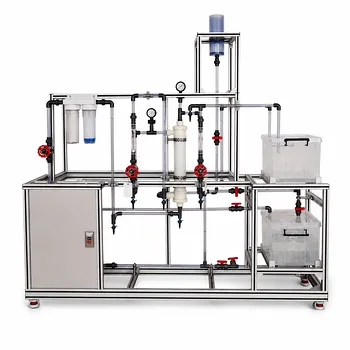
Demonstrating how complex atomic trends like ionization energy affect real-world ion-exchange dynamics requires hands-on, high-precision equipment. LABPARK provides state-of-the-art Educational and Vocational Unit Operations Pilot Plants in chemical engineering, bioprocess & biotech, and environmental & water treatment.
Engineered specifically for universities, research institutes, and enterprises, our pilot plants enable users to:
- Analyze real-world resin selectivity and adsorption kinetics.
- Test and optimize regeneration cycles for heavy metal recovery.
- Evaluate electrochemical reduction potentials and energy efficiency.
Contact LABPARK today to find the perfect pilot plant system to elevate your research and training capabilities!
Related Products
- Ion Exchange Water Purification Educational Pilot Plant for Engineering Unit Operations
- Solid Waste Pyrolysis and Refining Educational Pilot Plant for Unit Operations
- Electrochemical Water Treatment Educational Unit Operations Pilot Plant
- Thermal Desorption Exhaust Gas and Tail Water Treatment Educational Pilot Plant
- Dual-Mode Rectification Pilot Plant for Practical Training Unit Operations
People Also Ask
- How to Prevent Ion Exchange Channeling? Expert Solutions for Pilot Plants
- How does ion exchange work in water treatment pilot plants? Cost & process guide.
- What operational precautions should lab operators take for resin volume changes and air pockets? Key Guide
- How to use ion exchange pilot plants to verify alkalinity? A hands-on guide for engineering students.
- How can students use ion exchange pilot plants for column sizing? Master Wastewater Design