Density, specific volume, and specific gravity are fundamental state variables that describe how much matter occupies a given space—definitions that form the backbone of every pilot plant material balance. In chemical engineering operations, density is mass per unit volume (kg/m³, g/cm³, or lbm/ft³), specific volume is its reciprocal (volume per unit mass), and specific gravity is a dimensionless ratio comparing that density to a reference, almost always water at 4°C (1000 kg/m³ or 62.43 lbₘ/ft³). For the pure liquids and solids typically handled in pilot-scale unit operations, pressure changes have a negligible effect, and temperature-induced density variations are minor—but for gas streams and non‑ideal mixtures, the story is far more sensitive.
The precise answer to “what are they?” is simple, but the deeper insight for a pilot plant professional is this: while liquid and solid densities can often be treated as engineering constants, temperature is the real variable that drives small but meaningful shifts in density and specific gravity. In gas‑phase or mixed‑phase systems, both temperature and pressure become dominant. Ignoring these dependencies leads to errors in flow measurement, pump sizing, and separation modeling that can distort scale‑up results.
The Core Definitions: What They Mean Inside a Pilot Plant
Density: The Mass‑per‑Volume Foundation
Density (ρ) quantifies the compactness of a fluid or solid. In a pilot plant, you measure it to calculate hold‑up volumes, residence times, and mass flow rates from volumetric readings.
For a stream with mass (m) and volume (V): [ ρ = \frac{m}{V} ] Common field units include kg/m³ for SI systems and lbₘ/ft³ for US customary units.
Specific Volume: The Reciprocal That Simplifies Material Balances
Specific volume ((v)) is the inverse of density—the volume occupied by a unit mass. [ v = \frac{1}{ρ} ] It becomes particularly handy when you want to know how much space a given mass of feed will occupy in a reactor or a surge tank without constantly rearranging density numbers.
Specific Gravity: A Convenient, Temperature‑Sensitive Ratio
Specific gravity (SG) compares a substance’s density to that of a reference fluid (for liquids, water at 4°C and 1 atm). Mathematically: [ SG = \frac{ρ_{\text{substance}}}{ρ_{\text{reference}}} ] Because the reference density is fixed, SG is a dimensionless number that changes exactly when the substance’s density changes. It is not an independent property—it just repackages density relative to water.
How Environmental Factors Alter These Properties in Pilot Plants
Pure liquids and solids respond to the environment differently than gases and complex mixtures. The key variables are temperature and pressure, but their importance depends on the phase.
Temperature: The Main Culprit for Liquid and Solid Density Shifts
For liquids, density typically decreases slightly with rising temperature as thermal expansion increases the volume per unit mass. Solids follow a similar, even smaller trend. The effect is often described by a coefficient of thermal expansion, but in pilot plants where temperature swings are moderate (e.g., 20–80 °C), the variation rarely exceeds a few percent.
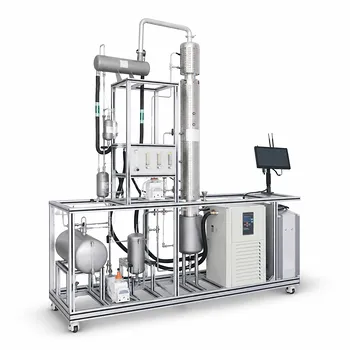
In educational and R&D pilot units—like distillation columns or tubular reactors—students and engineers directly observe this: a hot recycle stream has a measurably lower density than the cold feed, which can shift mass flow readings if the meter was calibrated at a different temperature.
For gases, temperature has the opposite effect on viscosity (viscosity increases with temperature) but density drops sharply with rising temperature at constant pressure—a relationship governed by the ideal gas law.
Pressure: Negligible for Liquids, Dominant for Gases
Pure liquids and solids are essentially incompressible. Pressurizing a liquid from 1 to 50 bar will change its density by a fraction of a percent—well within the noise of most pilot plant instrumentation. That’s why pressure correction is rarely applied to liquid density in routine calculations.
For gas streams, however, pressure is a primary density driver. A twofold increase in absolute pressure approximately doubles gas density at constant temperature. In a pilot plant, this means that the same compressor can deliver vastly different mass flow rates depending on the suction and discharge pressures.
When Mixtures and Non‑Idealities Magnify Sensitivity
Real pilot plant feeds are rarely pure. With mixed solvents, hydrocarbon blends, or reacting intermediates, the density response to temperature can deviate from linear predictions. In heavy hydrocarbon distillation units, for example, specific gravity alone is insufficient to capture the thermodynamic behavior. Relying solely on normal boiling point and SG can lead to inconsistencies in vapor‑liquid equilibrium (VLE) predictions, because structural differences—naphthenes versus paraffin‑aromatic mixes, or cracked versus virgin stocks—shift density independently of boiling point. Adding viscosity as a third characterization parameter dramatically improves the accuracy of equation‑of‑state calculations, ensuring that the pilot column’s temperature profiles match reality.
Understanding the Trade‑offs and Pitfalls
Treating Density as a Constant Can Sabotage a Material Balance
The most common mistake is assuming a liquid’s density doesn’t change from feed drum to reactor. A 5% density error on a large recycle stream can cause a 5% error in mass balance closure, leading engineers to chase phantom leaks or reaction side‑products.
SG Is Not a Magic Number—It Inherits All Temperature Dependencies
Because SG is a ratio with a fixed denominator, it moves in lockstep with density. An operator who reads “SG = 0.85” without noting the temperature can miscompute the actual mass in a tank. SG values are only comparable when measured at the same temperature (or properly corrected).
Ignoring Gas‑Phase Compressibility Skews Scale‑Up
Pilot plant compressors, flow control valves, and orifice meters all rely on accurate density for mass flow conversions. When pressure and temperature vary, using a constant gas density derived from “standard conditions” can introduce errors of 20–50% in computed throughput.
Cost of Too Much Complexity
On the flip side, installing online densitometers and applying real‑time temperature compensation adds capital and maintenance burden. For many liquid‑only processes with narrow temperature bands, the payoff is marginal. The art is knowing when the error is “in the noise” versus when it threatens scale‑up success.
Making the Right Choice for Your Pilot Plant Goal
Your approach to managing density, specific volume, and specific gravity should be driven by your primary operational need and the sensitivity of your system.
- If your primary focus is liquid‑phase material balances and simple fluid transport: Document the density at a reference temperature (the temperature at which your flowmeters are calibrated) and apply a linear temperature correction only if you expect swings larger than ~15 °C. For most pilot plant liquids, this keeps mass balances well within 2% accuracy without extra instrumentation.
- If your primary focus is gas‑phase reactions or compressible flow: Treat density as a strong function of both temperature and pressure. Use real‑time pressure and temperature measurements to compute gas density from an equation of state (ideal gas or a simple compressibility factor). Never rely on a single “standard” density value.
- If your primary focus is distillation or VLE‑sensitive separations, especially with heavy hydrocarbons: Avoid the common trap of using only SG and normal boiling point to predict thermodynamic properties. Incorporate an additional parameter like viscosity (or a reliable equation of state tuned to the specific stock) to ensure that your pilot column’s internal profiles match those predicted by your simulation—otherwise, scale‑up to plant level will amplify the errors.
A pilot plant’s job is to generate trustworthy data for full‑scale design. Respecting how density and its relatives respond—or don’t respond—to temperature and pressure keeps that data from leading you astray.
Summary Table:
| Property | Definition & Formula | Temperature Effect | Pressure Effect |
|---|---|---|---|
| Density (ρ) | Mass per unit volume ($\rho = m/V$) | Decreases as temp rises (liquids & gases) | Negligible for liquids; dominant for gases |
| Specific Volume (v) | Volume per unit mass ($v = 1/\rho$) | Increases as temp rises (liquids & gases) | Negligible for liquids; dominant for gases |
| Specific Gravity (SG) | Ratio of density to reference ($SG = \rho_{sub}/\rho_{ref}$) | Decreases as temp rises (mirrors density) | Negligible for liquids; dominant for gases |
Scale Up Your Chemical Engineering Training with LABPARK
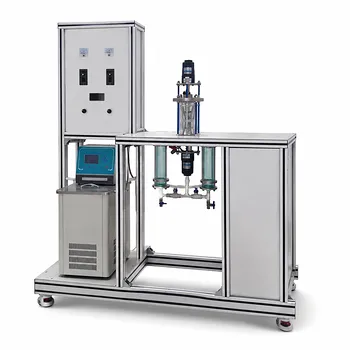
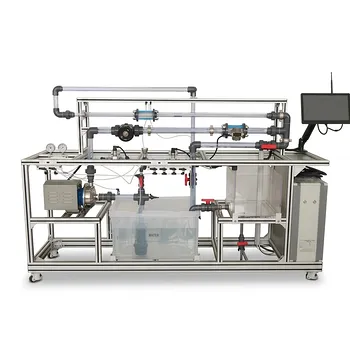
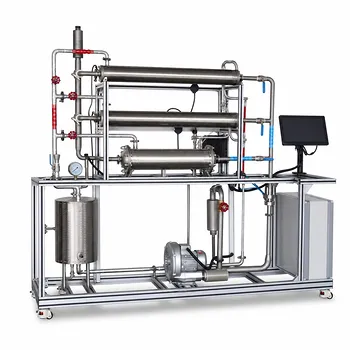
Accurate data starts with the right equipment. LABPARK designs and manufactures high-performance Educational and Vocational Unit Operations Pilot Plants in chemical engineering, bioprocess & biotech, and environmental & water treatment.
We help universities, research institutes, and enterprises bridge the gap between theory and industrial reality with systems that allow precise monitoring of density, pressure, temperature, and mass balance variations.
- Academic Excellence: Equip your students with hands-on, industry-grade pilot plants.
- R&D Precision: Ensure reliable scale-up data with highly customizable configurations.
- Comprehensive Support: From custom design to installation and training.
Ready to elevate your laboratory? Contact LABPARK today to request a quote!
Related Products
- Educational Unit Operations Pilot Plant for Intraparticle Diffusion Effective Factor Measurement
- Educational Compression Refrigeration Performance Determination Unit Operations Pilot Plant
- Two Phase Flow Pattern Velocity Resistance Measurement Educational Pilot Plant
- Orifice and Venturi Flowmeter Calibration Educational Pilot Plant for Fluid Mechanics Laboratory
- Quantitative Dosing and Liquid Flow Control Educational Unit Operations Pilot Plant
People Also Ask
- How do educational unit operations pilot plants bridge theory and design? Bridge the Engineering Gap
- How do educational unit operations pilot plants address safety and waste management when scaling up?
- Why is the chemical plant startup schedule crucial? De-risk scale-up with pilot plants.
- How do deviations in estimating latent heat impact pilot plant thermal systems? Avoid hardware mis-sizing.
- Why Compare Predicted and Experimental Excess Enthalpy? Key to Accurate Pilot Plant Scale-up