The equivalent diameter for the annular space in a double-pipe heat exchanger is simply the difference between the outer pipe’s inner diameter and the inner pipe’s outer diameter.
Mathematically, it is expressed as (d_e = d_1 - d_2), where (d_1) is the inner diameter of the outer pipe and (d_2) is the outer diameter of the inner pipe. This single value replaces the standard tube diameter in all convective heat transfer correlations, converting the non-circular flow area into an effective circular one for analysis.
The annular equivalent diameter (d_e = d_1 - d_2) allows direct application of standard circular‑tube heat transfer correlations (Dittus‑Boelter, Sieder‑Tate) to the non‑circular annulus. Its importance lies in making experimental Nusselt number and convective coefficient calculations possible on pilot‑plant setups, where direct measurement of an irregular cross‑section would otherwise be impractical.
How the Equivalent Diameter is Calculated – The Derivation
The equivalent diameter is derived from the hydraulic diameter concept, which normalises any flow cross‑section into an equivalent circular conduit. For a double‑pipe exchanger annulus, the formula unfolds in two straightforward steps.
The Hydraulic Radius Foundation
Every non‑circular duct is first reduced to its hydraulic radius (r_H):
(r_H = \frac{\text{Flow Area}}{\text{Wetted Perimeter}}).
This ratio captures the essential geometric “size” that governs fluid friction and heat transfer.
For the annular space:
- Flow area (A = \frac{\pi}{4}(d_1^2 - d_2^2))
- Wetted perimeter (\Pi = \pi d_1 + \pi d_2 = \pi(d_1 + d_2))
Therefore, (r_H = \frac{\pi(d_1^2 - d_2^2)/4}{\pi(d_1 + d_2)} = \frac{d_1 - d_2}{4}).
Converting to Equivalent Diameter
The hydraulic (equivalent) diameter is universally defined as:
(d_e = 4 , r_H).
Substituting the hydraulic radius yields the compact result:
(d_e = 4 \times \frac{d_1 - d_2}{4} = d_1 - d_2).
A Critical Distinction in Application
Use (d_e) only for dimensionless numbers and correlations.
When calculating the actual flow velocity (u) or volumetric flow rate, you must always use the true cross‑sectional area (A). Mixing the equivalent diameter into the area calculation would give a completely wrong mass balance, so this separation is non‑negotiable in pilot‑plant data reduction.
Why the Equivalent Diameter Matters for Heat Transfer
Experimental heat transfer analysis in a double‑pipe exchanger pivots on three dimensionless groups: Reynolds number (Re), Prandtl number (Pr), and Nusselt number (Nu). Without the equivalent diameter, the first and the third cannot be correctly computed for the annulus.
It Unlocks Standard Convective Correlations
Well‑known circular‑tube correlations like the Dittus‑Boelter or Sieder‑Tate equations are expressed as:
(Nu = C \cdot Re^n Pr^m).
Plugging (d_e) into the Re and Nu definitions makes these relationships immediately applicable to the annular flow.
For example, the Reynolds number becomes (Re = \frac{\rho u d_e}{\mu}) and the Nusselt number (Nu = \frac{h d_e}{k}). Research groups and students can then back‑calculate the convective heat transfer coefficient (h) directly from measured data and compare it with the predicted value—a cornerstone of unit operations lab exercises.
It Enables Consistent Experimental Verification
Pilot plants are designed to teach principles of scaling and similarity. By using (d_e = d_1 - d_2), the annulus is effectively “transformed” into a round tube of the same thermal character. This allows:
- Consistent calculation of the heat transfer coefficient from energy balances.
- Direct evaluation of how flow regime (laminar, transitional, turbulent) influences heat transfer.
- Reproducible comparison of experimental Nusselt numbers with literature correlations.
Without this step, every annular flow configuration would require its own dedicated and experimentally derived correlation—an impractical proposition for a teaching pilot plant.
Understanding the Assumptions and Limitations
The equivalent diameter approach is widely used, but it is not a perfect physical representation. Acknowledging its boundaries is crucial for interpreting pilot data honestly.
When the Simple Difference Works Best
The formula (d_e = d_1 - d_2) is extremely reliable for fully turbulent flow in annuli with moderate diameter ratios. In these conditions, the velocity profile is sufficiently “flat” that the equivalent diameter aligns well with the effective thermal‑fluid behaviour. Standard power‑law correlations then give excellent predictions.
Where Caution Is Needed
- Laminar flow introduces a larger departure, because the velocity profile depends on the exact shape. The simple (d_e) gives a reasonable first estimate, but an annular flow may deviate noticeably from a circular tube.
- Flow with a very large or very small (d_2/d_1) ratio can exhibit secondary flows or eccentricity effects that a single equivalent diameter cannot capture.
- Pressure drop vs. heat transfer: While the same (d_e) is used for both, the friction factor and heat transfer correlations are developed independently. Always verify that the correlation you use was specifically validated for annular geometries, not just for pressure drop.
A Practical Check for Pilot‑Scale Work
When reducing data, calculate Re using (d_e) and cross‑check the flow regime. If the experiment is deep in the turbulent range ((Re > 10{,}000)), the equivalent diameter method is robust. For transitional or laminar annulus flows, supplement the results with a comparison to annular‑specific correlations (if available) to judge uncertainty.
Making the Most of Annular Flow Analysis in Pilot Plants
Your experimental objective determines precisely how you should apply the equivalent diameter. Align your approach with your central learning or research goal.
- If your primary focus is calculating a highly accurate convective coefficient: Use (d_e = d_1 - d_2) for Re and Nu, but also measure all temperatures and flow rates with high precision. Small errors in the true annulus area overpower the uncertainty from the equivalent diameter.
- If your primary focus is demonstrating similarity principles: Explicitly show that the same (d_e) collapses data for different annular geometries onto a single Nusselt–Reynolds curve. This is a powerful visual proof of the hydraulic diameter concept.
- If your primary focus is comparing pressure drop and heat transfer: Use (d_e) for both correlations, but note that the friction analogy may not be exact. Separately discuss how the thermal boundary condition (constant wall temperature vs. constant heat flux) can affect the Nusselt number.
A well‑documented double‑pipe pilot experiment that correctly employs (d_e = d_1 - d_2) transforms an irregular flow channel into a reliable, teachable model of convective heat transfer. Master this one step, and the entire heat transfer analysis falls neatly into place.
Summary Table:
| Parameter | Formula / Definition | Role in Heat Transfer Calculations |
|---|---|---|
| Equivalent Diameter ($d_e$) | $d_e = d_1 - d_2$ | Used in Reynolds ($Re$) and Nusselt ($Nu$) numbers to apply standard circular-tube correlations. |
| Hydraulic Radius ($r_H$) | $r_H = \frac{\text{Flow Area}}{\text{Wetted Perimeter}}$ | The geometric foundation representing the ratio of flow area to friction-inducing perimeter. |
| True Flow Area ($A$) | $A = \frac{\pi}{4}(d_1^2 - d_2^2)$ | Must be used for calculating actual fluid velocity ($u$) and volumetric flow rates. |
Enhance Your Engineering Labs with LABPARK Pilot Plants
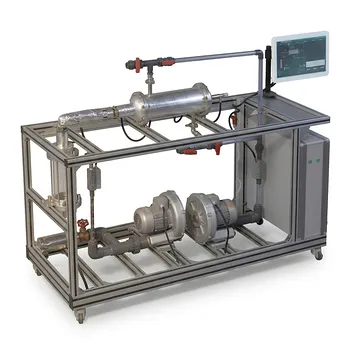
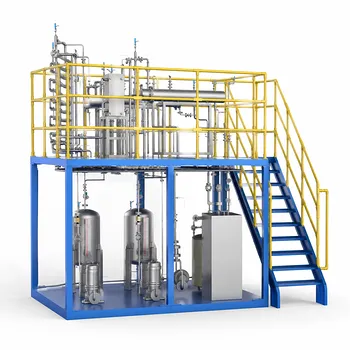
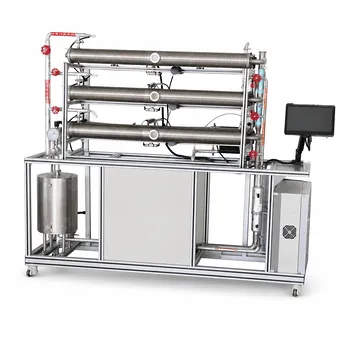
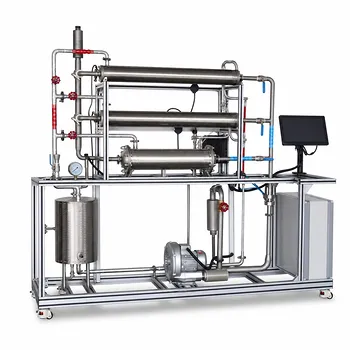
Are you looking to bridge the gap between theory and practical application in heat transfer? LABPARK provides premium Educational and Vocational Unit Operations Pilot Plants in chemical engineering, bioprocess & biotech, and environmental & water treatment designed specifically for universities, research institutes, and enterprises.
Our double-pipe heat exchanger pilot plants deliver precise, reproducible experimental data, helping students and researchers easily master fluid dynamics and heat transfer correlations.
Ready to upgrade your lab's capabilities? Contact LABPARK today to discuss your customized pilot plant needs!
Related Products
- Dual Mode Heat Transfer Pilot Plant for Unit Operations Training
- Shell and Tube Heat Exchanger Heat Transfer Coefficient Determination Educational Pilot Plant
- Comprehensive Multi-Modal Heat Transfer Unit Operations Pilot Plant for Engineering Training
- Three-Tube Heat Transfer Educational Pilot Plant for Unit Operations Training
- Multi Pump Fluid Transport Process Piping Unit Operations Training Pilot Plant
People Also Ask
- When is ε-NTU preferred over LMTD in pilot plants? Predict heat exchanger performance without iteration.
- Why is the prevention of scale formation on heat exchanger surfaces a critical learning objective? Key Lessons
- How do unit conversions affect pilot plant calibration? Avoid errors in heat transfer data analysis
- How is the thermal resistance of a thick-walled hollow cylinder calculated? Key Equations
- Under what conditions can arithmetic mean replace LMTD in pilot plant calculations?