The arithmetic mean temperature difference is a reliable stand-in for the LMTD, but only when the temperature driving forces at the two ends of the exchanger are nearly equal. The critical operating condition is the ratio of the larger terminal temperature difference to the smaller terminal temperature difference (Δt₂/Δt₁). As long as that ratio remains at or below 2, the arithmetic mean introduces a negligible error and can safely replace the Log Mean Temperature Difference in pilot plant calculations. Outside that window, the shortcut breaks down and will materially distort your heat transfer results.
Core Takeaway: You can replace the LMTD with the simple arithmetic mean when the end temperature differences are balanced—specifically, when the larger difference is no more than twice the smaller one (Δt₂/Δt₁ ≤ 2). This condition keeps the mathematical error small enough to be ignored in most pilot plant monitoring and preliminary design work.
Why the LMTD is the Standard Approach
The Log Mean Temperature Difference isn't just a formula; it's the correct weighting of the varying temperature driving force along a heat exchanger. Because the temperature change between the hot and cold streams is rarely linear, the LMTD gives the true average driving force for the rate equation Q = U·A·ΔT_m.
The Problem the Arithmetic Mean Solves
In a busy pilot plant, constantly calculating logarithms mid-experiment is tedious. When you're making quick adjustments, documenting live readings, or doing a preliminary equipment sizing, a simplified average is appealing. That's where the arithmetic mean offers a practical shortcut—provided you know when it's valid.
The Critical Condition: Δt₂/Δt₁ ≤ 2
The rule is simple and quantitative: the arithmetic mean temperature difference can be used if the ratio of the greater terminal temperature difference to the smaller terminal temperature difference is less than or equal to 2.
What This Ratio Actually Means
The terminal temperature differences are the driving forces at the two ends of the heat exchanger—typically the inlet temperature differences for a counter-flow arrangement. Let Δt₁ be the smaller of those two values, and Δt₂ be the larger.
When Δt₂/Δt₁ is close to 1, the temperature profiles are nearly parallel, and the arithmetic mean and the LMTD are virtually identical. As the ratio climbs toward 2, the arithmetic mean begins to overestimate the true average driving force, but the error remains small enough to be acceptable for many engineering purposes.
Where This Condition Comes From
The LMTD formula is LMTD = (Δt₂ – Δt₁) / ln(Δt₂/Δt₁). If you compare this to the arithmetic mean (Δt₂ + Δt₁)/2, the discrepancy grows with the spread of the end differences. At a ratio of exactly 2, the arithmetic mean is about 4% higher than the LMTD—a margin that most pilot plant heat balances and preliminary designs can tolerate.
Understanding the Trade-offs
Simplicity has its price. You need to know exactly what you’re giving up when you skip the logarithm.
The Acceptable Error Margin
At Δt₂/Δt₁ ≤ 2, the error introduced by the arithmetic mean is roughly 4% or less. For typical pilot plant work—monitoring trends, checking energy balances, or sizing insulation—this is well within normal engineering tolerances.
When the Error Becomes a Problem
As soon as the ratio exceeds 2, the error accelerates. At a ratio of 3, the arithmetic mean is already about 10% too high. At 5, it’s over 20% too high. That kind of error can lead to undersized heat exchangers, false efficiency interpretations, or incorrect heat duty reports in your lab documentation.
Not a Replacement for All Contexts
The arithmetic mean shortcut applies only to the temperature driving force in a simple counter-current or co-current arrangement. For multi-pass shell-and-tube exchangers, you must still apply the LMTD correction factor F_t. And if you’re predicting unknown outlet temperatures, the whole simplification becomes moot because you can’t even determine Δt₁ and Δt₂ without iterative solving—at which point the ε-NTU method is far more practical.
Pilot Plant Scenarios Where the Shortcut Excels
This rule is built for speed without sacrificing basic accuracy in a specific set of circumstances.
Real-Time Laboratory Monitoring
When you see temperatures stabilize during a run and you want a quick estimate of the current heat duty, you can check the ratio in seconds. If both end differences are visually similar, take the arithmetic mean, multiply by U·A, and you have your Q. No calculator needed.
Pre-Computational Sizing and Scoping
During the preliminary design of a pilot-scale heat exchanger, you often have approximate terminal temperatures. If the Δt ratio is under 2, you can quickly ballpark the required area without iterative log calculations, saving time before running the full LMTD model.
Educational Laboratory Reports
For teaching, this condition makes an excellent lab exercise. Students can calculate both the arithmetic mean and the LMTD across different experiments, observe exactly where the deviation becomes significant, and gain an intuitive feel for the log-mean concept.
Making the Right Choice for Your Goal
Your decision to use the arithmetic mean should always be tied to your specific objective in the pilot plant.
- If your primary focus is rapid, live monitoring: Use the arithmetic mean whenever Δt₂/Δt₁ ≤ 2. It gives you instant feedback while keeping the heat balance accurate enough to spot process upsets.
- If your primary focus is precise equipment rating or formal reporting: Always compute the LMTD. Even a 4% deviation could affect the calculated dirty heat transfer coefficient and lead to wrong conclusions about fouling or efficiency.
- If your primary focus is teaching fundamental heat transfer: Make the approximation a learning tool. Have students intentionally apply the arithmetic mean at different Δt ratios and quantify the error to cement their understanding of the LMTD’s importance.
- If your primary focus is designing for extreme temperature spreads: Never use the arithmetic mean when one end approach temperature is tiny and the other is large. The ratio will almost certainly exceed 2, and the error will compromise your design.
When you respect its limits, the arithmetic mean becomes an invaluable field tool that speeds up pilot plant calculations without undermining the physics.
Summary Table:
| Temperature Ratio (\Delta t₂/\Delta t₁) | Error Margin | Applicability in Pilot Plants |
|---|---|---|
| \le 2 | \le 4% | Safe: Ideal for quick monitoring, preliminary scoping, and student labs |
| 2 - 3 | 4% - 10% | Caution: Boundary zone; avoid for formal reporting or exact sizing |
| > 3 | > 10% to 20%+ | Unsafe: High risk of undersizing equipment; LMTD must be used |
Elevate Your Heat Transfer Training and Research with LABPARK
Need reliable, hands-on equipment to teach or test complex thermodynamic principles? LABPARK designs and delivers premium Educational and Vocational Unit Operations Pilot Plants tailored for universities, research institutes, and enterprises.
Whether your focus is chemical engineering, bioprocess & biotech, or environmental & water treatment, our high-precision pilot plants provide the real-world operational data your students and researchers need.
Ready to upgrade your laboratory capabilities? Contact LABPARK today to discuss your project requirements!
Related Products
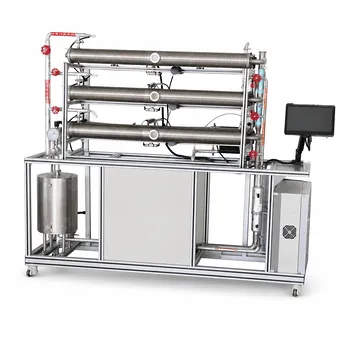
- Dual Mode Heat Transfer Pilot Plant for Unit Operations Training
- Three-Tube Heat Transfer Educational Pilot Plant for Unit Operations Training
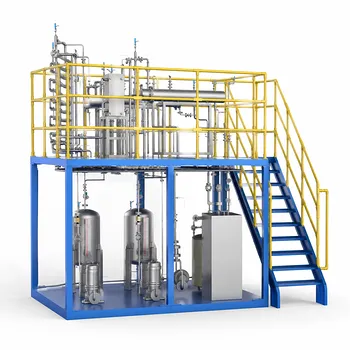
- Comprehensive Multi-Modal Heat Transfer Unit Operations Pilot Plant for Engineering Training
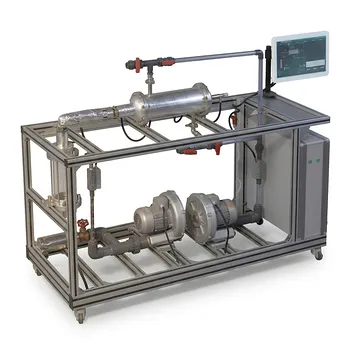
- Shell and Tube Heat Exchanger Heat Transfer Coefficient Determination Educational Pilot Plant
- Solid Spherical Heat Transfer Coefficient Determination Educational Chemical Engineering Pilot Plant
People Also Ask
- When is ε-NTU preferred over LMTD in pilot plants? Predict heat exchanger performance without iteration.
- Why is the prevention of scale formation on heat exchanger surfaces a critical learning objective? Key Lessons
- How do unit conversions affect pilot plant calibration? Avoid errors in heat transfer data analysis
- How is the thermal resistance of a thick-walled hollow cylinder calculated? Key Equations
- How to analyze heat exchanger CAPEX vs. OPEX in pilot plants? Optimizing Process Design Education