Knowledge Applied Chemistry Education What procedures ensure complete removal of impurity ions during precipitate washing? Guide for chemistry labs.
Author avatar

Tech Team · LABPARK

Updated 1 month ago

What procedures ensure complete removal of impurity ions during precipitate washing? Guide for chemistry labs.


The complete removal of impurity ions during precipitate washing is achieved through a cycle of repeated washing with deionized water, systematic verification of the wash effluent, and a final solvent removal step. The core procedure is simple: wash, test, and repeat until the impurity is no longer detectable, then dry the solid under vacuum.

While the mechanical act of washing seems straightforward, true purity assurance in educational labs hinges on the disciplined feedback loop of testing the filtrate after each wash. The procedure is not complete until a sensitive chemical test proves the absence of the target impurity; skipping this verification is the most common reason for a "pure" product that still contains contaminants.

The Heart of the Process: Displacement and Decantation

Why a Single Rinse is Never Enough

Pores and surfaces within a filter cake trap mother liquor rich in dissolved impurity ions. A single pour of clean water merely dilutes the outermost layer. Multiple washing cycles are required to progressively reduce the impurity concentration deep within the solid.

The Standard Washing Protocol

In educational labs, the precipitate is washed repeatedly with deionized water to avoid introducing new ions. After each addition of water, you swirl the mixture, allow the solid to settle, and then carefully decant or pull the liquid through the filter. This "wash and decant" sequence is repeated multiple times to achieve near-complete removal.

The Non-Negotiable Step: Verifying Purity by Filtrate Testing

The Testing Loop

This is the step that transforms a guess into a guarantee. After a wash cycle, you collect a small sample of the filtrate and test it chemically for the specific impurity ion you want to remove. For example, if the impurity is sulfate ($SO_4^{2-}$), adding a few drops of barium chloride solution will form white, insoluble barium sulfate.

How to Interpret the Result

You are looking for a negative result: no precipitate, no turbidity. A cloudy or milky appearance means the impurity is still present and you must wash again. You continue the “wash → test” loop until the test shows absolutely no reaction. Only then can you be confident the impurity level has been reduced to a point where a routine chemical test can no longer detect it.

Why This Matters in an Educational Setting

Students often equate a predetermined number of washes with purity. This is a critical misconception. The impurity load depends on the initial concentration and the wash volume. The only reliable endpoint is a clean chemical test. This teaches a fundamental principle: analytical verification must drive process decisions.

The Final Step: Solvent Removal and Drying

Vacuum Filtration’s Role in Purity

The final wash leaves behind clean solid suspended in clean water. To remove this water completely, vacuum filtration is applied. The reduced pressure pulls air through the filter cake, mechanically displacing liquid and evaporating residual solvent. This step is essential because any remaining liquid re-deposits dissolved impurities as the solid dries.

The Link to Accurate Results

In educational labs where the precipitate might be weighed for stoichiometric yield experiments or analyzed for composition, a damp product introduces error. Thorough vacuum-assisted drying ensures that the final mass reflects only the desired solid, free from excess water and the trace ions it carried initially.

Common Pitfalls to Avoid

Using Tap Water Instead of Deionized Water

Tap water contains calcium, magnesium, and chloride ions. Washing a precipitate with tap water contaminates it with new ions, defeating the purpose. Always use deionized or distilled water for every wash.

Testing an Unrepresentative Sample

Testing the first few drops that come through a filter can give a false negative because they are merely residual clean water from the wash vessel. Wait until you have collected a few milliliters of freshly filtered liquid to get a representative sample that has actually passed through the entire filter cake.

Stopping Too Early

Nearing the endpoint, the impurity signal becomes faint. A slight turbidity can be easily missed against a poor lighting background. Hold the test tube against a dark card and a light source. If in doubt, wash one more time and test again. An extra wash is far less costly than a contaminated product.

Ignoring Coprecipitated Ions

Washing primarily removes surface or mechanically trapped impurities. Ions that have co-precipitated or become incorporated into the crystal lattice may not be fully removable by simple washing alone. In such cases, hot washing or digestion (prolonged heating in the mother liquor) may be needed, but this extends beyond basic washing procedures and must be verified by more sophisticated analysis.

Making the Right Choice for Your Lab Work

Your exact protocol should align with the final use of the precipitate. Use these goal-driven recommendations to decide when the washing is truly complete.

  • If your primary focus is obtaining an analytically pure solid for quantitative gravimetric analysis: Do not stop until the barium chloride test (or equivalent targeted test) shows zero turbidity. Then apply prolonged vacuum drying and repeat weighing until the mass is constant.
  • If your primary focus is a qualitative demonstration of a reaction where a trace of impurity does not alter the visible outcome: Three washes with deionized water followed by a quick qualitative check for the main impurity is usually sufficient. A faint cloudiness may be acceptable if it does not interfere with the demonstration’s visual goal.
  • If your primary focus is speed and you are in a time-limited practical session: Perform a fixed number of five washes with small, efficient volumes, then run a confirmatory test. If the test fails, communicate that the product is not yet fully pure rather than proceeding with impure material under the false assumption of completeness.
  • If your primary focus is teaching the scientific method: Emphasize the testing loop as the core learning outcome. Ask students to document each wash and test result, build a wash profile, and explain why the endpoint is defined by chemical evidence, not by a count.

Complete removal is defined by what you can reliably detect, not by an arbitrary ritual. Make the filter cake prove its purity before you call the work done.

Summary Table:

Step Action & Protocol Purpose & Purity Indicator
1. Displacement & Decantation Wash repeatedly with deionized water and decant. Progressively dilutes and removes trapped mother liquor.
2. Filtrate Testing Chemically test wash effluent samples (e.g., $BaCl_2$). Confirms absence of target impurity ions (no turbidity).
3. Vacuum Filtration Apply reduced pressure to dry the filter cake. Displaces residual solvent to prevent solute re-deposition.

Enhance Your Unit Operations Training with LABPARK

Mastering filtration and chemical synthesis requires robust, hands-on training equipment that mirrors industrial processes. LABPARK provides state-of-the-art Educational and Vocational Unit Operations Pilot Plants in chemical engineering, bioprocess & biotech, and environmental & water treatment.

We help universities, research institutes, and enterprises bridge the gap between theory and practice with safe, reliable, and high-performance training systems.

Ready to elevate your laboratory capability? Contact us today to request a quote or customization options!

Related Products

People Also Ask

Related Products

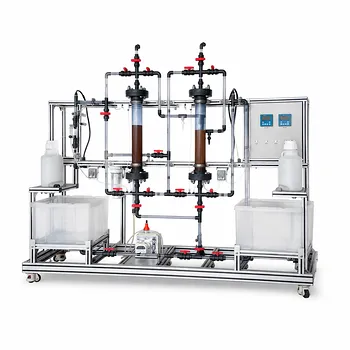
Ion Exchange Water Purification Educational Pilot Plant for Engineering Unit Operations

Ion Exchange Water Purification Educational Pilot Plant for Engineering Unit Operations

This bench-scale ion exchange pilot plant trains engineering students in water purification. Dual transparent columns simulate industrial softening and demineralization. Students observe fluid dynamics, perform resin regeneration, and analyze breakthrough curves. The corrosion-resistant frame ensures durability in unit operations experiments.

Electrolyte Distillation Purification and Formulation Educational Pilot Plant

Electrolyte Distillation Purification and Formulation Educational Pilot Plant

Integrated bench-to-pilot scale educational pilot plant for electrolyte distillation, purification, and formulation with borosilicate glass construction, PLC automation, touchscreen HMI, and advanced industrial safety features for hands-on chemical process training, ideal for chemical engineering and materials science curricula.

Constant Pressure Filtration Educational Unit Operations Pilot Plant

Constant Pressure Filtration Educational Unit Operations Pilot Plant

Hands-on educational pilot plant for constant pressure filtration. Classic plate and frame filter press allows students to study kinetics, determine specific cake resistance, perform cake washing and evaluate washing rates. Ideal for chemical engineering curriculum. Mobile, customizable, safety-compliant design.

Multi-Functional Membrane Separation Educational Pilot Plant for Unit Operations Lab

Multi-Functional Membrane Separation Educational Pilot Plant for Unit Operations Lab

The Multi-functional Membrane Separation Educational Unit Operations Pilot Plant is an integrated bench-scale laboratory system designed for teaching undergraduate engineering education. It features Ultrafiltration, Nanofiltration, and Reverse Osmosis modules in a compact, mobile unit for practical hands-on learning.

Rising and Falling Film Evaporation Educational Unit Operations Pilot Plant

Rising and Falling Film Evaporation Educational Unit Operations Pilot Plant

Hands-on educational pilot plant for studying rising and falling film evaporation, flow regimes, and heat transfer. Customizable for university labs with industrial instrumentation and data acquisition. Enables comparative evaluation of evaporation modes and energy efficiency.

Water Electrolysis Hydrogen Production and Storage Educational Pilot Plant

Water Electrolysis Hydrogen Production and Storage Educational Pilot Plant

Integrated pilot-scale training system for higher education engineering labs. Features AWE/PEM electrolysis, adjustable DC power, PLC controls, gas-liquid separation, and pressurized hydrogen storage. Hands-on learning in green hydrogen, process control, and safety, ideal for chemical and energy departments.

Educational Rotary Disc Liquid-Liquid Extraction Pilot Plant

Educational Rotary Disc Liquid-Liquid Extraction Pilot Plant

A transparent rotary disc column for educational liquid-liquid extraction experiments. This pilot plant enables students to study mass transfer, droplet dynamics, and flooding behavior, bridging theory and practice in chemical engineering unit operations education. Features variable-speed agitation and PLC control.

Electrolytic Hydrogen Production Educational Unit Operations Pilot Plant

Electrolytic Hydrogen Production Educational Unit Operations Pilot Plant

Bench-scale electrolytic hydrogen production pilot plant designed for university engineering labs. Provides hands-on training in water electrolysis, gas-liquid separation, and process safety. Fully customizable system with digital PID control, corrosion-resistant components, and hydrogen gas detector. Ideal for chemical engineering curricula.

Multifunctional Membrane Separation Educational Pilot Plant with Ultrafiltration, Nanofiltration, Reverse Osmosis

Multifunctional Membrane Separation Educational Pilot Plant with Ultrafiltration, Nanofiltration, Reverse Osmosis

An integrated laboratory bench-scale membrane separation system for higher education engineering labs combining Ultrafiltration, Nanofiltration, and Reverse Osmosis processes. Features industrial PLC control with touch-screen HMI, transparent piping, and academic assessment software. Ideal for chemical and environmental engineering curricula.

Electrochemical Water Treatment Educational Unit Operations Pilot Plant

Electrochemical Water Treatment Educational Unit Operations Pilot Plant

Enhance engineering education with this pilot-scale electrochemical water treatment plant. Designed for hands-on learning of efficient salt removal, electrolytic reactions, and real-time data acquisition. Features multi-mode control, corrosion-resistant PVC, low-voltage safety, and wireless connectivity for modern teaching labs.

Potassium Salt Thermal Dissolution and Crystallization Separation Educational Unit Operations Pilot Plant

Potassium Salt Thermal Dissolution and Crystallization Separation Educational Unit Operations Pilot Plant

This educational pilot plant allows chemical engineering students to perform potassium salt thermal dissolution and cooling crystallization experiments, integrating solubility studies, supersaturation control, and solid-liquid separation in a safe, compact, and customizable laboratory system for hands-on unit operations learning.

Alkaline Membrane Water Electrolysis Educational Pilot Plant Unit Operations Training System

Alkaline Membrane Water Electrolysis Educational Pilot Plant Unit Operations Training System

Hands-on educational pilot plant for alkaline membrane water electrolysis hydrogen production, integrating unit operations training with industrial PLC control, real-time data logging, customizable design, durable 316L stainless steel construction, explosion-proof safety, and modern 5G connectivity for university laboratories.

Centrifugal Pump Performance Determination Educational Unit Operations Pilot Plant

Centrifugal Pump Performance Determination Educational Unit Operations Pilot Plant

This lab system determines centrifugal pump performance curves for unit operations. Students configure dual pumps in series or parallel for hands-on learning. Includes industrial controls, clear piping, and data logging. Customizable for chemical, mechanical, and environmental engineering programs.

Multi-Functional Special Distillation Educational Pilot Plant

Multi-Functional Special Distillation Educational Pilot Plant

Versatile multi-functional special distillation pilot plant for chemical engineering education. Supports continuous, vacuum, azeotropic, reactive, extractive distillation. Transparent glass columns enable real-time visual observation of hydrodynamics and separation processes.

General Purpose Cosmetics Production Unit Operations Training Pilot Plant

General Purpose Cosmetics Production Unit Operations Training Pilot Plant

Integrated pilot-scale cosmetics production training plant for chemical engineering education featuring utility supply emulsification blending and filtration modules with dual touchscreen manual control customizable mobile design ideal for practical hands-on unit operations and advanced process control learning.

Centrifugal Pump Performance and Orifice Flowmeter Calibration Educational Pilot Plant

Centrifugal Pump Performance and Orifice Flowmeter Calibration Educational Pilot Plant

This versatile educational pilot plant enables engineering students to conduct centrifugal pump performance tests, orifice flowmeter calibration, and fluid mechanics experiments using a transparent flow loop, industrial HMI, and 3D virtual simulation for a comprehensive hands-on learning experience.

Gas-Solid Heterogeneous Separation Demonstration Educational Unit Operations Pilot Plant

Gas-Solid Heterogeneous Separation Demonstration Educational Unit Operations Pilot Plant

Comprehensive visual transparent gas-solid separation pilot plant for chemical engineering labs. Demonstrates gravity settling inertial settling cyclone and bag filter technologies. Enables real-time analysis of fluid-particle mechanics pressure drop and collection efficiency. Ideal for undergraduate unit operations courses.

Hot Filtration Educational Unit Operations Pilot Plant Laboratory System

Hot Filtration Educational Unit Operations Pilot Plant Laboratory System

This integrated laboratory bench-scale hot filtration pilot plant enables students to study solid-liquid separation under thermal conditions, featuring a stainless steel vessel, removable heating jacket, and multi-layer filter plates for unit operations education, ideal for chemical engineering laboratory curriculum.

Continuous Batch Extractive Distillation Educational Pilot Plant

Continuous Batch Extractive Distillation Educational Pilot Plant

Versatile pilot plant for continuous, batch, and extractive distillation training. High-borosilicate glass column for visualizing hydraulics, 15.6-inch touchscreen with data logging, precise reflux ratio control 1-99, and durable corrosion-resistant frame. Ideal for chemical engineering education and process research.

Fluid Friction Resistance Determination Educational Unit Operations Pilot Plant

Fluid Friction Resistance Determination Educational Unit Operations Pilot Plant

Engineered bench-scale system for university engineering labs. Provides hands-on fluid mechanics experience: quantitative energy loss analysis, flow regime observation, friction coefficient determination. Features four-point pressure measurement, transparent sections, industrial touchscreen PLC, 3D virtual simulation. Ideal for chemical, mechanical, civil engineering.


Leave Your Message