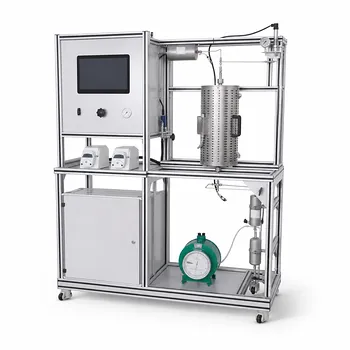
Yield reactor models become the design tool of choice when the reaction system’s complexity outpaces the availability of detailed kinetic data.
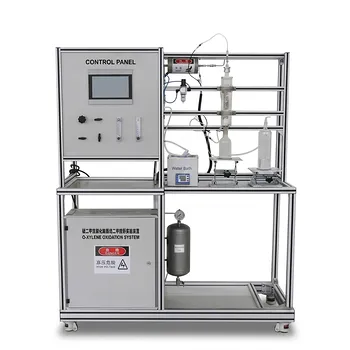
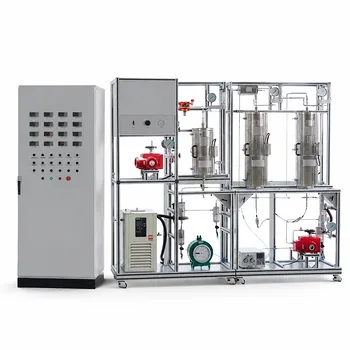
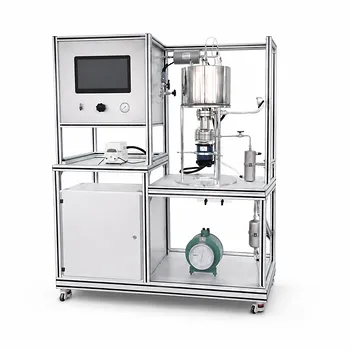
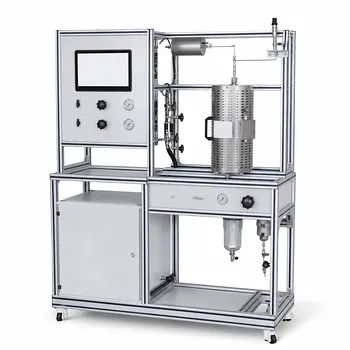
These models are preferred in process design whenever reaction kinetics are unknown, when virtual components or complex solid streams with particle size distributions are involved, or when numerous minor side products would make a full kinetic description prohibitively expensive. Instead of solving rate equations, a yield model allows the engineer to directly specify the product distribution based on empirical data. That empirical data comes directly from a chemical reactor pilot plant, where yields are measured under a range of operating conditions to build the correlation curves that feed the simulation.
The core insight: a yield model sacrifices mechanistic depth for direct, operational predictability. It is the go-to approach when building a rigorous kinetic model is impractical. Its success, however, depends entirely on representative pilot plant data that captures both the chemical selectivity and the physical losses that define real-world plant performance.
What Sets a Yield Reactor Model Apart from a Kinetic Model
The Core Assumption of a Yield Model
A kinetic model solves the differential equations of reaction rates based on concentration and temperature.
A yield model bypasses this by locking in the product split as a defined output, often as a function of one or two key operating variables (like temperature or residence time).
This makes the yield model a lumped-parameter shortcut.
It does not need to know reaction order, activation energies, or intermediate concentrations.
It only needs a reliable set of “if‑X‑then‑Y” correlations.
When Kinetics Fail: Triggers for Choosing a Yield Model
Unknown reaction pathways.
When the detailed mechanism is too complex or simply not available, you cannot write the rate equations.
A yield model lets you move forward without guessing at invalid kinetics.
Virtual components and ill-defined mixtures.
Process simulators often represent heavy residues, tars, or bio‑based feeds as virtual components with no true molecular identity.
Kinetic models struggle with these, but a yield model can assign them a fixed mass or molar yield.
Solid streams with particle size distributions.
Heterogeneous reactions involving solids (like ore roasting or biomass pyrolysis) introduce physical phenomena that don’t fit neat kinetic laws.
Here, specifying a yield for each particle size fraction is often the only practical path.
Multiple minor side products.
Ten side reactions that each produce 0.1% of a by-product can make a kinetic model numerically stiff and impossible to validate.
A yield model folds all these minor fractions into a single, measured output stream.
The Pilot Plant as the Yield Model’s Data Engine
Collecting Yield Correlation Curves
A yield model is only as good as the data behind it.
That data is generated in a chemical reactor pilot plant—a scaled‑down version of the commercial unit.
Engineers run the pilot reactor under a matrix of temperatures, pressures, feed rates, and residence times.
At each operating point, they sample the product and perform a full material balance.
These empirical results become the yield correlation curves inside the simulation: for example, “at 350 °C and 2 bar, the yield of product A is 88 mol%.”
This direct line from pilot plant to model replaces the need for an expensive, time‑consuming kinetic determination campaign.
Going Beyond Single‑Pass: Recycle and Overall Plant Yield
Pilot plants that run in a continuous reaction‑separation‑recycle mode are essential for calibrating yield models.
In a real plant, unreacted material is recycled, and by‑products can accumulate or be purged.
Reaction yield (or chemical yield) accounts only for what is lost to side reactions inside the reactor.
Overall plant yield (process yield) additionally accounts for physical losses: evaporation, leaks, separation inefficiencies.
When a yield model is built solely on single‑pass pilot data, it can seriously over‑predict plant‑level performance.
Running the pilot plant with a closed recycle loop exposes accumulation of impurities and shows how separation losses erode the overall yield—data that must be baked into the yield model’s correlations.
Mastering the Metrics: Conversion, Selectivity, and Yield in the Pilot Plant
The Fundamental Equation: Yield = Conversion × Selectivity
Pilot‑plant exercises teach a critical relationship:
Conversion is the fraction of raw material that reacted.
Selectivity is the fraction of converted material that turned into the desired product.
Their product is the yield of desired product relative to total feed.
Understanding this equation on a pilot plant control panel is powerful.
For example, raising temperature may increase conversion but destroy selectivity, leaving yield unchanged.
The yield model must reflect these trade‑offs, and the pilot plant is where you map them.
Why Selectivity Becomes the Target in Recycle Systems
If unreacted raw material can be perfectly recycled, single‑pass conversion becomes less important—you will eventually “catch” all the feed.
In that case, the system yield target is effectively transformed into a selectivity target.
Mathematically, the required overall reactor selectivity is calculated by dividing the target system yield by the recovery efficiency of downstream separation.
Pilot plants with physical recycle loops demonstrate this principle directly: you see that optimizing selectivity, not just conversion, is what maximizes the final amount of saleable product while minimizing by‑product formation.
Understanding the Trade‑offs
The Empirical Trap: Data Quality and Extrapolation Risk
A yield model inherits all the noise and uncertainty of the pilot plant data.
If the pilot unit was small enough that mass‑transfer or heat‑transfer behavior is different from the full‑scale reactor, the correlations may not scale up linearly.
Extrapolating beyond the tested range is particularly dangerous.
A yield model will happily give a number at a temperature 50 °C above your highest pilot run, but that number has no physical basis.
Rigor requires you to treat yield correlations as valid only inside the experimental envelope.
Ignoring Physical Losses in Overall Yield
When a yield model is built solely from reactor‑outlet samples, it captures only reaction yield.
Downstream losses in separation, drying, or solvent recovery are invisible.
A process design that confuses reaction yield with overall plant yield can underestimate capital and energy costs dramatically.
Pilot‑plant mass balances that include the entire unit operations train are the only way to convert reaction‑based yield models into plant‑realistic predictions.
When to Revisit Kinetics
Yield models are design accelerators, but they become brittle when you need to radically change chemistry.
If a new catalyst, solvent, or feedstock is being evaluated, the empirical foundation collapses.
At that point, the cost of building a mechanistic kinetic model may be justified, because it can predict behavior outside historical data.
The decision, then, is cyclical: start with a yield model to get a process on paper, use the pilot plant to test it, and revisit kinetics only when the yield model limits your optimization space.
Making the Right Choice for Your Process Design Goal
The relationship between yield modeling and pilot‑plant operation pivots entirely on your stage of development and your ultimate objective.
- If your primary focus is rapid early‑stage screening of multiple process concepts: Use a yield model fed by targeted pilot‑plant campaigns; it lets you eliminate unfeasible routes without ever writing a rate equation.
- If your primary focus is scaling up a high‑volume, well‑understood commodity process: Invest in a kinetic model early, but still use pilot‑plant data to validate selectivity predictions and identify trace by‑product accumulation in the recycle loop.
- If your primary focus is optimizing a complex mixture with many side products or unknown components: The yield model is your only practical choice; ensure your pilot plant runs in recycle mode to capture system‑level yield, not just single‑pass conversion.
- If your primary focus is training engineers or students on industrial decision‑making: Operate the pilot plant to measure conversion, selectivity, and yield simultaneously, demonstrating how the Yield = Conversion × Selectivity relationship guides the economic balance between reactor performance and separation cost.
The value of a yield reactor model lies not in theoretical elegance but in its direct, honest dependence on real‑world pilot data—an indispensable design tool when complexity rules out kinetics, and a permanent reminder that simulation is only as good as the experiments behind it.
Summary Table:
| Feature | Yield Reactor Model | Kinetic Model |
|---|---|---|
| Data Input | Empirical correlation curves from pilot runs | Reaction rate constants & activation energy |
| Ideal Application | Complex mixtures, unknown kinetics, solid streams | Well-defined, pure chemical reaction pathways |
| Key Advantage | Simpler setup, bypasses mechanistic complexity | Predicts behavior safely outside tested range |
| Limitation | Vulnerable to extrapolation errors | Costly and time-consuming to validate |
Optimize Your Process Design & Training with LABPARK
Bridging the gap between theoretical reactor models and real-world operation requires precise, empirical data. LABPARK provides high-quality Educational and Vocational Unit Operations Pilot Plants in chemical engineering, bioprocess & biotech, and environmental & water treatment.
Tailored for universities, research institutes, and enterprises, our pilot plants empower your students and researchers to master crucial metrics like conversion, selectivity, and overall plant yield in a safe, controlled environment.
Ready to elevate your engineering curriculum or research capabilities? Contact LABPARK today to request a quote!
Related Products
- Fixed-Bed Chemical Reaction and Gas Dust Tar Removal Unit Operations Pilot Plant
- Fixed Bed Gas Solid Catalytic Reaction Educational Pilot Plant
- Multi-Reactor Educational Pilot Plant for Reaction Engineering Unit Operations
- Residence Time Distribution and Reactor Flow Characteristics Determination Educational Pilot Plant
- Tubular Reactor Flow Characteristics Determination Educational Unit Operations Pilot Plant
People Also Ask
- When to transition from PID to adaptive control in pilot plants? Key process indicators.
- How do deviations in estimating latent heat impact pilot plant thermal systems? Avoid hardware mis-sizing.
- Why Compare Predicted and Experimental Excess Enthalpy? Key to Accurate Pilot Plant Scale-up
- How to study gasification in pilot plants? Compare exit gas composition & efficiency
- Why Use PTFE & Hastelloy in Chemical Pilot Plants? Prevent Corrosion & Ensure Safety