The immediate answer to your question is that crystallization rate and filtration kinetics are inversely linked, creating a classic process bottleneck. A rapid crystallization produces many small particles that form a dense, high-resistance filter cake, drastically slowing filtration. Conversely, a slow crystallization yields larger, more porous particles that filter quickly but demand a longer residence time in the crystallizer. The total batch cycle time is the sum of these two competing durations, and the optimum is found where their combined time is minimized—not where either step individually is fastest.
The core trade-off when integrating crystallization and filtration pilot plants is between particle size and downstream filterability. Pushing for fast crystallization always creates fines that choke the filter; growing large, easily filtered crystals always takes more time in the crystallizer. The total batch cycle time is dictated by the sum of these two steps, and the true optimum is the precise crystallization rate that delivers the lowest combined time, not the fastest individual step.
Inside the Crystal-to-Cake Connection
The relationship between your crystallizer and filter is governed by the physical properties of the slurry you generate. Understanding this direct link is the first step to reducing total cycle time.
How Crystallization Kinetics Dictate Particle Size
The rate at which you drive supersaturation directly determines the crystal size distribution (CSD) and morphology.
- Rapid crystallization (fast cooling, high antisolvent addition) promotes spontaneous nucleation, generating a cloud of countless fine, needle-like crystals with a high aspect ratio.
- Slow, controlled crystallization, especially with seeded growth, suppresses nucleation and allows existing crystals to grow into thicker, rod-like or equant particles with a low aspect ratio.
The morphology produced in the crystallizer becomes the packaging geometry on your filter medium.
The Filtration Penalty of Fine Particles
Filtration kinetics are governed by the specific cake resistance, a parameter that measures how much the filter cake resists fluid flow.
- Fine, high-aspect-ratio crystals pack tightly, creating a cake with low porosity. This results in a very high specific cake resistance (e.g., (6.9 \times 10^{10}) m/kg), which directly translates to a slow filtrate flow rate.
- Larger, low-aspect-ratio crystals bridge and pack loosely, forming a highly permeable cake with a significantly lower resistance (e.g., (9.0 \times 10^9) m/kg), enabling rapid filtration.
A reduction in specific cake resistance by an order of magnitude can slash filtration time from hours to minutes, completely dominating the cycle time calculation.
What This Means for Your Total Cycle Time
Pilot plant data will consistently show you a U-shaped curve when you plot total cycle time against crystallization rate.
The Fast-Crystallization Trap
Accelerating the crystallizer to reduce its occupancy time often backfires catastrophically.
You might shave 20 minutes off the crystallization time, but the resulting fines can add hours to the filtration step. The filter becomes the bottleneck, requiring higher pressure differentials that can compress the already-dense cake and further reduce permeability. The total cycle time skyrockets.
The Slow-Growth Sweet Spot
Investing more time in controlled crystal growth can pay enormous dividends downstream.
An approach using a controlled cooling profile and well-timed seeding might double the time in the crystallizer. However, the large, robust crystals that form can reduce the filtration time by 80-90%. The net effect is a dramatic drop in the combined batch cycle time.
Quantifying the Trade-off in Your Pilot Plant
The handshake between the two unit operations is calculable, and pilot plants provide the exact measurements you need.
Calculating the True Batch Filtration Time
For batch operations like a plate-and-frame filter press, the real filtration cycle ((T)) goes beyond just the active filtration time ((\theta)). It includes washing ((\theta_w)) and downtime for cake discharge, cleaning, and reassembly ((\theta_d)).
(T = \theta + \theta_w + \theta_d)
A cake that is slow to filter is also typically slow to wash due to channeling in the dense bed. Therefore, the poor filterability from rapid crystallization extends every component of the non-productive time. The hourly productivity ($Q$) can be calculated directly from pilot plant measurements to compare scenarios.
Accounting for Process Variability
Pilot-scale work is essential because it reveals hidden sources of variability that affect this trade-off.
- Operator skill: Inconsistency in seeding technique or cooling rate application directly changes the CSD and subsequent filtration time.
- Fouling: Degraded heat transfer during crystallization can alter the cooling rate, while fouled filter media steadily reduces baseline filtration flux over multiple runs.
Training on pilot plants helps engineers identify and manage these variables, ensuring the optimized cycle time is robust and repeatable.
Understanding the Trade-offs
An objective assessment requires acknowledging that optimizing for cycle time creates tensions with other process objectives.
Pitfall 1: Crystal Purity vs. Size
Large, fast-filtering crystals grown slowly can have a hidden cost: purity. Rapid crystallization, despite its filtration nightmare, may kinetically trap impurities in the crystal lattice. The slow-growth route keeps those impurities in solution, achieving higher purity. Choosing the larger, filterable crystals is only viable if the slower kinetics do not compromise the entrapment of solvent or impurities.
Pitfall 2: Solvent Effects Are Amplified
The trade-off is not absolute; it is heavily modulated by solvent properties. The primary reference highlights that a low-viscosity solvent like TBME can partially rescue the filtration of a smaller crystal size, while a viscous solvent like IPA makes a poor CSD catastrophically slow. The optimum crystallization rate is always solvent-dependent. The true minimization problem becomes a function of both particle size and fluid viscosity.
Pitfall 3: Overlooking Non-Filtration Downtime
A narrow focus on active filtration time ((\theta)) is a common mistake. The time required to discharge a sticky, poorly formed cake from a difficult crystallization can eclipse the filtration time savings. The optimal particle size must also produce a cake that releases cleanly and quickly from the filter cloth.
Making the Right Choice for Your Operation
Optimizing total batch cycle time requires you to prioritize the combined performance of the crystallizer and filter, not the individual steps.
- If your primary focus is maximizing throughput: Do not simply push the crystallizer to its limit. Systematically slow the crystallization rate using controlled cooling and seeding until the sum of crystallization time and filtration time reaches its absolute minimum on your pilot plant.
- If your primary focus is product purity: Accept that you may need to operate at a slower, more controlled crystallization rate than the one that gives the absolute fastest cycle time. The larger crystals produced often yield higher purity, creating a beneficial alignment with filtration goals, but you must verify that impurity entrapment is not occurring.
- If your primary focus is reducing operator-dependent variability: Invest in automated seeding and precise temperature control. A consistent, slightly slower crystallization will produce a repeatable CSD, leading to a dependable filtration time and a predictable, stable total cycle time that is easier to schedule.
The power of a pilot plant lies in its ability to physically demonstrate this inverse relationship. By measuring the specific cake resistance for different crystallization protocols, you can directly map the U-shaped curve and confidently choose the exact operating point that unlocks the fastest, most reliable cycle.
Summary Table:
| Parameter | Rapid Crystallization | Slow & Controlled Crystallization |
|---|---|---|
| Crystal Size & Shape | Small, needle-like (fines) | Larger, rod-like / equant |
| Specific Cake Resistance | High (dense, low porosity) | Low (permeable, high porosity) |
| Filtration Speed | Very slow (process bottleneck) | Rapid and efficient |
| Crystallizer Time | Short | Long (controlled growth/seeding) |
| Impact on Total Cycle Time | Long (slow filtration dominates) | Optimized (minimized overall time) |
Master Unit Operations with LABPARK Pilot Plants
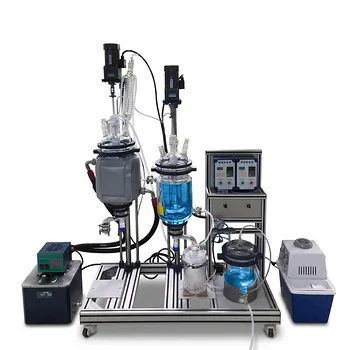
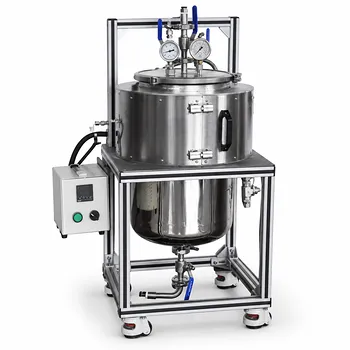
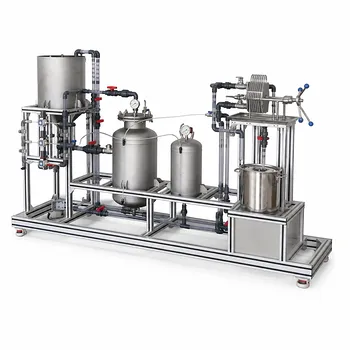
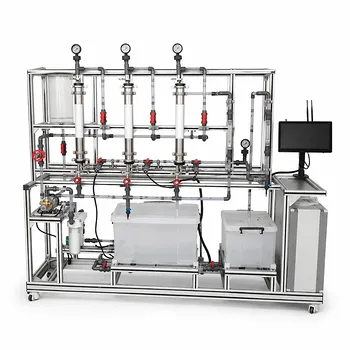
Optimizing the balance between crystallization and filtration requires hands-on experience and precise control. LABPARK provides premium Educational and Vocational Unit Operations Pilot Plants in chemical engineering, bioprocess & biotech, and environmental & water treatment.
Designed specifically for universities, research institutes, and enterprises, our pilot plants empower students, researchers, and engineers to model real-world kinetics, eliminate bottlenecks, and maximize process efficiency.
Ready to elevate your training and research capabilities? Contact LABPARK today to request a quote or discuss your custom laboratory needs.
Related Products
- Multi Functional Membrane Crystallization Educational Unit Operations Pilot Plant
- Potassium Salt Thermal Dissolution and Crystallization Separation Educational Unit Operations Pilot Plant
- Hot Filtration Educational Unit Operations Pilot Plant Laboratory System
- Constant Pressure Filtration Educational Unit Operations Pilot Plant
- Multifunctional Membrane Separation Educational Pilot Plant with Ultrafiltration, Nanofiltration, Reverse Osmosis
People Also Ask
- Why is precise temperature control critical in crystallization pilot plants? Key to Scale-Up Success
- Control Crystallization Pilot Plant Secondary Nucleation: 4 Key Adjustments
- What key factors should be considered when configuring a crystallization unit operations pilot plant?
- What are the benefits of integrating online PAT tools like ATR-FTIR into crystallization unit operations pilot plants?
- How to use crystallization pilot plant agitation speed to identify diffusion vs reaction growth?