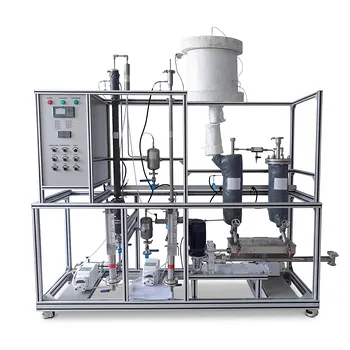
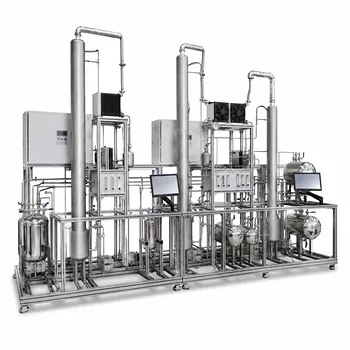
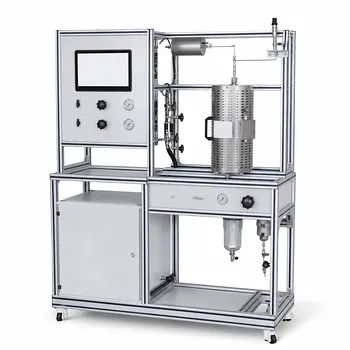
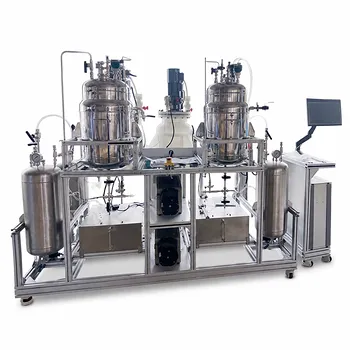
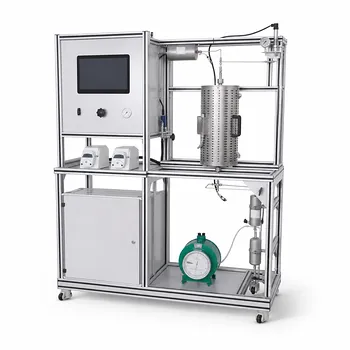
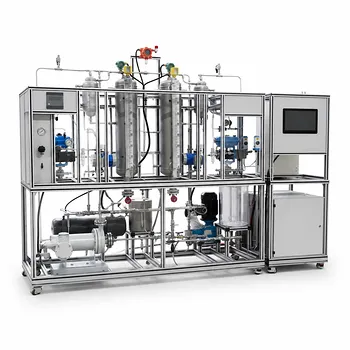
The hydrodesulfurization pilot plant transforms a textbook conflict into a living, controllable experiment.
By allowing students to precisely manipulate temperature, pressure, hydrogen flow, and catalyst type, the unit makes the inverse relationship between sulfur removal and octane number preservation immediately visible. The system generates real product samples that can be analyzed for both residual sulfur and Research Octane Number (RON), enabling learners to map the exact boundary where environmental compliance meets fuel quality.
The core lesson is that deeper desulfurization inevitably saturates high-octane olefins, but a well-designed pilot plant lets students discover the narrow operating window where 10–15 ppmw sulfur is achieved with only a marginal octane penalty. The trade-off is not something to eliminate—it is a design parameter to navigate.
The Inherent Conflict: Sulfur Removal vs. Octane Preservation
Chemistry of Hydrodesulfurization
In the catalytic reactor, organic sulfur compounds react with hydrogen over a catalyst—typically cobalt-molybdenum (CoMo) or nickel-molybdenum (NiMo)—to form hydrogen sulfide (H₂S).
This is a hydrogenolysis reaction: carbon-sulfur bonds break, and the sulfur atom is replaced by hydrogen.
Why Olefins Are the Collateral Damage
The same hydrogen atmosphere and active metal sites that cleave C–S bonds also attack carbon-carbon double bonds in olefins.
Olefins are precisely the high-energy molecules responsible for gasoline’s knock resistance and high octane number. When they become saturated paraffins, the octane value drops sharply.
Measuring the Loss
A gasoline stream entering the pilot plant might have an octane number of 92. After aggressive hydrotreating to reach ultra-low sulfur, students can observe the RON fall to 88 or lower.
The gap between the desired sulfur spec and the resulting octane loss defines the educational trade-off that must be optimized.
The Pilot Plant as an Adjustable Battleground
Controllable Variables That Shape the Trade-off
The unit operations pilot plant makes the trade-off tangible because every key parameter can be dialed in independently.
- Reactor temperature – Higher temperatures accelerate desulfurization but also speed up olefin saturation.
- Hydrogen partial pressure – More hydrogen pushes both reactions forward; lowering pressure can spare olefins but may miss the sulfur target.
- Liquid hourly space velocity (LHSV) – A higher feed flow rate reduces contact time, limiting olefin attack, yet may leave more sulfur untouched.
- H₂/oil ratio – Excess hydrogen ensures deep desulfurization but magnifies the octane penalty if not balanced carefully.
Catalyst Selection and Selectivity
The choice between CoMo and NiMo catalysts becomes a practical lesson in selectivity.
CoMo catalysts often show higher intrinsic desulfurization activity with less hydrogenation of olefins, making them a common choice for gasoline. NiMo catalysts, with stronger hydrogenation function, may cause a sharper octane dip. By swapping catalyst beds, students can directly compare the selectivity performance under identical conditions.
Real-Time Data Collection and Analysis
Steady-state operation of the pilot plant yields liquid product samples for gas chromatography (sulfur speciation) and octane engine testing.
Plotting these results—sulfur concentration (ppmw) on one axis, octane number change on the other—transforms the trade-off from an abstract concept into a quantitative curve with a clear optimal region.
Designing an Educational Experiment to Map the Trade-off
Step 1: Establish the Baseline
Students first analyze the untreated gasoline feed for its sulfur content and olefin distribution. This provides the reference point against which all product changes are measured.
Step 2: Vary Temperature and Pressure Systematically
A series of runs at progressively harsher conditions (e.g., increasing temperature from 300 °C to 360 °C while holding pressure constant) reveals how each increment shaves off more sulfur but also consumes more octane.
Step 3: Plot the Trade-off Curve
By plotting sulfur removal efficiency (%) versus octane number loss, a characteristic knee appears.
To the left, sulfur compliance is not reached; to the right, octane drops below acceptable limits. The "sweet spot" lies precisely at the bend of the curve.
Interpreting the "Sweet Spot"
At this optimum, students learn that the goal is not maximum desulfurization but sustainable desulfurization.
They see that a small relaxation in temperature or pressure can recover significant octane while still meeting the 10–15 ppmw sulfur target, an insight that textbooks alone cannot deliver.
Understanding the Trade-offs: Limitations and Pitfalls
The Over-Processing Trap
Pushing the reactor to extremes—high temperature and high pressure—may achieve sub-5 ppm sulfur, but at the cost of a severe octane penalty and excessive hydrogen consumption.
Students learn to identify the point of diminishing returns where further sulfur removal yields no practical benefit and ruins the fuel’s performance.
Catalyst Deactivation and Reproducibility
Over long runs, coke formation on the catalyst reduces activity. This can mislead students into thinking a condition is milder than it truly is.
Teaching the importance of catalyst activity monitoring and baseline regeneration reinforces good experimental practice and industrial realism.
Economic Awareness
Higher temperature and excess hydrogen increase operating costs. The pilot plant experiment can be extended to calculate hydrogen usage per barrel of feed, tying the trade-off to real refinery economics.
Students discover that the optimal technical point must also be justified financially, an essential systems-thinking skill.
Making the Right Choice for Your Educational Goal
After running the pilot plant, the optimum condition depends on the learning objective you set.
- If your primary focus is demonstrating fundamental principles: Have students generate a single clear trade-off curve by varying pressure at a fixed temperature, so the inverse relationship between sulfur and octane is unmistakable.
- If your primary focus is process optimization: Challenge students to identify the combination of temperature, pressure, and LHSV that achieves <15 ppm sulfur with less than a 1-unit octane number loss, documenting their decision logic.
- If your primary focus is catalyst evaluation: Ask students to compare CoMo and NiMo under identical conditions, analyzing the product’s sulfur and octane to recommend the most selective catalyst for a naphtha hydrotreater.
The hydrodesulfurization pilot plant does more than illustrate a trade-off—it puts the controls directly in students’ hands, teaching them to balance environmental imperatives with product quality in the same way they will on an industrial unit.
Summary Table:
| Operating Parameter | Impact on Sulfur Removal | Impact on Octane Preservation | Educational Trade-off Insight |
|---|---|---|---|
| Reactor Temperature | Higher temp increases removal efficiency. | Higher temp decreases octane (olefin saturation). | Must find the minimum temp that meets sulfur specs. |
| Hydrogen Pressure | Higher pressure accelerates removal. | Higher pressure saturates olefins, dropping octane. | Lower pressure preserves octane but limits desulfurization. |
| Space Velocity (LHSV) | Lower LHSV (longer contact) increases removal. | Lower LHSV allows more olefin saturation. | Higher LHSV spares olefins but leaves residual sulfur. |
| Catalyst Selection | CoMo/NiMo act as active agents. | CoMo preserves more olefins than NiMo. | Students compare catalyst selectivity directly. |
Empower Your Students with Hands-On Engineering Excellence
Bring real-world refining and chemical processes to life in your laboratory. LABPARK provides advanced Educational and Vocational Unit Operations Pilot Plants in chemical engineering, bioprocess & biotech, and environmental & water treatment.
Designed specifically for universities, research institutes, and enterprises, our pilot units enable students and researchers to master complex process dynamics—such as the hydrodesulfurization trade-off—through safe, hands-on experimentation.
Ready to elevate your training curriculum? Contact LABPARK today to discuss your custom pilot plant requirements!
Related Products
- Methane Cracking Educational Unit Operations Pilot Plant
- Electrolytic Hydrogen Production Educational Unit Operations Pilot Plant
- Steam Methane Reforming Hydrogen Production and Purification Educational Pilot Plant
- Green Anhydrous Ethanol Purification Extractive Distillation Unit Operations Training Pilot Plant
- Dual-Mode Rectification Pilot Plant for Practical Training Unit Operations
People Also Ask
- How do ethane vs naphtha cracking influence teaching pilot plant analytical configurations? Key Design Guide
- How can flow-NMR be integrated with pilot plant reactors to monitor kinetics? A Complete Guide
- How do cracking temperature and residence time affect olefin yield? Pilot Plant Guide
- How are utility consumption rates integrated into chemical pilot plant economic evaluations?
- How should OSBL investments be estimated? Key Steps to Avoid Budget Overruns in Pilot Plant Projects