The direct answer is that seeded crystallization dramatically reduces filtration cycle time in an integrated pilot plant when compared to spontaneous nucleation. Seeded methods produce larger, more uniform crystals that form a porous, low-resistance filter cake. Spontaneous nucleation, on the other hand, creates a mass of fine, needle-like particles that quickly blind the filter medium, drastically slowing liquid removal and extending cycle times.
While spontaneous nucleation may seem faster in the crystallizer, the downstream filtration penalty often outweighs that gain. The total batch cycle time is a composite function of crystallization kinetics and solid-liquid separation, and controlling crystal growth through seeding is the most effective lever to minimize it.
The Direct Link Between Crystal Morphology and Filtration Resistance
The physical form of the crystals you produce is the single biggest predictor of how long filtration will take. This is not a linear relationship; a small change in particle habit can cause an order-of-magnitude shift in cycle time.
How Spontaneous Nucleation Creates a Filtration Bottleneck
Spontaneous, or primary, nucleation occurs when a solution becomes supersaturated without the presence of existing crystal surfaces. This results in a rapid, uncontrolled birth of many nuclei simultaneously.
These nuclei typically grow into fine, needle-like crystals with a high aspect ratio. When this slurry reaches the filter, the long, thin crystals interlock and pack tightly. According to pilot plant data, this morphology can create a specific cake resistance as high as 6.9 × 10¹⁰ m/kg. That extreme resistance acts like a dense plug, severely impeding filtrate flow and ballooning the filtration cycle time.
How Seeded Crystallization Accelerates Filtration
Seeded crystallization introduces a controlled mass of small, pre-formed crystals into the supersaturated solution. The solute then deposits preferentially on these existing surfaces, directing the process toward growth rather than new particle creation.
This method fosters the development of thicker, rod-like crystals with a lower aspect ratio. These more compact, blocky particles form a much more permeable filter cake. The same pilot-scale measurements show a specific cake resistance around 9.0 × 10⁹ m/kg — nearly an order of magnitude lower. The result is a significantly higher filtrate flux and a dramatically shortened filtration cycle.
The Combined Cycle Time Trade-off
Optimizing a process based solely on the crystallizer or the filter in isolation will fail. You must analyze the total batch cycle time, which is the sum of the crystallization hold time and the filtration time.
The Fast-Crystallization, Slow-Filtration Paradox
A rapid crystallization, often driven by high supersaturation or fast cooling, generates a profusion of small particles. While this gets the material out of the crystallizer quickly, the resulting high cake resistance and low porosity in the filter can make liquid removal the dominant bottleneck in the plant.
The Viscosity Multiplier
The impact of crystal habit is magnified by the solvent’s kinematic viscosity. In a high-resistance cake, a more viscous solvent will compound the filtration delay exponentially. This is a critical consideration when choosing between solvents like TBME (low viscosity) and IPA (higher viscosity) in a pilot process. A poor crystal shape in IPA can be catastrophic for cycle time.
The Role of Pilot Plant Agitation and Scale-Up
Your pilot plant’s mixing system is a hidden variable. The agitation that keeps crystals suspended is also the primary driver of secondary nucleation.
The Danger of Contact Nucleation
In a stirred vessel, collisions between crystals, the impeller, and the vessel walls shatter existing particles, creating a new cascade of fine nuclei. This contact nucleation is influenced by agitation speed and collision energy. A pilot run with an overly aggressive impeller tip speed can inadvertently mimic the high-fines distribution of a spontaneous nucleation event, even when using a seeded process, thereby destroying the expected filtration performance.
Prioritizing Scale-Up Parameters
For a successful scale-up, the goal is to produce a coarse, uniform crystal size distribution. You must therefore prioritize impeller design, rotational speed, and cooling rate. Data from a pilot plant allows you to find the "sweet spot" of gentle agitation that provides adequate solid suspension without generating fines that will penalize the subsequent filtration and washing stages.
Understanding the Trade-offs
No single crystallization method is universally superior. An honest assessment requires acknowledging the specific cost-performance balance.
- Capital vs. Operating Cost: A seeded process might require a longer crystallization hold time and more precise seeding hardware, but the drastically reduced filtration time frees up downstream equipment capacity and reduces solvent-laden waste from a wetter cake.
- Purity vs. Throughput: Extremely slow growth in a seeded process can yield exceptionally high-purity crystals with minimal inclusions, but it may sacrifice overall plant throughput. Conversely, spontaneous nucleation is simple, but its poor filtration and washing characteristics often lead to higher product loss from liquid entrainment in the cake.
- Process Robustness: A process based on seeding is inherently more robust to minor fluctuations in raw material purity or cooling rates. An unseeded process is highly sensitive, and any variability can cause a runaway nucleation event, leading to process time variability and inconsistent product quality.
Making the Right Choice for Your Pilot Plant Goals
Your optimization target dictates the best approach. Use the following logic to guide your pilot-plant design of experiments.
- If your primary focus is minimizing total batch cycle time: Prioritize a seeded crystallization process. The slight increase in crystallizer time is overwhelmingly compensated for by the order-of-magnitude reduction in filtration time.
- If your primary focus is enhancing product purity and washing efficiency: Aim for a seeded process that produces coarse, uniform crystals. This morphology improves cake washing dramatically, reducing product loss and solvent consumption.
- If your primary focus is ensuring process robustness during scale-up: Use pilot data to identify the maximum allowable agitation speed that preserves your seeded crystal size distribution, preventing secondary nucleation from undermining your filtration step.
The key to mastering an integrated crystallization-filtration pilot plant lies in shifting your focus from individual unit operations to the entire solid-state journey, recognizing that the decisions made in the crystallizer irrevocably dictate the throughput and efficiency of the filter.
Summary Table:
| Parameter | Spontaneous Nucleation | Seeded Crystallization |
|---|---|---|
| Crystal Morphology | Fine, needle-like (high aspect ratio) | Thick, rod-like (low aspect ratio) |
| Cake Resistance | High (~6.9 × 10¹⁰ m/kg) | Low (~9.0 × 10⁹ m/kg) |
| Filtration Speed | Slow (prone to filter blinding) | Fast (high filtrate flux) |
| Process Robustness | Low (sensitive to fluctuations) | High (stable scale-up) |
Optimize Your Unit Operations with LABPARK
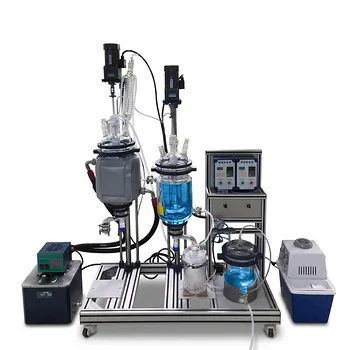
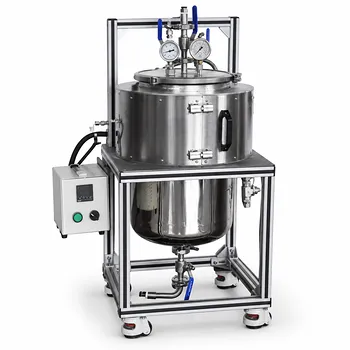
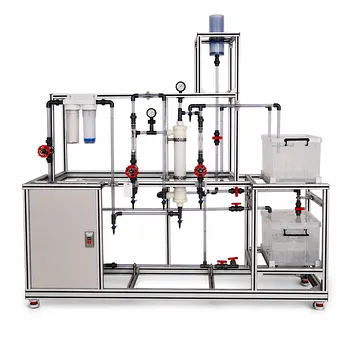
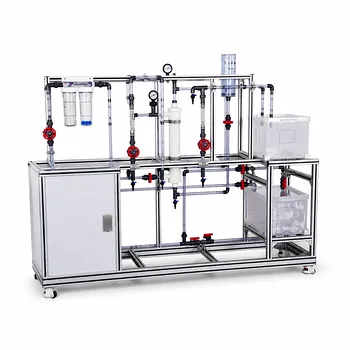
Are you looking to eliminate downstream bottlenecks and improve process efficiency? LABPARK provides premium Educational and Vocational Unit Operations Pilot Plants in chemical engineering, bioprocess & biotech, and environmental & water treatment.
Tailored for universities, research institutes, and enterprises, our advanced pilot plants help you master crystallization kinetics, filtration cycle times, and scale-up parameters with hands-on, industry-grade technology.
Ready to elevate your research and training? Contact our engineering experts today to find the perfect pilot plant solution!
Related Products
- Multi Functional Membrane Crystallization Educational Unit Operations Pilot Plant
- Potassium Salt Thermal Dissolution and Crystallization Separation Educational Unit Operations Pilot Plant
- Hot Filtration Educational Unit Operations Pilot Plant Laboratory System
- Constant Pressure Filtration Educational Unit Operations Pilot Plant
- Multifunctional Membrane Separation Educational Pilot Plant with Ultrafiltration, Nanofiltration, Reverse Osmosis
People Also Ask
- Control Crystallization Pilot Plant Secondary Nucleation: 4 Key Adjustments
- Why is precise temperature control critical in crystallization pilot plants? Key to Scale-Up Success
- What key factors should be considered when configuring a crystallization unit operations pilot plant?
- What are the benefits of integrating online PAT tools like ATR-FTIR into crystallization unit operations pilot plants?
- How to use crystallization pilot plant agitation speed to identify diffusion vs reaction growth?