Knowledge Environmental and Water Treatment Education How does feed pH affect RO rejection of organic acids? Optimize your pilot plant separation.
Author avatar

Tech Team · LABPARK

Updated 1 week ago

How does feed pH affect RO rejection of organic acids? Optimize your pilot plant separation.


The pH of your feed solution isn't just a chemical detail—it's a primary control knob for the entire reverse osmosis (RO) separation. Directly, as pH rises, the rejection efficiency of a weak organic acid like lactic acid increases dramatically because the acid shifts from a neutral, membrane-permeable form to a charged, highly-rejected ion. This single parameter can move rejection from ~94% at pH 2 to over 99% at pH 5.

For weak organic acids, pH dictates the molecule’s electrical charge. Since RO membranes repel charged species far more strongly than neutral ones, lifting the pH above the acid’s pKa converts the solute into a rejected ion, essentially turning a mediocre separation into a near-perfect one.

The Science Linking pH and Rejection

Why the Acid’s Form Matters

Lactic acid is a weak acid, meaning it exists in two forms depending on pH. Below its pKa (around 3.86), the molecule stays protonated and neutral. In this undissociated state, it behaves more like a small, uncharged organic molecule—it can slip through the membrane’s free-volume holes relatively easily. At pH 2, for instance, a pilot plant might see only 94% rejection.

The Shift to a Charged Ion

Once the pH climbs to 5, well above the pKa, lactic acid dissociates into a negatively charged carboxylate ion and a hydrogen ion. This is where the separation mechanics change fundamentally. The membrane surface, which typically carries a mild negative charge at neutral-to-alkaline pH, now exerts strong electrostatic repulsion on the like-charged lactate ion. The same physical barrier that barely impeded the neutral form now actively rejects the ion, pushing rejection to 99%.

It’s Not Just About Size

A common mistake is to think rejection depends only on molecular size. While the lactate ion is slightly hydrated and larger, the dominant effect is charge. The electrical double layer at the membrane-solution interface creates an energy barrier that charged species must overcome. Neutral molecules face no such barrier, so their transport remains governed by partitioning and diffusion. This charge-based mechanism explains why a small pH tweak can yield a 5% jump in rejection without any change in membrane pore size or operating pressure.

pH as a Precise Process Lever in Your Pilot Plant

Rapid, Reversible Control

Unlike changing a membrane module or altering the feed temperature (which involves thermal inertia), pH can be adjusted with a simple acid or base injection. The effect is near-instantaneous and fully reversible. This makes pH the go-to parameter for process development when you need to map the separation window of a new organic acid stream.

Navigating the pKa Sweet Spot

The steepest change in rejection happens within 1–2 pH units of the acid’s pKa. For lactic acid, operating at pH 4 (just above the pKa) might give intermediate rejection, but the full benefit materializes at pH 5 where >99% dissociation is guaranteed. In pilot trials, you’ll often run a pH profile to confirm where the rejection plateau begins, ensuring you haven’t overshot without benefit.

Signal for Process Monitoring

Because rejection is so pH-sensitive, a sudden drop in permeate quality can immediately point to a pH excursion. Operators can use online conductivity or TOC (total organic carbon) measurements as a proxy, triggering alarms if the rejection slips below the 99% threshold. This turns pH from a set-and-forget variable into a real-time indicator of membrane integrity or control system health.

Understanding the Trade-offs

Membrane Chemical Tolerance Limits

Thin-film composite (TFC) RO membranes have a specified pH operating range, typically 2–11 for short-term exposure. Consistently running at pH 5 is safe, but if your process requires pH 10 for a different acid, verify the membrane’s long-term stability. Hydrolysis of the polyamide layer accelerates at extreme alkaline conditions, gradually eroding salt rejection.

Scaling and Fouling Risks

Raising the pH can precipitate hardness ions (calcium, magnesium) as carbonates or hydroxides. A lactate salt solution at pH 5 might seem benign, but calcium lactate scaling is a real concern if the feed contains calcium. Anti-scalant dosing or chelation may be needed. Additionally, organic fouling characteristics can change with pH, so a pre-treatment strategy suitable at pH 2 may be insufficient at pH 5.

Selectivity Trade-offs in Mixed Solute Streams

If your feed contains multiple weak acids with different pKa values, a pH that perfectly rejects one may let another pass. You may also face co-rejection of desirable components—for example, if you’re trying to separate lactic acid from sugars, the charged lactate form will be rejected alongside any anionic impurities, potentially reducing your overall separation efficiency for the sugar. The target product’s location (permeate or retentate) must guide the pH strategy.

Interplay with Other Operating Parameters

While pH is powerful, it doesn’t work in isolation. At very high pH, the increased osmotic pressure from fully dissociated ions might reduce net driving force. The supplementary references remind us that flux and rejection also drop at lower operating pressures or when concentration polarization builds. Therefore, after setting the optimal pH, you still need to maintain adequate crossflow velocity and transmembrane pressure to realize the 99% rejection figure in practice.

Making the Right Choice for Your Separation Goal

Tailoring pH to your objective is the final step in transforming a fundamental principle into a practical operating recipe.

  • If your primary focus is maximizing product recovery in the permeate: Operate at a low pH (e.g., pH 2) where lactic acid is neutral and passes through, but recognize you’ll need a subsequent step to concentrate the acid if 94% purity isn’t enough.
  • If your primary focus is removing organic acids as waste or capturing them in the retentate: Shift the pH above the acid’s pKa (pH 5 or higher) to lock in >99% rejection, effectively concentrating the acid for disposal or further use.
  • If your primary focus is pilot-scale data generation for scale-up: Run a systematic pH ladder experiment to map rejection vs. pH, confirming the inflection point aligns with the known pKa and documenting the impact on flux, fouling rate, and cleanability—this becomes your design basis for a full-scale system.

Use pH not as a troubleshooting afterthought, but as the first intentional lever you pull when designing a RO separation for any weak organic acid.

Summary Table:

Feed pH Level Acid Form & Charge Primary Rejection Mechanism Rejection Rate Primary Application Focus
Low pH (< pKa) Protonated (Neutral) Size exclusion / diffusion ~94% Maximizing organic acid recovery in permeate
High pH (> pKa) Dissociated (Negatively Charged) Electrostatic repulsion >99% Concentrating or removing acids in retentate

Optimize Your Separation Processes with LABPARK

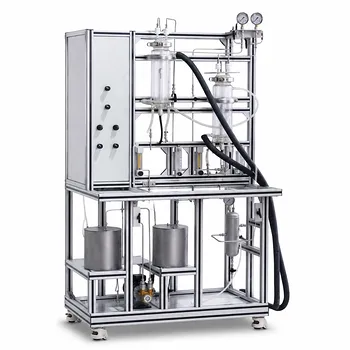
To achieve precise control over critical parameters like pH, flow rate, and pressure in your research, you need reliable equipment. LABPARK provides state-of-the-art Educational and Vocational Unit Operations Pilot Plants in chemical engineering, bioprocess & biotech, and environmental & water treatment. Designed specifically for universities, research institutes, and enterprises, our pilot plants enable accurate data generation and seamless process scale-up.

Ready to elevate your research and training capabilities? Contact LABPARK today to find the ideal pilot plant solution for your facility!

Related Products

People Also Ask

Related Products

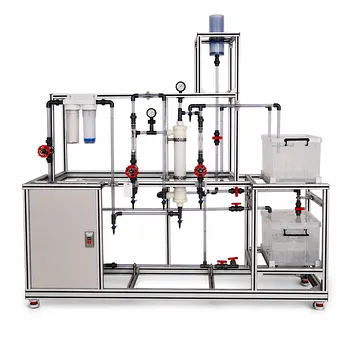
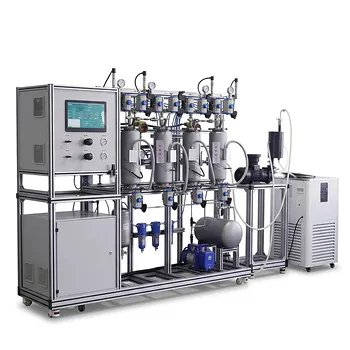
Multi-Functional Membrane Separation Educational Pilot Plant for Unit Operations Lab

Multi-Functional Membrane Separation Educational Pilot Plant for Unit Operations Lab

The Multi-functional Membrane Separation Educational Unit Operations Pilot Plant is an integrated bench-scale laboratory system designed for teaching undergraduate engineering education. It features Ultrafiltration, Nanofiltration, and Reverse Osmosis modules in a compact, mobile unit for practical hands-on learning.

Photocatalytic Membrane Separation and Degradation Unit Operations Pilot Plant

Photocatalytic Membrane Separation and Degradation Unit Operations Pilot Plant

Bench-scale pilot plant integrating photocatalytic degradation with membrane separation for engineering education. Study advanced oxidation, microfiltration, and hybrid processes using industrial sensors. Features safety light-blocking curtain, low-noise compressor, and durable stainless-steel construction.

Ultrafiltration Membrane Separation Educational Pilot Plant

Ultrafiltration Membrane Separation Educational Pilot Plant

This ultrafiltration membrane separation educational pilot plant enables undergraduate students to process PVA solutions, study hollow fiber membrane dynamics, and perform quantitative analysis with spectrophotometry for hands-on learning of unit operations and industrial maintenance and membrane cleaning protocols.

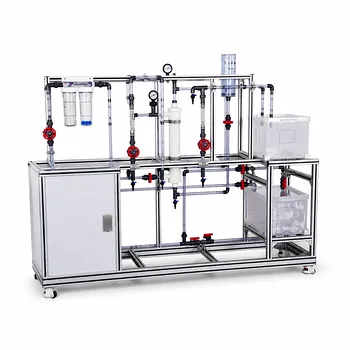
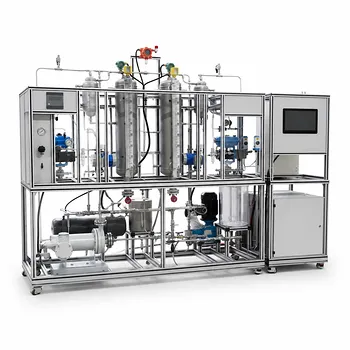
Multifunctional Membrane Separation Educational Pilot Plant with Ultrafiltration, Nanofiltration, Reverse Osmosis

Multifunctional Membrane Separation Educational Pilot Plant with Ultrafiltration, Nanofiltration, Reverse Osmosis

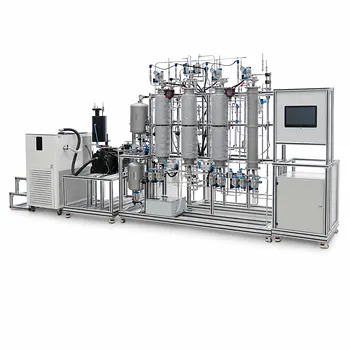
An integrated laboratory bench-scale membrane separation system for higher education engineering labs combining Ultrafiltration, Nanofiltration, and Reverse Osmosis processes. Features industrial PLC control with touch-screen HMI, transparent piping, and academic assessment software. Ideal for chemical and environmental engineering curricula.

Hollow Fiber Ultrafiltration Membrane Separation Educational Pilot Plant

Hollow Fiber Ultrafiltration Membrane Separation Educational Pilot Plant

Explore our hollow fiber ultrafiltration membrane separation educational pilot plant for hands-on learning of industrial ultrafiltration processes, flux analysis, fouling mitigation, and process control. Compact, customizable, and built for engineering labs.

Multi Functional Membrane Crystallization Educational Unit Operations Pilot Plant

Multi Functional Membrane Crystallization Educational Unit Operations Pilot Plant

Integrated bench-scale membrane crystallization pilot plant for engineering education. Provides hands-on training in advanced separation technologies, combining membrane distillation crystallization and process intensification. Features variable scaling vessels, industrial-grade flow control, and interactive digital data acquisition. Customizable for university labs.

Alkaline Membrane Water Electrolysis Educational Pilot Plant Unit Operations Training System

Alkaline Membrane Water Electrolysis Educational Pilot Plant Unit Operations Training System

Hands-on educational pilot plant for alkaline membrane water electrolysis hydrogen production, integrating unit operations training with industrial PLC control, real-time data logging, customizable design, durable 316L stainless steel construction, explosion-proof safety, and modern 5G connectivity for university laboratories.

Multi-Component Gas Pressure Swing Adsorption Pilot Plant for Unit Operations Education

Multi-Component Gas Pressure Swing Adsorption Pilot Plant for Unit Operations Education

Multi-component gas pressure swing adsorption pilot plant designed for unit operations education. Features four-tower configuration, IoT touchscreen control, dual regeneration, and real-time breakthrough curve analysis for engineering training with safety interlocks and mobile frame simulates industrial PSA processes.

Gas-Solid Heterogeneous Separation Demonstration Educational Unit Operations Pilot Plant

Gas-Solid Heterogeneous Separation Demonstration Educational Unit Operations Pilot Plant

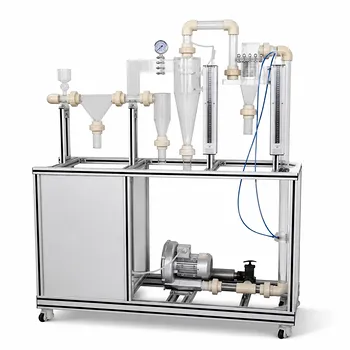
Comprehensive visual transparent gas-solid separation pilot plant for chemical engineering labs. Demonstrates gravity settling inertial settling cyclone and bag filter technologies. Enables real-time analysis of fluid-particle mechanics pressure drop and collection efficiency. Ideal for undergraduate unit operations courses.

Hot Filtration Educational Unit Operations Pilot Plant Laboratory System

Hot Filtration Educational Unit Operations Pilot Plant Laboratory System

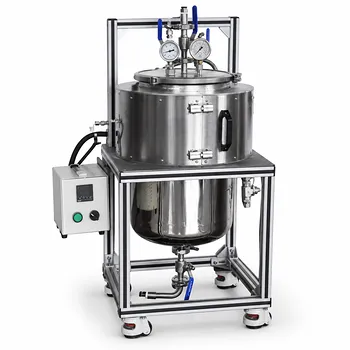
This integrated laboratory bench-scale hot filtration pilot plant enables students to study solid-liquid separation under thermal conditions, featuring a stainless steel vessel, removable heating jacket, and multi-layer filter plates for unit operations education, ideal for chemical engineering laboratory curriculum.

Multimodal Absorption and Desorption Pilot Plant for Unit Operations Training

Multimodal Absorption and Desorption Pilot Plant for Unit Operations Training

Multimodal absorption and desorption pilot plant for higher education labs. Bridges theory and industrial practice with transparent packed columns, three operational modes (real-material, simulated, semi-physical), and SCADA control. Students explore mass transfer, column hydraulics, and process control. Customizable.

Educational Pressure Swing Adsorption Ethylene Capture Unit Operations Pilot Plant

Educational Pressure Swing Adsorption Ethylene Capture Unit Operations Pilot Plant

Advanced educational pilot plant for pressure swing adsorption ethylene capture provides comprehensive hands-on training in industrial gas separation processes, featuring an eight-column PSA system, real-time data acquisition, and fully customizable design for chemical engineering unit operations laboratories and research.

Pressure Swing Adsorption Educational Unit Operations Pilot Plant

Pressure Swing Adsorption Educational Unit Operations Pilot Plant

Integrated bench-scale pressure swing adsorption pilot plant for hands-on teaching of gas-solid separation, mass transfer, and process optimization using nitrogen-oxygen model, featuring dual-column design, industrial touchscreen control, digital assessment suite, and customizable hardware and software configurations for educational laboratories.

Continuous Sieve-Plate Distillation Pilot Plant for Unit Operations Laboratory Education

Continuous Sieve-Plate Distillation Pilot Plant for Unit Operations Laboratory Education

Integrated pilot-scale teaching system for continuous sieve-plate distillation studies. Visual demonstration of tray hydraulics, flexible feed positions, and automatic reflux control for hands-on unit operations education in engineering labs. Designed for higher education engineering laboratories.

Bio-fermentation Ethanol Production Practical Training Unit Operations Pilot Plant

Bio-fermentation Ethanol Production Practical Training Unit Operations Pilot Plant

Bio-fermentation ethanol production pilot plant for hands-on training in unit operations: fermentation, solid-liquid filtration, membrane separation, and distillation. Bridges theory with industrial practice using industrial-grade components, customizable for university labs. Hybrid automated and manual control for comprehensive learning.

Fixed-Bed Chemical Reaction and Gas Dust Tar Removal Unit Operations Pilot Plant

Fixed-Bed Chemical Reaction and Gas Dust Tar Removal Unit Operations Pilot Plant

Integrated educational pilot plant for studying catalytic gas-solid reactions and downstream gas purification. Features dual fixed-bed reactor, three-stage heating, and touchscreen control for hands-on engineering training. Ideal for chemical and environmental engineering curricula.

Natural Product Extraction Unit Operations Training Pilot Plant

Natural Product Extraction Unit Operations Training Pilot Plant

Integrated natural product extraction pilot plant for chemical engineering training bridges theory and industrial practice with modular extraction and evaporation/concentration units, hybrid touchscreen and manual control, realistic process simulation, and self-contained softened water and vacuum utilities.

Multi-Reactor Educational Pilot Plant for Reaction Engineering Unit Operations

Multi-Reactor Educational Pilot Plant for Reaction Engineering Unit Operations

Integrated bench-scale educational pilot plant for chemical engineering teaching featuring fixed bed fluidized bed and stirred tank reactors with web-based digital twin controls and safety interlocks for hands-on unit operations and reaction engineering comparative studies in one compact system.

Dual-Mode Rectification Pilot Plant for Practical Training Unit Operations

Dual-Mode Rectification Pilot Plant for Practical Training Unit Operations

Industrial-scale dual-mode rectification pilot plant for chemical engineering practical training. Features real-material and simulated-material operation modes, sieve-plate column with sight glasses for visual observation of hydrodynamics, and customizable SCADA control for safe, hands-on learning of unit operations and mass transfer.

Bench Scale Dual Column Gas Separation and Capture Educational Pilot Plant

Bench Scale Dual Column Gas Separation and Capture Educational Pilot Plant

This dual-column educational pilot plant provides hands-on teaching of gas adsorption, separation, and capture processes. It features stainless steel columns, regeneration up to 400°C, and a 15.6-inch touchscreen PLC for TSA and PSA studies in chemical engineering curricula, process simulation.


Leave Your Message