The single most important variable for seamless scale-up is not the flow rate or temperature—it’s how you program the gradient. To transfer a chromatographic separation from a bench-scale column to a pilot plant without loss of purity or recovery, the solvent gradient must be expressed in scalable terms: specifically, as a change in solvent composition over a defined number of Column Volumes (CVs), not over a fixed number of minutes. This simple shift in programming eliminates the most common cause of scale‑up failure, making the method inherently independent of column size.
The core insight: A gradient defined in Column Volumes normalizes the separation process. The same “%B change per CV” slope exposes every solute molecule in every scale column to an identical chemical environment, ensuring that the concentration profile—and therefore product purity and yield—remains consistent when moving from lab to pilot plant.
Why Time-Based Gradients Fail at Scale
When you program a gradient in minutes, the actual gradient experienced by the solute depends directly on the column’s physical dimensions.
A pilot column with 10 times the internal volume of a lab column would need a proportionally longer time to deliver the same gradient shape—yet a time‑based program would deliver it in the same duration, effectively compressing the gradient and destroying the separation.
This occurs because the key driver is not clock time but how many bed volumes of mobile phase have passed through the stationary phase.
A solute in a larger column simply traverses more bed length before the solvent composition arrives, altering elution times and band spacing.
Column Volumes: The Universal Coordinate System for Chromatography
Using Column Volumes as the gradient’s base unit makes the method portable across all scales.
One CV equals the total liquid volume inside the packed bed (volume of packed column × column porosity).
Defining a gradient as “from 5% to 95% B over 10 CV” means the solvent composition changes linearly per unit bed volume, independent of column diameter or length.
This approach ensures the chemical environment at any given point inside the column—and thus the local retention factor of every solute—is the same regardless of scale, provided the packing quality is maintained.
How to Program a CV-Based Gradient in a Pilot Plant
Most modern pilot‑scale chromatography controllers allow you to enter gradient segments directly in CV units.
If your system requires time input, you calculate the gradient duration by multiplying the desired number of CVs by the column’s actual volumetric flow rate.
- Example: A 1 L column operated at 200 mL/min needs 25 minutes for a 5‑CV gradient.
Scale‑up to a 10 L column (same linear velocity, so flow rate becomes 2000 mL/min) still demands 25 minutes for 5 CV. The gradient shape in CV terms is perfectly preserved.
This simple conversion makes the gradient automatically self‑correct when flow rate scales with column cross‑sectional area.
Accounting for System Dwell Volume
A CV‑based gradient only governs the composition at the column inlet if the system dwell volume (the liquid volume from gradient mixer to column head) is known and accounted for.
A significant mismatch in dwell volume between scales can shift the effective gradient start, altering separation selectivity.
For seamless transfer, either measure and match dwell volumes across scales (by adding or removing mixing loops) or program an isocratic hold at the start of the gradient that absorbs the difference.
This ensures the “%B per CV” slope you see on the computer applies exactly at the column entrance.
Maintaining Chromatographic Efficiency at Scale: More Than Just the Gradient
Even a perfectly programmed CV gradient will fail if the column’s physical performance degrades at pilot scale.
Supplementary references highlight that Height Equivalent to a Theoretical Plate (HETP) must be preserved to maintain the sharp concentration profile.
At larger diameters, radial flow maldistribution and eddy diffusion can broaden bands.
Pilot plants counteract this by incorporating optimized distributor plates or baffles that promote plug flow and minimize wall effects.
Educational and pilot systems often feature adjustable bed heights and interchangeable flow distributors to demonstrate this critical interplay.
When the column’s efficiency (HETP) remains constant, a CV‑based gradient will reproduce the same separation profile from milligram to multi‑kilogram scales.
Balancing Flow Velocity and Gradient Steepness
For gradient methods, the linear velocity (cm/min) should ideally stay constant during scale‑up, which means scaling volumetric flow proportionally to column cross‑sectional area.
This maintains the same residence time and preserves the effective gradient slope per CV.
If pressure‑drop constraints or particle‑size changes force a lower linear velocity, the gradient’s effective residence time increases.
In such cases, you may slightly flatten the gradient slope (increase the number of CVs over which the composition changes) to compensate and keep the separation comparable.
Understanding the Trade‑offs
- Throughput vs. Resolution: Wider columns boost throughput but risk eddy diffusion and band broadening. For difficult separations with low selectivity (α < 1.15), longer, narrower columns are preferred, and gradient steepness must be carefully optimized.
- Gradient Complexity vs. Economic Viability: Multi‑step gradients can improve peak resolution but complicate solvent recovery in integrated distillation units. Pilot plants often favour simpler, single‑solvent gradients that are easier to recycle and reduce cost, even if they require more CVs.
- Safety and Exothermic Effects: On scale‑up, rapid changes in solvent polarity can generate exothermic heat when wetting the adsorbent, and pressurized flows may cause localized boiling. These factors dictate solvent choice (preferring less volatile, non‑flammable mixtures) but do not alter the fundamental need for CV‑based programming.
Making the Right Choice for Your Goal
All recommendations assume you have defined your gradient in CV units—this is the non‑negotiable starting point.
- If your primary focus is direct method transfer and product purity: Always program gradients in CV, measure and harmonize system dwell volume between scales, and verify HETP by tracer pulse tests on the pilot column before the first production run.
- If your primary focus is maximizing throughput while preserving separation: Scale flow based on constant linear velocity, use CV-based gradients, and invest in high‑quality flow distributors to minimize axial dispersion in large‑diameter columns.
- If your primary focus is process economics and sustainability: Design gradients as linear, single‑solvent ramps whenever possible, specify CV-based control for reliability, and integrate solvent recovery early. The simplicity of the gradient pays for itself in reduced distillation cost and lower environmental impact.
By making Column Volumes the language of your gradient, you turn the pilot plant from a scaling risk into a predictable, repeatable unit operation.
Summary Table:
| Feature | Time-Based Gradients | CV-Based Gradients |
|---|---|---|
| Scale Independence | No (Fails during scale-up) | Yes (Portable across all scales) |
| Gradient Control | Fixed duration in minutes | Linear change per bed volume |
| Flow Rate Adjustments | Requires manual recalculation | Automatically self-corrects |
| Separation Quality | High risk of peak compression | Consistent purity and yield |
Optimize Your Chromatography Scale-Up with LABPARK
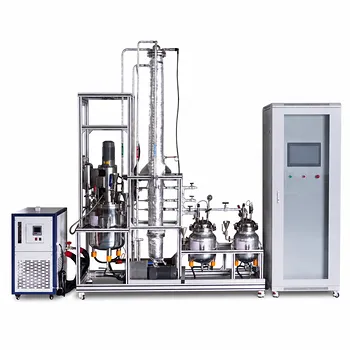
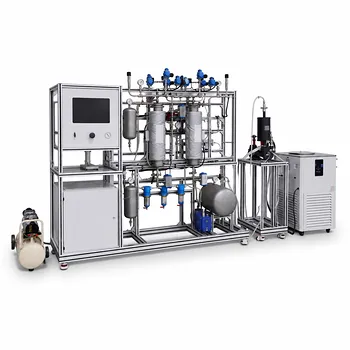
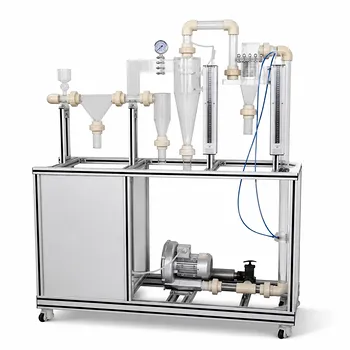
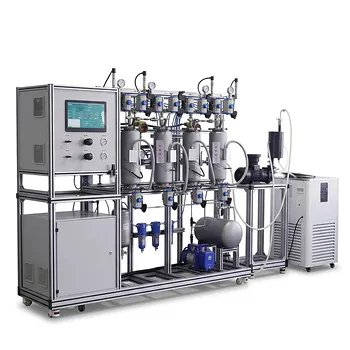
Transitioning from lab-scale chromatography to pilot-scale production requires precision and reliable equipment. LABPARK provides state-of-the-art Educational and Vocational Unit Operations Pilot Plants in chemical engineering, bioprocess & biotech, and environmental & water treatment designed for universities, research institutes, and enterprises.
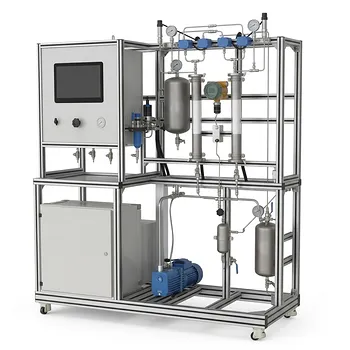
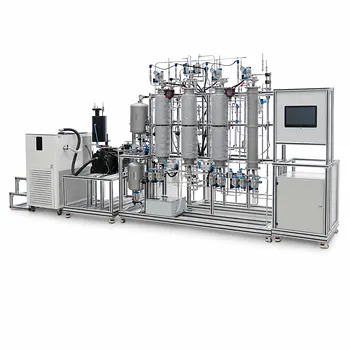
Our pilot systems feature advanced gradient control interfaces, adjustable bed heights, and optimized flow distributors to ensure your Column Volume (CV) programming translates to perfect separations every time.
Ready to enhance your pilot plant capabilities and secure seamless scale-up? Contact LABPARK today to discuss your custom pilot plant needs!
Related Products
- Multifunctional Membrane Separation Educational Pilot Plant with Ultrafiltration, Nanofiltration, Reverse Osmosis
- Multi-Functional Membrane Separation Educational Pilot Plant for Unit Operations Lab
- Carbon Material Thermal Pretreatment Multiphase Separation Educational Pilot Plant
- Bench Scale Dual Column Gas Separation and Capture Educational Pilot Plant
- Gas-Solid Heterogeneous Separation Demonstration Educational Unit Operations Pilot Plant
People Also Ask
- How do PEI, PVDF, and PSU membranes compare in pilot plants? Find the best fit.
- Pervaporation vs. Vapor Permeation: Handling Suspended Solids in Membrane Pilot Plants
- What are the trade-offs of polymer vs inorganic membranes in teaching pilot plants? Key laboratory comparison.
- What are the advantages of membrane separation in pilot plants? Efficient Organic Vapor Recovery
- How can operators optimize operating conditions and cleaning protocols in membrane separation pilot plants to mitigate fouling?