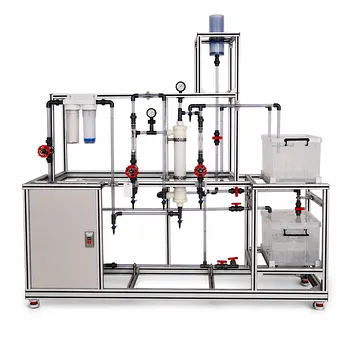
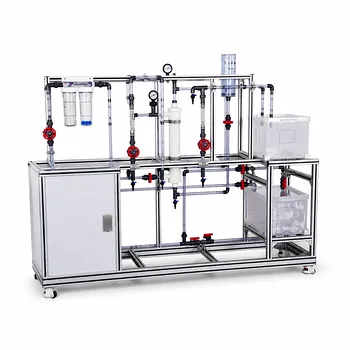
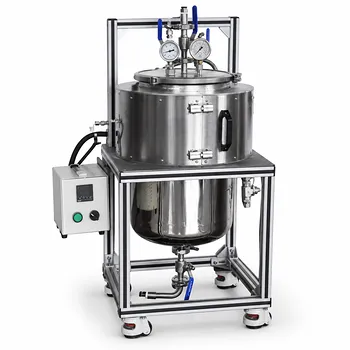
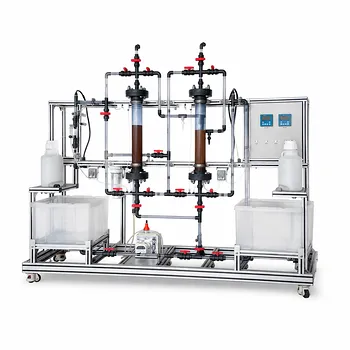
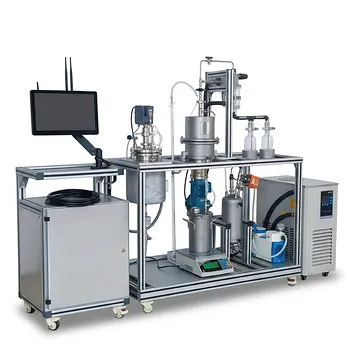
The selection is entirely dictated by the physical and chemical nature of your target solute. For a bioprocess pilot plant, the rule is elegantly simple: choose Microfiltration (MF) if your goal is to retain large particles like cells and debris, Ultrafiltration (UF) if you need to concentrate or fractionate dissolved proteins and macromolecules, and Nanofiltration (NF) if you must separate small organic molecules or selectively remove divalent ions based on charge. You are essentially matching your solute's size and charge to the membrane's mechanism of sieving or electrostatic rejection.
The definitive guide for instructors is to frame the choice around the solute's scale. Microfiltration stops what you can see (cells, >0.1 μm) via physical sieving. Ultrafiltration captures what you can't see but can weigh (proteins, >2 kDa) by size. Nanofiltration adds an electrostatic dimension, rejecting what you can measure by its charge (multivalent ions, 200-2000 Da).
Building a Decision Framework: Size, Mechanism, and Scale
The key to teaching this is anchoring the student's understanding not just in pore size, but in the dominant separation mechanism. The driving force (pressure) and the rejection principle change significantly as the target solute gets smaller.
Microfiltration: The First Line of Clarification
Microfiltration is almost exclusively a size-exclusion sieving mechanism. Its membranes serve as physical barriers with pores large enough to let dissolved molecules flow through but small enough to block discrete, suspended particles.
- Target Solute Scale: Whole cells (yeast, bacteria, mammalian cells), cell debris, large colloids, and emulsions.
- Pore Size Scope: Typically 0.1 to 10 μm.
- Operating Pressure: Very low, typically below 2 bar.
In a pilot plant setting, this is the unit you select for a "Cell Harvesting" or "Clarification" experiment. An instructor demonstrates that the permeate can still contain a full spectrum of proteins, sugars, and salts because the pore size is far too large to retain them.
Ultrafiltration: Entering the Realm of the Macromolecule
Ultrafiltration shifts the focus from visible particles to dissolved macromolecules. While still primarily a sieving process, the separation is defined by the Molecular Weight Cut-Off (MWCO), which requires a deeper conceptual understanding than simply reading a pore size.
- Target Solute Scale: Proteins, polysaccharides, nucleic acids, and viruses.
- Pore Size Scope: Typically 1–100 nm (or expressed as >2000 Daltons).
- Operating Pressure: Moderate, in the 1–10 bar range.
The critical teaching point here is size-based differentiation. Select UF for experiments like "Protein Concentration" or "Buffer Exchange." You show students that a 30 kDa MWCO membrane lets small peptides, salts, and water pass freely into the permeate while efficiently concentrating a target antibody (150 kDa) in the retentate. This allows them to visualize the principle of the "factor of 10" rule—selecting a MWCO at least ten times smaller than the target molecule to prevent significant loss.
Nanofiltration: The Hybrid Separator
Nanofiltration introduces a non-mechanical, chemical separation mechanism. It is the correct choice when the target solute is small and charge interactions become the dominant factor. Selecting NF moves beyond simple physical sieving into a domain where membrane surface chemistry controls rejection.
- Target Solute Scale: Small organic molecules (sugars, antibiotics) and specific salts (divalent vs. monovalent).
- Pore Size Scope: Tightly clustered around the 1–2 nm range.
- Operating Pressure: Higher, between 3–20 bar.
Choose NF for experiments like "Water Softening" or "Desalting of Small Organics." An instructor can demonstrate a seemingly paradoxical separation: a negatively charged NF membrane will reject divalent sulfate (SO₄²⁻) and divalent calcium (Ca²⁺) ions almost completely through electrostatic repulsion, while allowing a high percentage of monovalent sodium (Na⁺) and chloride (Cl⁻) ions to pass. This effectively teaches that rejection is not based on the relative atomic size of Na⁺ versus Ca²⁺, but on the strength of their ionic charge.
Understanding the Trade-offs: Purity, Flux, and Fouling
Selecting the right unit for a pilot plant also means teaching the operational consequences. Tighter membranes do not simply mean "better" separation; they bring predictable operational trade-offs.
The Inverse Relationship of Size and Pressure
An instructor must connect membrane selection to plant infrastructure. Moving from MF to UF to NF requires a drastic increase in pump capacity and a design suited for higher operating pressures. A pump system ideal for a 1-bar MF experiment is completely inadequate for a 20-bar NF run. Simultaneously, the permeate flux rate drops dramatically as pore size decreases, fundamentally altering the required membrane area and processing time for a given batch.
The Real-World Imperative of Fouling
No lesson plan on membrane selection is complete without addressing fouling. In MF and UF bioprocessing experiments, protein-induced fouling and the concentration polarization layer—where rejected solutes build up a gel-like barrier at the membrane surface—often dictate performance more than the nominal pore size does. Instructors must use these pilot units to teach that the choice of an UF membrane for protein concentration must immediately be paired with training on controlling cross-flow velocity and developing effective Cleaning-in-Place (CIP) protocols to manage this fouling.
Making the Right Choice for Your Training Goal
Before selecting a membrane unit, the instructor must define the primary pedagogical objective of the laboratory session.
- If your primary focus is demonstrating cell removal and primary clarification: Begin with Microfiltration. Use a yeast suspension to show quantitative removal of biomass while all dissolved components pass through.
- If your primary focus is teaching protein concentration and the concept of molecular weight cut-off: Select Ultrafiltration. Run a two-protein mixture (e.g., albumin and a small peptide) to demonstrate fractionation based on molecular size, directly linking membrane selection to product yield.
- If your primary focus is exploring charge-based separations for small molecules or salt removal: Choose Nanofiltration. An experiment separating divalent from monovalent ions or desalting a small organic dye makes the electrostatic mechanism tangible.
The power of a well-equipped pilot plant lies in letting students make this choice, then experience firsthand how the very nature of separation—from physical sieving to chemical rejection—changes as the solute size shrinks from a whole cell to a single ion.
Summary Table:
| Membrane Type | Target Solute | Pore Size / MWCO | Operating Pressure | Separation Mechanism |
|---|---|---|---|---|
| Microfiltration (MF) | Cells, cell debris, large colloids | 0.1–10 μm | < 2 bar | Size-exclusion physical sieving |
| Ultrafiltration (UF) | Proteins, macromolecules, viruses | >2 kDa (1–100 nm) | 1–10 bar | Size-based sieving (MWCO) |
| Nanofiltration (NF) | Small organics, divalent ions | 200–2000 Da (1–2 nm) | 3–20 bar | Electrostatic charge & sieving |
Equip Your Lab with Industry-Grade Filtration Technology
To effectively teach these complex separation principles, students need hands-on experience with robust, real-world equipment.
LABPARK provides premium Educational and Vocational Unit Operations Pilot Plants in chemical engineering, bioprocess & biotech, and environmental & water treatment. Tailored specifically for universities, research institutes, and enterprises, our training systems help instructors demonstrate membrane mechanisms, fouling, and scale-up challenges in a controlled academic environment.
Ready to upgrade your biotechnology lab? Contact LABPARK today to discuss your pilot plant needs!
Related Products
- Multifunctional Membrane Separation Educational Pilot Plant with Ultrafiltration, Nanofiltration, Reverse Osmosis
- Multi-Functional Membrane Separation Educational Pilot Plant for Unit Operations Lab
- Ultrafiltration Membrane Separation Educational Pilot Plant
- Hollow Fiber Ultrafiltration Membrane Separation Educational Pilot Plant
- Hot Filtration Educational Unit Operations Pilot Plant Laboratory System
People Also Ask
- How do PEI, PVDF, and PSU membranes compare in pilot plants? Find the best fit.
- Pervaporation vs. Vapor Permeation: Handling Suspended Solids in Membrane Pilot Plants
- What are the trade-offs of polymer vs inorganic membranes in teaching pilot plants? Key laboratory comparison.
- What are the advantages of membrane separation in pilot plants? Efficient Organic Vapor Recovery
- How can operators optimize operating conditions and cleaning protocols in membrane separation pilot plants to mitigate fouling?