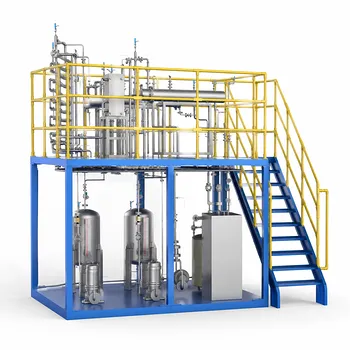
The foundational configuration for studying alkene metathesis, specifically the conversion of ethene and butenes to propene, centers on a high-pressure fixed-bed reactor tightly integrated with a two-column distillation train. This pilot plant setup is not arbitrary; it is a direct physical representation of the reaction-separation-recycle loop that defines the economic viability of the process. The configuration physically enforces the equilibrium limitations for students and researchers to observe, measure, and ultimately overcome.
The definitive pilot plant for analyzing the alkene metathesis flow sheet must pair a reactor operating above 530 K and 30 bar with a dedicated ethene-recycle column and a propene-purification column. This closed-loop system transforms a simple equilibrium reaction into a dynamic, multi-unit study of mass balance, separation efficiency, and the critical role of purge streams in managing by-product accumulation.
Configuring the Metathesis Reaction Section
The reactor is the heart of the process, but in a pilot plant, its true purpose is to teach parametric sensitivity. The operating window isn't just a specification; it's a variable to be tested against catalyst stability and selectivity.
Defining the Reactor Operating Envelope
The primary reference establishes a fixed-bed reactor at a minimum temperature of 530 K and a pressure of 30-35 bar. These are not starting points for optimization in a teaching environment. They are the core setpoints required to shift the metathesis equilibrium toward a commercially relevant propene yield. The pilot plant must be able to safely explore excursions from this baseline.
The reactor itself must be a continuous flow system. While a batch reactor can generate kinetic data as described in the supplementary concepts, studying the full process flow requires steady-state operation. This steady state is the only way to observe the long-term accumulation of heavy by-products and the real-time impact of the recycle loops.
Integrating Analytics for Mass Balance Closure
A reactor alone is a black box. You must configure the skid with online gas chromatography (GC) sampling immediately at the reactor outlet and across every column stream. Without this, the primary goal—analyzing mass balances in the recycle loops—fails.
These analytical taps allow the direct calculation of the key equilibrium metric: ethene conversion per pass versus overall yield. This distinction is the core lesson of the integrated plant, teaching how separation and recycle artificially boost the performance of a thermodynamically limited reaction.
Designing the Separation Sequence
The downstream configuration is what elevates this from a reaction experiment to a unit operations study. The distillation sequence must solve a specific binary separation problem twice in series, with a pure recycle stream as the critical output.
The Ethene Column for Unreacted Feed Recovery
The first column downstream of the reactor is the ethene fractionator. Its single objective is to take the high-pressure reactor effluent and produce an ethene-rich distillate for direct recycle. This teaches the physical constraint of recycle loop design: the separation energy cost is dictated by the need to recompress or re-pressurize this top stream back to the 30–35 bar reactor inlet.
Running this column sub-optimally demonstrates a cascade failure. If ethene is not sharply separated and drags heavy components overhead, those heavies accumulate in the reactor loop and poison the catalyst. This hard-fought physical insight is difficult to grasp in pure simulation.
The Propene Column for Product Purification
The bottoms from the ethene column, now rich in propene and unreacted butenes, must be split. A propene column is required to isolate the product. The pilot plant design here must allow for the study of a difficult separation, as the relative volatility between propene and butenes is low.
The deep need addressed here is trade-off analysis. You operate this column to directly link propene purity targets to energy consumption (reboiler duty) and product loss in the butene bottoms stream. The bottom stream itself must be recycled, completing a second essential loop back to the reactor.
Beyond the Basic Setup: Measuring True Performance
The static configuration of two columns and a reactor is the minimum. To achieve the deep need of diagnosing process health, you must add tools to measure non-ideality.
Diagnosing Recycle Loop Dynamics with Tracers
A constant flow rate does not imply good flow. The supplementary insight on Residence Time Distribution (RTD) is critical here. The pilot plant should have injection ports for a non-reacting tracer.
When introduced into the ethene recycle line, an early breakthrough peak on a downstream detector diagnoses gas-phase channeling in the fixed-bed reactor. Bypassing invalidates the mass balance data, and the RTD study provides the evidence to correct it, either by re-packing the bed or modifying the inlet distributor—a direct application of non-ideal flow diagnostics.
The Critical Role of the Purge Stream
The separation sequence is chemically imperfect. The primary reference correctly notes the need to remove inerts and by-products like butanes. The pilot plant configuration must, therefore, have a controllable purge stream on the butene recycle loop.
You do this to illustrate the fundamental tension in recycle purity. High recycle rates maximize reactant conversion but also concentrate inert by-products. The pilot plant needs to allow users to adjust the purge rate and directly observe its effect on steady-state reactor conversion, making the concept of a recycle "bleed" stream a tangible optimization variable rather than a textbook footnote.
Understanding the Trade-offs
No pilot plant configuration is without its blind spots. A fixed-bed reactor integrated with columns creates a research conflict between steady-state throughput and kinetic exploration. The thermal mass and liquid holdup in the columns mean that process stabilization after any parameter change (temperature, feed ratio) can take hours.
Furthermore, this specific setup obscures the catalyst deactivation mechanism. Is a drop in conversion caused by a physical flow maldistribution (bypassing) or a true chemical deactivation? Decoupling these requires frequent, offline catalyst samples, as the online analytical data alone will show only the symptom of lower yield, not the root cause. Finally, the high-pressure, multi-column configuration prioritizes studying physical separation physics over flexible exploration of alternative catalyst chemistries, locking the user into a very specific thermodynamic separation scheme.
Making the Right Choice for Your Goal
Configuring this plant depends entirely on whether your objective is pedagogical demonstration, process control mastery, or new catalytic research.
- If your primary focus is teaching fundamental mass balance and recycle dynamics: Implement the minimal configuration of a reactor, ethene column, and propene column. Keep the unit manual and the data logging granular to force hands-on analysis of closure.
- If your primary focus is advanced process control and optimization: Augment the minimum setup with automated valve sequences for the purge stream and a dynamic tracer injection system on the ethene recycle line to correlate control actions with changes in RTD curves.
- If your primary focus is bridging homogeneous catalyst design with process integration: Do not rely on this fixed-bed configuration. Instead, modify the reactor section entirely to incorporate a continuous liquid-liquid extraction unit downstream of a continuous stirred-tank reactor to study biphasic catalyst recovery, as molecular decomposition above 420 K in a distillation column would defeat the purpose.
The ultimate purpose of an integrated pilot plant is to convert theoretical flowsheets into practical constraints, and the correct configuration is the one that makes your specific research bottleneck impossible to ignore.
Summary Table:
| Section | Key Components | Operating Parameters | Primary Function |
|---|---|---|---|
| Reaction Section | Fixed-bed reactor & online GC | Temp: ≥ 530 K, Press: 30-35 bar | Measures ethene conversion per pass and catalyst selectivity. |
| Ethene Recovery | Ethene fractionator column | High pressure | Recovers unreacted ethene distillate for reactor recycle. |
| Propene Purification | Propene column & purge stream | Low relative volatility separation | Purifies propene product; manages by-product buildup via purge. |
Accelerate Your Chemical Engineering Research & Education with LABPARK
Are you looking to equip your laboratory with advanced, reliable systems for process flow and separation studies? LABPARK provides premium Educational and Vocational Unit Operations Pilot Plants in chemical engineering, bioprocess & biotech, and environmental & water treatment.
Tailored for universities, research institutes, and enterprises, our pilot plants are designed to bridge the gap between theory and industrial reality—helping your students and researchers master complex recycle loops, equilibrium dynamics, and process optimization.
Ready to configure the ideal pilot plant for your institution? Contact us today to discuss your custom project requirements with our engineering experts!
Related Products
- Carbon Dioxide Hydrogen Methanol Synthesis Educational Unit Operations Pilot Plant
- Multi Pump Fluid Transport Process Piping Unit Operations Training Pilot Plant
- Natural Product Extraction Unit Operations Training Pilot Plant
- Multi-Modal Distillation Unit Operations Training Pilot Plant
- Multi-Reactor Educational Pilot Plant for Reaction Engineering Unit Operations
People Also Ask
- How do temp & pressure affect methanol synthesis pilot plants? Optimize equilibrium and catalyst performance.
- Why is a purge system necessary when operating a gas recirculation loop in a methanol synthesis pilot plant? (Guide)
- Why do modern methanol pilot plants operate at lower pressures? Catalyst & Feed Requirements Explained
- What are the operational requirements for catalyst activation? Safe Methanol Pilot Plant Operation
- Why is the chemical plant startup schedule crucial? De-risk scale-up with pilot plants.