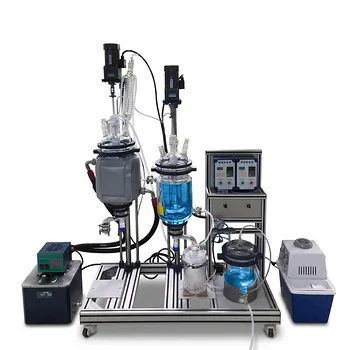
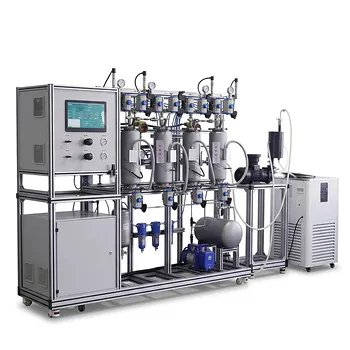
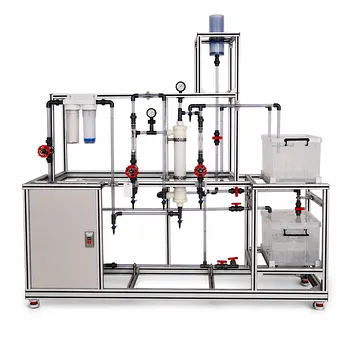
To put it simply: in educational pilot plants, the purification of sulfur by sublimation is represented as a thermally driven, phase-change separation where crude solid sulfur is vaporized under controlled heat and then directly condensed into highly pure, solid "flowers of sulfur" on a cooled surface. The pilot-scale unit recreates the full sublimation–condensation cycle to teach students core chemical engineering principles such as mass transfer, vapor pressure behavior, and the direct link between cooling rate and final product quality—purity and particle size.
While the visible process is a straightforward solid-to-vapor-to-solid transformation, the real educational value lies in manipulating temperature profiles and cooling kinetics to control both the separation efficiency and the physical characteristics of the condensed product. In a single unit operation, students confront the same design and control challenges that govern the production of pharmaceutical powders, specialty chemicals, and agricultural sulfur formulations.
How a Pilot Plant Mirrors the Industrial Sublimation Process
The Core Apparatus: A Controlled Two-Zone System
A dedicated educational sublimation pilot plant for sulfur consists of two distinct thermal zones. The first is a sublimation chamber where crude sulfur is heated, typically in a controlled manner—often under partial vacuum to lower the sublimation temperature. The second is a condensation zone, cooled by air, water, or a chilled surface, where the sulfur vapor re-solidifies.
This physical separation of heating and cooling mirrors industrial “flowers of sulfur” production while making every driving force visible. Thermocouples and pressure sensors installed throughout the system allow students to record real-time data, connecting theoretical phase diagrams with actual process behavior.
Crude Sulfur as the Feedstock
The feedstock is deliberately chosen to represent real raw material. Crude sulfur can contain non-volatile impurities like soil, ash, or mineral residues. As the charge is heated, only sulfur molecules (S₂ to S₈, depending on temperature) enter the vapor phase. The solid residue stays behind, providing a clear visual lesson in selective volatilization.
The primary reference explicitly frames this as a “phase-change separation process,” and the pilot plant makes that intangible concept tangible: what remains in the boat after a run is a concrete measure of impurity removal.
The Educational Principles Embedded in the Operation
Mass Transfer and Vapor Pressure in Action
When students operate the unit, they observe how the sublimation rate depends on temperature and system pressure. Vapor pressure is not an abstract formula—it becomes the force that transports molecules from the hot zone to the cold zone. By adjusting the heating mantle or pressure, learners directly see the impact on throughput, forming an intuitive understanding of mass transfer driving forces.
Cooling Rate as a Product Design Tool
The condensation step is where the pilot plant truly teaches process intensification. If the vapor is cooled slowly on a surface kept just below the dew point, large, well-formed sulfur crystals grow. Rapid quenching, on the other hand, produces a fine, powdery “flowers of sulfur” with high surface area. This single knob—cooling rate—demonstrates the design trade-off between particle size, purity, and handling properties.
This directly supports the primary reference’s emphasis on “manipulating particle size and purity” for applications in fungicides and specialty powders. Students learn that a fertilizer-grade sulfur prill and a high-purity pharmaceutical intermediate can both emerge from the same phase-change principle, separated only by how rigorously the condensation temperature is controlled.
Purity by Sublimation: Inherent Selectivity and Its Limits
Because sublimation relies on vapor pressure differences, non-volatile impurities are left behind almost completely. The condensed product can easily reach 99.9% purity with a single pass. However, the pilot plant also teaches the limitation: any impurity that co-sublimes—such as certain arsenic, selenium, or mercury compounds if present in the crude sulfur—will condense alongside the sulfur.
This is where a critical industrial reality, hinted at in the supplementary reference, becomes a powerful teaching point. In processes like gas cleaning for roasting furnaces, arsenic and other volatile contaminants must be removed upstream to avoid catalyst poisoning and corrosion. Similarly, a sublimation-based sulfur purification pilot plant forces students to ask: “What happens if the crude sulfur contains arsenic sulfides?” The answer reveals why upstream pretreatment or fractional sublimation stages are sometimes needed—and why “pure” is a relative term even in a seemingly perfect separation.
Understanding the Trade-offs and Pitfalls
The Challenge of Volatile Impurities
Sublimation is an excellent purification method for non-volatile dirt, but not a magic bullet. Arsenic, selenium, and fluorine compounds can exhibit significant vapor pressures at sulfur sublimation temperatures, and the supplementary reference makes clear that in related industrial systems these species cause severe catalyst degradation and corrosion. If the educational goal is to illustrate real-world impurity challenges, the pilot plant should not hide this limitation; instead, it should incorporate analysis of the condensate to show that trace volatiles can carry over, underscoring why industrial processes combine sublimation with other purification steps.
Scaling Up: Heat Transfer and Uniformity
At the pilot scale, the distance between the sublimation front and the condensation wall is small, and heat transfer is forgiving. Students should recognize that scaling this operation to a production unit introduces temperature gradients, uneven condensation, and potential re-melting. Discussing these limitations turns a simple lab demonstration into a serious design exercise, giving students the mental toolkit to approach larger-scale phase-change separation units.
Making the Right Choice for Your Educational Goal
Sulfur sublimation in a pilot plant can be adapted to emphasize different learning outcomes. Choose your focus based on the curriculum objective.
- If your primary focus is fundamental mass transfer and phase equilibrium: Use a simple glass sublimation cell with adjustable vacuum and a cold-finger condenser. Let students map sublimation rate versus temperature and pressure, reinforcing the Clausius-Clapeyron relationship.
- If your primary focus is product design and powder technology: Equip the condensation zone with programmable cooling and collect the flowers of sulfur at different rates. Have students perform particle size analysis and link the cooling profile to the resulting agglomerate morphology.
- If your primary focus is process safety and industrial relevance: Integrate gas analysis for volatile impurities and discuss the fate of contaminants like arsenic. Use the supplementary reference’s lessons on catalyst poisoning to show how separation choices cascade through a complete plant.
- If your primary focus is troubleshooting and scale-up thinking: Deliberately introduce non-uniform heating or a fluctuating vacuum and ask students to propose solutions, mirroring the real-world difficulty of maintaining a sharp sublimation front across larger vessels.
The beauty of the sulfur sublimation pilot plant is that it represents an entire unit operation in a single piece of glass or metalware, yet it opens a window into everything from thermodynamics to industrial contamination control. Teach it well, and students walk away with a mental model they can apply directly to pharmaceuticals, agrochemicals, and beyond.
Summary Table:
| System Zone / Stage | Process & Operation | Core Educational Value |
|---|---|---|
| Sublimation Chamber | Controlled heating of crude sulfur (often under vacuum) | Demonstrates vapor pressure, mass transfer driving forces, and selective volatilization |
| Condensation Zone | Gas-to-solid phase transition on cooled surfaces | Illustrates cooling kinetics, crystal growth, and particle size design (flowers of sulfur) |
| Impurity Separation | Retention of non-volatiles; migration of volatile co-sublimates | Teaches the limits of sublimation selectivity and the necessity of upstream purification |
Elevate Chemical Engineering Education with LABPARK
Ready to bring hands-on phase-change separation concepts to life? LABPARK provides state-of-the-art Educational and Vocational Unit Operations Pilot Plants in chemical engineering, bioprocess & biotech, and environmental & water treatment.
We empower universities, research institutes, and enterprises with robust, industrial-grade systems that bridge the gap between textbook theory and real-world process design. Contact LABPARK today to find the perfect pilot plant configuration for your curriculum and research needs!
Related Products
- Multi Functional Membrane Crystallization Educational Unit Operations Pilot Plant
- Potassium Salt Thermal Dissolution and Crystallization Separation Educational Unit Operations Pilot Plant
- Hot Filtration Educational Unit Operations Pilot Plant Laboratory System
- Multi-Functional Membrane Separation Educational Pilot Plant for Unit Operations Lab
- Ion Exchange Water Purification Educational Pilot Plant for Engineering Unit Operations
People Also Ask
- Control Crystallization Pilot Plant Secondary Nucleation: 4 Key Adjustments
- Why is precise temperature control critical in crystallization pilot plants? Key to Scale-Up Success
- What key factors should be considered when configuring a crystallization unit operations pilot plant?
- What are the benefits of integrating online PAT tools like ATR-FTIR into crystallization unit operations pilot plants?
- How to use crystallization pilot plant agitation speed to identify diffusion vs reaction growth?