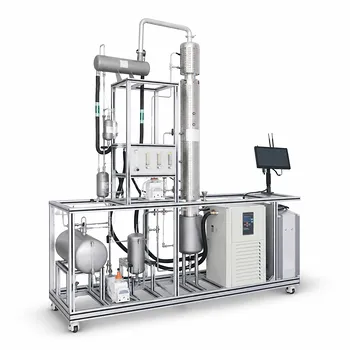
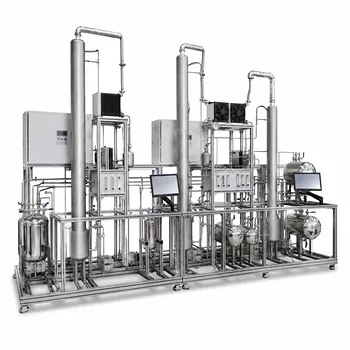
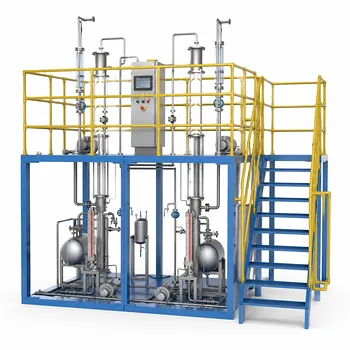
A pilot-scale crude methanol purification process is structurally defined by a two-column distillation sequence. This setup is the industry-standard method for transforming synthesis-derived crude methanol into a high-purity product. The first column strips away highly volatile dissolved gases, while the second column performs the critical separation of pure methanol from water and heavier organic byproducts.
A methanol purification pilot plant typically uses a light ends column followed by a pure methanol column. This two-step configuration demonstrates fundamental fractional distillation principles, showing how a complex multi-component feed is systematically separated by boiling point differences into distinct product streams, with pure methanol recovered as the heart cut.
The Core Architecture of a Methanol Purification Pilot Plant
The design mirrors an industrial-scale process but is engineered for flexibility and observation. The system's goal is to take a crude methanol feed—a mixture containing the target alcohol, dissolved gases, water, and higher alcohols—and resolve it into its constituent parts.
The sequence is linear and logical. The feed enters the first column, and the overheads from that column are discarded. The bottoms product, now free of light impurities, becomes the feed for the second, more critical column.
Stage 1: The Light Ends Column
The first unit is the light ends column. Its sole function is to purge the system of components with boiling points lower than methanol.
These impurities include dissolved gases (like CO₂, H₂, or CH₄) that remain from the synthesis gas feedstock. It may also remove trace quantities of light organic compounds like dimethyl ether.
Operating Principle: The column is operated to drive all these light components overhead, where they are condensed and vented or sent to a waste stream. The key control objective is to minimize methanol loss in this overhead stream while ensuring a thorough cut of all low-boiling compounds. The bottom product from this column is a stabilized methanol-water-heavy alcohols mixture, now ready for the final purification step.
Stage 2: The Pure Methanol Column
This column is the workhorse of the pilot plant. The feed, now free of light ends, enters the pure methanol column for the main separation event.
Here, the distillation target is reversed. The goal is to drive high-purity methanol vapor up the column and out as the overhead distillate.
The Temperature Gradient: A sharp temperature profile is maintained. The top of the column is held at methanol's boiling point (approximately 64.7 °C at atmospheric pressure). The bottom of the column operates at a significantly higher temperature, close to the boiling point of water (100 °C) or higher, to accommodate the heavy by-products.
Product Recovery: Pure methanol is drawn off as a liquid distillate from the condenser. The heaviest impurities—predominantly water and higher alcohols like ethanol, propanol, and butanol—are more temperature-sensitive and require flexible collection strategies. They are withdrawn from the column base or, for better energy efficiency and purity control, as a liquid side stream from a point lower in the column where they concentrate.
Operational Nuances in a Pilot-Scale Setup
The basic two-column structure is the starting point. A true learning environment extends this by incorporating modular capabilities that demonstrate deeper operational control and analytical methods.
A pilot plant is not a static production line. It is a flexible experimental platform designed to make invisible physical phenomena visible and measurable.
Demonstrating Modularity and Operation Modes
A pilot plant’s plumbing is deliberately over-engineered to support multiple configurations. This flexibility is essential for transitioning from a fundamental demonstration to a rigorous experimentation platform.
Switching Between Batch and Continuous Operation: The physical setup uses adjustable feed points at various column heights, along with configurable pumps and collection vessels. By simply redirecting valves, operators can run a finite volume of crude methanol in a batch cycle or establish a steady state with a continuous feed stream. This directly illustrates the momentum and mass balance differences between the two modes.
Adapting to Vacuum Conditions: To demonstrate the separation of heat-sensitive materials—a principle relevant even in methanol purification when considering low-pressure operations—the pilot plant integrates a vacuum pump, vacuum-rated sealing, and inline pressure sensors. Running under vacuum lowers the boiling points of all components, a critical technique for preventing thermal degradation in later, more advanced chemical separations.
Process Monitoring and End-Point Determination
In a pilot plant, the question is not just "what happens?" but "how do you know?" The instrumentation teaches the critical skill of process analysis.
Direct Analytical Methods: The most definitive method for verifying product purity is direct sampling, typically using gas chromatography (GC). A small volume is drawn from the still or product line for off-line analysis. While absolute, this method introduces a process lag, as the sample must be cooled and the analysis run before operational adjustments can be confirmed.
Indirect Inferential Methods: A faster, more elegant method involves monitoring the process temperature itself. For instance, during a batch distillation of a heterogeneous mixture, the still temperature remains constant during the boiling of the more volatile component. The moment that component is exhausted, a rapid and clear temperature increase is observed. This inflection point, trending toward the boiling point of the pure replacement solvent (or next heaviest component), provides a real-time inferential signal. Students learn to use this thermodynamic signature to precisely time the cut from one product fraction to the next.
Understanding the Trade-offs
Pilot-scale distillation is an exercise in managing conflicting objectives. No single solution optimizes every variable simultaneously.
The primary trade-off is between product purity and recovery rate. Operating the pure methanol column at a very high reflux ratio will yield extremely pure methanol but at a lower throughput and a higher energy cost. Conversely, pushing for a higher distillate rate risks dragging heavier alcohols and water into the final product.
Another critical consideration is steady-state stability versus operational flexibility. A continuous pilot plant is excellent for demonstrating long-term steady-state principles but is inherently more rigid. A modular, batch-capable system offers far greater flexibility for experimenting with different feed compositions but requires constant attention and presents a more complex set of dynamic control challenges to stabilize.
Making the Right Choice for Your Goal
A two-column crude methanol purification pilot plant is a specific configuration serving a core set of pedagogical goals. How you apply it depends entirely on what truth you are trying to uncover.
- If your primary focus is demonstrating the logic of a complete industrial separation train: Configure the pilot plant for continuous operation with the two columns in sequence, focusing on stabilizing the feed and achieving stable purity profiles at each product stream.
- If your primary focus is investigating fundamental thermodynamic behavior: Run the pure methanol column in batch mode, using the temperature inflection point method to manually determine the optimal cut points between the light ends, pure methanol heart, and heavy ends.
- If your primary focus is on process control and instrumentation: Utilize the modular piping to experiment with different feed point locations and reflux ratios, comparing the response time and accuracy of direct GC analysis against real-time inferential temperature measurements to characterize column dynamics.
Ultimately, the structured simplicity of the light ends and pure methanol columns provides an elegant, physically contained framework for teasing apart the complex, intertwined principles of fractional distillation into clear, observable, and measurable stages.
Summary Table:
| Distillation Column | Primary Function | Key Operating Target |
|---|---|---|
| Light Ends Column | Purges dissolved gases (CO₂, H₂) and low-boiling compounds | Minimize methanol loss in the overhead vent stream |
| Pure Methanol Column | Separates high-purity methanol from water and heavy alcohols | Maintain top temperature at ~64.7°C; draw pure distillate |
Bring Industrial-Scale Distillation Training to Your Lab
LABPARK provides premium Educational and Vocational Unit Operations Pilot Plants in chemical engineering, bioprocess & biotech, and environmental & water treatment for universities, research institutes, and enterprises. Our modular, highly-instrumented distillation systems allow students and researchers to master complex dynamic separations, process control, and thermodynamics safely and efficiently.
Ready to elevate your engineering curriculum or research capabilities? Contact LABPARK today to design the perfect pilot plant solution for your facility!
Related Products
- Continuous Sieve-Plate Distillation Pilot Plant for Unit Operations Laboratory Education
- Multi-Modal Distillation Unit Operations Training Pilot Plant
- Green Anhydrous Ethanol Purification Extractive Distillation Unit Operations Training Pilot Plant
- Dual-Mode Rectification Pilot Plant for Practical Training Unit Operations
- Ethyl Acetate Synthesis Unit Operations Pilot Plant for Practical Training
People Also Ask
- How to select the right activity coefficient model (Wilson, NRTL, UNIQUAC) for distillation pilot plants?
- Why is vacuum operation capability an essential feature for a distillation unit operations pilot plant? Unlock Efficiency
- How does catalyst water concentration affect distillation pilot plant design? Key separation train choices.
- How can real-time carbon number prediction improve distillation pilot plants? Optimize control.
- What are the primary reflux ratio control strategies? Master Distillation Unit Operations