The heat of reaction in a pilot plant reactor is calculated by merging a precise material balance with an inlet-outlet enthalpy table, while monitoring relies on an integrated network of temperature sensors, flow meters, and data acquisition systems that transform real-time measurements into the extent of reaction and the resulting enthalpy change. Put simply, you first determine how much of each component enters and leaves the reactor – then pair those flows with their thermodynamic properties to compute the energy change. This direct energy balance yields both the heat of reaction (ΔH_rxn) and the necessary utility duty, enabling you to control temperature, avoid hotspots, and scale the process safely.
Core Takeaway: Although predictive methods like Hess’s Law, heat‑of‑formation tables, or quantum chemistry can estimate ΔH_rxn offline, the definitive on‑line calculation in a pilot plant is built around a running inlet‑outlet enthalpy table. By linking that table to the measured extent of reaction—derived from conversion data—you convert raw sensor readings into the exact heating or cooling required by your heat exchangers, ensuring stable operation and a data‑driven basis for scale‑up.
The Energy Balance: From Theory to Pilot Plant Reality
Establishing the Foundation: The Material Balance
Before any heat calculation can be trusted, you must know the mass flow rates of every component entering and leaving the reactor. Without a complete material balance, the energy balance is incomplete—every mole carries its own enthalpy contribution. In a pilot plant, this balance is built from calibrated flow meters, analytic instruments (GC, IR, or titration), and a clear definition of the system boundaries.
Selecting a Common Reference State
Energy balance calculations require a reference temperature and phase, typically 298 K and the standard state. Most published thermodynamic data—heat capacities, standard enthalpies of formation, latent heats—are tabulated at this reference, so picking 298 K eliminates tedious conversions. For streams that undergo phase change or contain solvated species, you must also define the reference physical state consistently for all components.
The Inlet-Outlet Enthalpy Table and the Extent of Reaction
The heat of reaction is extracted from the overall enthalpy change across the reactor:
ΔH_total = Σᵢnᵢ,out · Hᵢ,out – Σⱼnⱼ,in · Hⱼ,in
Each specific enthalpy H is calculated relative to the reference state by integrating heat capacity (Cₚ) over temperature— H = ∫ Cₚ dT —and adding any latent heat contributions. The difference between outlet and inlet sensible enthalpies equals the heat of reaction plus any heat exchanged with the utility side. To isolate ΔH_rxn, you solve using the extent of reaction (ℰ), which is determined from the limiting reactant’s conversion. The standard approach is:
ΔH_total = ℰ × ΔH°_rxn + (sensible heat of products – sensible heat of reactants)
Here, ΔH°_rxn is the standard enthalpy of reaction at the reference temperature, which can be obtained from heats of formation or previous calorimetric data.
Translating the Calculation to Utility Demands
Once the energy balance is solved, you know exactly how much energy the reaction consumes or releases. If ΔH_total is negative (exothermic), that energy must be removed by the cooling system; if positive (endothermic), it must be supplied. The calculated duty feeds directly into the design or control of your heat exchangers—cooling water flow, steam pressure, or electrical heating—so the reactor temperature stays on target.
Monitoring Heat of Reaction in Real Time
The Sensor Ecosystem of a Pilot Plant Reactor
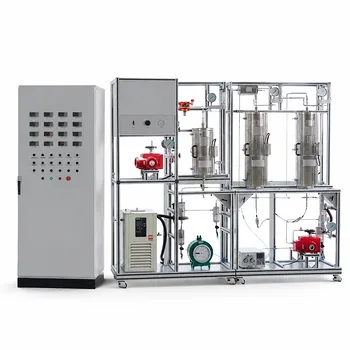
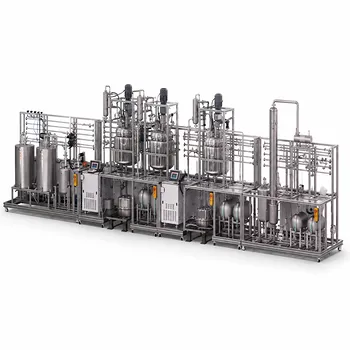
Modern unit‑operations pilot plants are densely instrumented with thermocouples, RTDs, and flow meters on both the process and utility sides. Reactor internal temperature, jacket inlet/outlet temperatures, and cooling/heating fluid flow rates are measured continuously, often at 1‑second intervals. These data streams are collected by a computerized data acquisition system (SCADA or DCS), which enables on‑the‑fly energy balances.
From Sensor Readings to Real‑Time Heat Flow
For a jacketed reactor, the instantaneous heat transfer can be estimated from the utility side using the relationship Q = U · A · ΔT_m, where ΔT_m is the log mean temperature difference. By measuring the jacket fluid’s flow rate and its temperature rise (or drop), you directly compute the heat being removed or added—a direct calorimetric signal. That measured heat flow, when corrected for heat accumulation in the reactor mass ( M · Cₚ · dT/dt ), yields the actual reaction heat at that moment without needing a full enthalpy table.
Reconciling On‑Line and Off‑Line Methods
In practice, you run two parallel checks. The real‑time calorimetric signal gives an immediate picture of heat release, crucial for detecting exotherms and ensuring thermal safety. The steady‑state enthalpy table, built once the reactor stabilizes, provides the most accurate ΔH_rxn and validates any drifts in sensor calibration or heat‑transfer coefficients.
Practical Implementation in a Pilot Plant Campaign
Step 1: Stabilise the Reactor and Collect Data
Wait until the reactor reaches thermal and chemical steady state—stable temperatures, constant conversion, and steady flows. Log all process temperatures, feed rates, product composition, and jacket fluid conditions for a representative time window.
Step 2: Build the Reference‑Based Enthalpy Table
For each inlet and outlet stream, calculate the specific enthalpy relative to 298 K using Cₚ correlations (often polynomial fits). Multiply by the corresponding molar flows to get enthalpy rates. Sum them for the inlet and outlet sides.
Step 3: Solve for the Heat of Reaction and Validate
Calculate ΔH_total and, using the measured ℰ, confirm the implied ΔH_rxn. Compare this number with the jacket heat balance – the integrated Q_utility over the same period should match within the expected error, closing the balance and confirming sensor reliability.
Understanding the Trade‑offs
Accuracy vs. Dynamic Response
Inlet‑outlet enthalpy tables demand steady‑state operation and high‑accuracy composition analysis, making them slow but highly accurate. Direct calorimetric monitoring (jacket Q + accumulation) works in real time and can catch runaway tendencies, but it is sensitive to uncertainties in U·A and Cₚ estimations. Choose your primary method based on whether your goal is precision or immediate hazard detection.
Predictive Calculations vs. Pilot Plant Data
Computational predictions (DFT, group contribution) can supply ΔH_rxn when no literature data exist, but they must be validated against experiments. Pilot plant measurements are the closest truth, yet they require careful calibration and are subject to heat losses. When predictions and measurements disagree, trust the pilot plant – but investigate the gap to improve your model.
Educational or Small‑Scale Pilot Plants
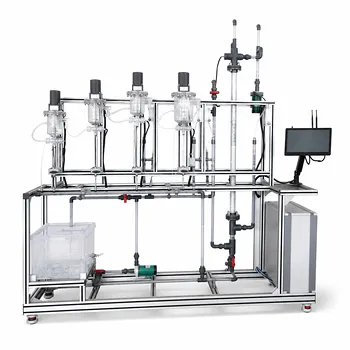
Training‑oriented reactors often have less insulation and simpler sensors, so absolute ΔH_rxn values may carry larger uncertainties. The value lies in seeing the energy balance come to life: students learn that no calculation matters unless it is backed by correctly installed sensors, material balances, and the discipline of the reference state.
Making the Right Choice for Your Goal
- If your primary focus is process development and scale‑up: Rely on building robust enthalpy tables from measured conversion and validated thermodynamic data, then cross‑check with jacket heat balances to ensure your utility sizing is correct.
- If your primary focus is thermal safety and runaway prevention: Prioritise real‑time calorimetric monitoring (jacket Q plus accumulation) to catch exothermic excursions instantly, even if absolute precision is slightly lower.
- If your primary focus is academic or vocational training: Teach the step‑by‑step material‑and‑energy‑balance approach, using the 298 K reference, and guide students in comparing their calculated ΔH_rxn with live sensor‑derived heat flows—this builds intuition for industrial practice.
By anchoring your approach in a rigorous energy balance and leveraging the sensor‑rich environment of a pilot plant, you transform abstract thermodynamic numbers into a practical, safe, and scalable thermal management strategy.
Summary Table:
| Method | Data Source | Key Advantage | Best Used For |
|---|---|---|---|
| Enthalpy Tables | Molar flows, $C_p$ correlations, conversion data | High accuracy, validates physical data | Process development & scale-up |
| Calorimetric Monitoring | Utility flow rate, $\Delta T$, heat accumulation | Real-time tracking, fast response | Thermal safety & hazard detection |
Optimize Your Process Scale-Up with LABPARK Pilot Plants
Need to teach or test precise reaction kinetics and thermal management? LABPARK provides state-of-the-art Educational and Vocational Unit Operations Pilot Plants in chemical engineering, bioprocess & biotech, and environmental & water treatment. We help universities, research institutes, and enterprises bridge the gap between theory and industrial reality with high-accuracy instrumentation and robust safety controls.
Ready to elevate your training and research? Contact us today to find the perfect pilot plant solution for your lab!
Related Products
- Fixed-Bed Chemical Reaction and Gas Dust Tar Removal Unit Operations Pilot Plant
- Multi-Reactor Educational Pilot Plant for Reaction Engineering Unit Operations
- Tubular Reactor Flow Characteristics Determination Educational Unit Operations Pilot Plant
- 100L Continuous Loop Hydrogenation Educational Unit Operations Pilot Plant
- Multi Pump Fluid Transport Process Piping Unit Operations Training Pilot Plant
People Also Ask
- How to Estimate Tc & Pc of Unknown Hydrocarbons in Pilot Plant Experiments | Guide
- How do hydraulic gradients and energy gradients differ in a piping system? Key Differences
- Why are runaway reactions critical in chemical engineering? Learn how pilot plants train students in process safety.
- What is the difference in expansion factor (Y) for Venturi vs. Orifice? Theory vs. Empirical Data Explained
- Why build a pilot plant reactor for scale-up studies? Bridge lab kinetics to industrial success.