The Gibbs phase rule isn't just a theoretical equation—it’s your pilot plant's control roadmap. It tells you exactly how many variables you can independently manipulate to define the system's equilibrium, thereby setting the boundaries for separation efficiency. By applying (F = C - P + 2), you calculate the system’s degrees of freedom (F), which directly translates to how you must design your control strategy for distillation and extraction to achieve stable, reproducible results.
The core problem is maintaining control and predictability during separation. The Gibbs phase rule provides the foundational logic by quantifying the independent variables (pressure, temperature, composition) you must fix to define a system at equilibrium. For a binary distillation, (F=2) means fixing any two intensive variables—like column pressure and a tray temperature—automatically locks in all phase compositions, enabling precise and repeatable performance analysis.
Decoding the Rule for Separation Control
The Thermodynamic Blueprint for Your Experiment
The rule, (F = C - P + 2), links components (C) and phases (P) to your control levers. For a typical binary distillation, where C=2 and P=2 (liquid and vapor), the math gives you (F = 2 - 2 + 2 = 2).
This means you have exactly two independent knobs to turn. Fixing any two intensive properties completely defines the thermodynamic state of the system.
Why This is the Key to Reproducible Data
Without this logic, you might try to control too many things and find the system unresponsive, or control too few and see it drift. The phase rule tells you the minimum set of variables required for equilibrium.
It transforms an abstract process into a defined system. You are no longer just "running the column"; you are defining a thermodynamic state.
Applying the Rule in Distillation Pilot Plants
Defining the Target Separation
For a binary mixture in a distillation column, your operational goal is to achieve a specific separation. According to the phase rule, once you decide on your target, your control strategy must center on two intensive variables.
The primary reference highlights that specifying operating pressure and temperature will directly fix the compositions of the vapor and liquid phases. In practice, a pilot plant operator will fix the column pressure via a back-pressure regulator and then control the reboiler temperature to target a specific boil-up rate and separation.
Building a Stable Control Architecture
Your calculated degrees of freedom (F=2) directly map to your control loops. One effective strategy is:
- Loop 1 (Fixed Variable): Fix the column operating pressure. This decouples the separation from atmospheric changes and is a typical first choice.
- Loop 2 (Controlled Variable): Control the temperature at a sensitive tray by manipulating the reboiler heat input. Because of the pressure-temperature-composition relationship, this temperature setpoint corresponds directly to a specific liquid composition.
When these two variables are fixed, the entire column profile is thermodynamically locked. This is how you ensure the separation efficiency you measure on Tuesday is comparable to the data from Monday.
Diagnosing Separation Efficiency
The phase rule also provides a framework for analysis. If your measured compositions deviate from the equilibrium prediction at your set pressure and temperature, you've identified a non-equilibrium condition.
This confirms that efficiency losses are not thermodynamic but kinetic or mechanical. Problems like flooding, weeping, or poor tray mixing are the culprits, and the phase rule gives you the baseline to prove it.
Applying the Rule in Extraction Pilot Plants
Adapting the Control Logic to Liquid-Liquid Systems
The logic is identical, but the phases are different. For a single-component solute partitioning between two immiscible solvents—a common pilot-scale extraction—you have C=3 and P=2.
The calculation yields (F = 3 - 2 + 2 = 3). You gain an extra degree of freedom compared to a binary distillation. To fix the equilibrium and thus the efficiency, you must control three intensive variables.
A Practical Extraction Control Strategy
In a counter-current extraction column, a robust control scheme based on the three degrees of freedom might be:
- Fix the operating pressure (often atmospheric, but must be specified).
- Fix the operating temperature, often via jacketed vessels, as solubility is highly temperature-dependent.
- Fix the flow ratio of the two immiscible solvents, which determines the system’s operating point and solute inventory.
By fixing pressure, temperature, and the solvent ratio, you have defined all equilibrium compositions. The measured solute concentration in the extract versus the theoretical value now becomes your direct measure of mass transfer efficiency.
Understanding the Trade-offs and Pitfalls
The Assumption of Equilibrium is a Double-Edged Sword
The phase rule describes systems at equilibrium. A real pilot plant operates at a dynamic steady state, which is not necessarily equilibrium. The rule provides the destination, not the path length.
Using it for control gives you a stable, predictable target. However, it cannot predict the rate of separation or the actual efficiency of imperfect trays or short contact times.
The Trap of Overthinking Your Components
The primary reference correctly uses simple systems. For the pilot plant, you might have trace impurities. The key insight is to focus on the key components driving the separation.
Treating a 99.5% pure mixture as a binary system (C=2) is a valid, simplifying approach that doesn't change your control structure. Overcomplicating C with irrelevant minute impurities adds theoretical degrees of freedom that offer no practical control benefit and lead to an unmanageable control strategy.
Controlling the Wrong Variables
You have F degrees of freedom, but not all choices are equal. Choosing a combination like "tray 5 temperature" and "tray 10 temperature" is mathematically valid for F=2 but creates a non-independent, under-defined control scheme that hides the real process driver.
Always choose truly independent variables. The robust pairing is one extrinsic variable like pressure and one intrinsic variable that is a direct indicator of phase composition, such as a strategically chosen temperature.
Making the Right Choice for Your Experimental Goal
The Gibbs phase rule is not just an equation; it's a diagnostic and design tool for your pilot plant experiments. Your goal dictates how you apply it.
- If your primary focus is achieving stable, steady-state operation: Use the phase rule to define the minimum number of independent variables you must actively control. For a binary distillation, establish two tight control loops, typically on column pressure and a key tray temperature, to lock the system in place.
- If your primary focus is measuring mass transfer efficiency: Use the phase rule to calculate the theoretical equilibrium state for your controlled variables. The gap between this ideal state and your actual, measured phase compositions is your direct, quantitative metric of stage efficiency.
- If your primary focus is screening solvents for extraction: Recognize that for a solute in two solvents (C=3, P=2), you have three degrees of freedom. Deliberately fix temperature, pressure, and the solvent-to-feed ratio to compare equilibrium outcomes and true separation performance across different solvent candidates.
The phase rule provides the theoretical ceiling of your separation. Use it as your target to build a controlled experiment, then as a benchmark to measure how well your real-world pilot plant performs.
Summary Table:
| Process Type | Components (C) | Phases (P) | Degrees of Freedom (F) | Recommended Control Variables |
|---|---|---|---|---|
| Binary Distillation | 2 | 2 | 2 | Column pressure, sensitive tray temperature |
| Liquid-Liquid Extraction | 3 (1 solute, 2 solvents) | 2 | 3 | Operating pressure, jacket temperature, solvent flow ratio |
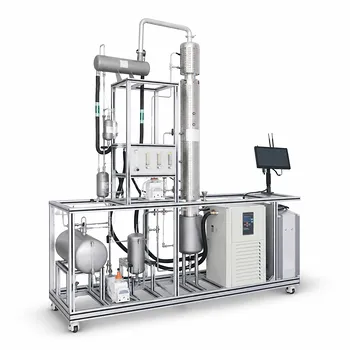
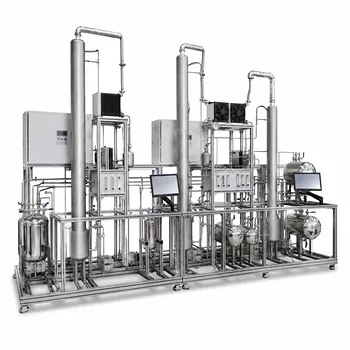
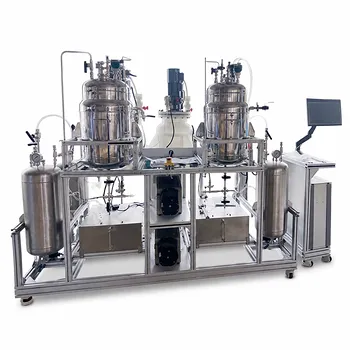
Are you looking to equip your lab with robust, highly controllable systems? LABPARK provides premium Educational and Vocational Unit Operations Pilot Plants in chemical engineering, bioprocess & biotech, and environmental & water treatment. Designed specifically for universities, research institutes, and enterprises, our pilot plants enable precise thermodynamic control and reproducible experimental data.
Ready to elevate your research and training capabilities? Contact LABPARK today to find the perfect pilot plant solution for your facility!
Related Products
- Continuous Sieve-Plate Distillation Pilot Plant for Unit Operations Laboratory Education
- Multi-Functional Special Distillation Educational Pilot Plant
- Continuous Batch Extractive Distillation Educational Pilot Plant
- Multi-Modal Distillation Unit Operations Training Pilot Plant
- Electrolyte Distillation Purification and Formulation Educational Pilot Plant
People Also Ask
- How can real-time carbon number prediction improve distillation pilot plants? Optimize control.
- Why is vacuum operation capability an essential feature for a distillation unit operations pilot plant? Unlock Efficiency
- What are the primary reflux ratio control strategies? Master Distillation Unit Operations
- How to select the right activity coefficient model (Wilson, NRTL, UNIQUAC) for distillation pilot plants?
- How does catalyst water concentration affect distillation pilot plant design? Key separation train choices.