The Gibbs energy minimization principle acts as the unbreachable thermodynamic anchor in any gas-phase reaction study. When operating a pilot-plant reactor—such as a packed bed or tubular system—you first calculate the equilibrium state by setting the total Gibbs energy of the system to its minimum, which for a single reaction simplifies to solving (\Delta_r G = 0). This yields the theoretical ceiling for conversion and product yield at the chosen temperature and pressure. You then compare your real pilot-plant effluent against that equilibrium baseline to expose every inefficiency rooted in kinetics, heat transfer, or mass transfer limitations.
In gas-phase reaction pilot plants, the Gibbs energy minimization principle provides the non-negotiable thermodynamic baseline. Operators compute this equilibrium limit from fundamental data, then use the gap between ideal and observed performance to diagnose and quantify the kinetic, thermal, and transport resistances that keep the reactor from reaching full potential. The principle isn’t just a textbook exercise—it’s the foundation for all data-driven process optimization at pilot scale.
The Role of Gibbs Energy Minimization in Reaction Engineering Pilot Plants
Defining the Thermodynamic Ceiling
Every gas-phase reaction has a maximum achievable conversion under a given set of conditions. That maximum isn’t set by catalyst activity or mixing quality—it’s set by the point where the chemical driving force vanishes.
For a pilot-plant run, you define this ceiling by finding the composition that makes the change in Gibbs energy zero. In a simple syngas-to-methane example ((2CO + 2H_2 \rightleftharpoons CO_2 + CH_4)), solving (\Delta_r G = 0) at the reactor’s operating temperature and pressure gives you the equilibrium composition. This is the theoretical limit against which every gram of product will be judged.
Why (\Delta_r G = 0) Is the Operator’s Benchmark
The condition (\Delta_r G = 0) does more than predict a final state. It tells you the direction of the net reaction: if (\Delta_r G < 0) the forward reaction is spontaneous; if (\Delta_r G > 0) you’re pushing against thermodynamics and need a parameter shift.
In pilot-plant operation, you log real-time temperature, pressure, and concentration data. By continuously comparing the current composition to the equilibrium composition calculated from those same logged conditions, you can see whether the reactor is approaching the limit or being held back. That comparison turns raw sensor streams into a performance diagnostic.
Practical Application: From Theory to Real-Time Decision Making
Calculating Equilibrium Composition for Pilot Plant Conditions
Before a run, you use thermodynamic software or in-house codes to solve the minimization problem. For a gas-phase system with multiple simultaneous reactions, you minimize the total Gibbs energy of the system subject to atom balances. This gives the equilibrium mole numbers of all species.
The calculation requires accurate standard-state Gibbs energies of formation and a suitable equation of state to capture non-ideal gas behavior—especially at the elevated pressures common in pilot-plant methanation or ammonia synthesis. The output is a look-up table or a continuous curve: expected conversion as a function of temperature and pressure.
Using Pilot Plant Data to Diagnose Performance Gaps
Once the reactor reaches steady state, you compare the measured conversion with the equilibrium conversion at identical conditions. A large gap points directly to kinetic limitations. If the gap shrinks when you increase residence time (by lowering feed rate), the culprit is insufficient contact time. If it persists even at long residence time, you investigate mass or heat transfer restrictions—perhaps the catalyst bed has channeling, or the wall temperature profile isn’t uniform.
This diagnostic loop—thermodynamic benchmark → measured output → gap analysis—is the core operating logic of a research pilot plant. It turns a reactor from a black box into a transparent testbed.
Key Operating Parameters That Shift Equilibrium
Temperature: Leveraging Enthalpy and Entropy Effects
For exothermic reactions like methanation, raising temperature shifts equilibrium away from products, lowering the theoretical maximum conversion. Pilot-plant operators exploit this by running at the highest temperature that still meets conversion targets, trading a slight thermodynamic penalty for dramatically faster kinetics.
You can experimentally identify the threshold where (\Delta G) turns negative—the point where the reaction becomes spontaneous. By precisely controlling furnace or jacket temperatures, you map the boundary between feasible and infeasible operating windows, confirming where (\Delta H) and (\Delta S) interactions flip the spontaneity direction.
Pressure and Inert Diluents: Volume-Driven Shifts
For gas-phase reactions that produce fewer moles (like (2CO + 2H_2 \rightarrow CO_2 + CH_4), where moles decrease), increasing pressure drives equilibrium toward products. Pilot plants with back-pressure regulators let you test this directly: raising pressure at constant temperature lifts the equilibrium ceiling, giving you a new, higher benchmark.
Introducing an inert like nitrogen has a similar effect by reducing reactant partial pressures. In a pilot plant, you can vary the diluent fraction while holding total pressure constant and track how the equilibrium conversion shifts. This teaches operators how to decouple thermodynamic effects from purely kinetic changes.
Understanding the Trade-offs and Pitfalls
The Trap of Over-Reliance on Equilibrium Predictions
A perfect equilibrium calculation is worthless if the reactor never gets there. In fast-throughput pilot campaigns, there’s a temptation to skip the equilibrium calculation and “run by feel.” That obscures whether a poor yield is due to bad thermodynamics or something you can fix.
Conversely, treating the equilibrium limit as an absolute target can mislead. If a highly selective catalyst gives 95% of equilibrium conversion at a much lower temperature than equilibrium would suggest, you’re not failing—you’re operating at an optimal kinetic sweet spot. The equilibrium ceiling is a yardstick, not a mandate.
When Minimization Algorithms Lead to False Bottoms
In multi-reaction gas-phase systems—especially with non-ideal equations of state—the total Gibbs surface can have multiple local minima. A numerical solver might declare a “minimum” that isn’t the true global equilibrium, giving you an artificially low conversion benchmark.
To guard against this in pilot-plant modeling, you must seed the solver with chemically plausible initial guesses and use global optimization methods when possible. You also cross-check the result against the simpler (\Delta_r G = 0) balance for the dominant reaction. If the computed equilibrium looks suspiciously unfavorable, the solver—not the chemistry—may be at fault.
Making the Gibbs Principle Work for Your Pilot Plant Study
Your operational strategy determines how you translate equilibrium data into actionable insights. Use the baseline according to your true study objective.
- If your primary focus is maximizing single-pass conversion: Compute the equilibrium composition as a function of temperature and pressure; pick the setpoint that gives the highest equilibrium yield your catalyst can approach; then tune residence time and bed packing to capture as much of that thermodynamic potential as possible.
- If your primary focus is extracting kinetic rate parameters: First measure the equilibrium limit at each temperature to establish the thermodynamic driving force; use the measured conversion to calculate the approach to equilibrium; isolate the kinetic rate constant without confusing it with equilibrium suppression.
- If your primary focus is scale-up validation: Build a reactor model that solves momentum, heat, and mass balances while calling the equilibrium calculation as the ultimate constraint; compare pilot-plant temperature and concentration profiles against the model to identify transport resistances that will change at larger scale.
When you treat the Gibbs energy minimum as the fixed boundary within which engineering ingenuity operates, your pilot plant becomes a precision instrument for separating the possible from the merely practical.
Summary Table:
| Operating Parameter | Thermodynamic Effect on Equilibrium | Pilot Plant Application & Control |
|---|---|---|
| Temperature | Exothermic: Higher T lowers equilibrium limit; Endothermic: Higher T increases it. | Precise furnace/jacket control to map feasibility windows. |
| Pressure | Higher P drives equilibrium toward products for reactions with mole reduction. | Adjust back-pressure regulators to lift the equilibrium ceiling. |
| Inert Diluents | Lowers reactant partial pressure, shifting equilibrium based on mole change. | Vary diluent fraction to isolate kinetic vs. thermodynamic effects. |
| Residence Time | No effect on thermodynamic equilibrium (limit remains constant). | Adjust feed rates to analyze kinetic/transport gaps against baseline. |
Optimize Your Pilot Plant Operations with LABPARK
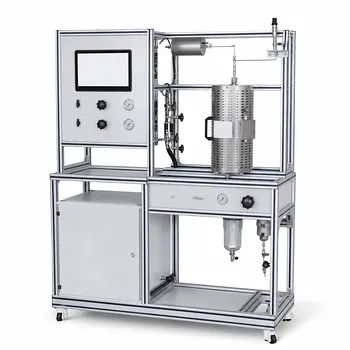
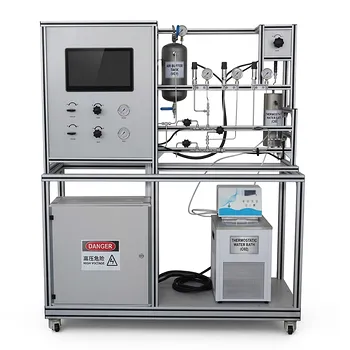
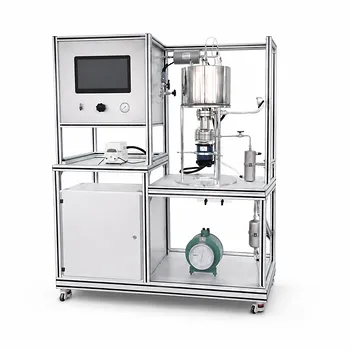
Bridging the gap between thermodynamic limits and actual reactor performance requires precision equipment. LABPARK provides premium Educational and Vocational Unit Operations Pilot Plants in chemical engineering, bioprocess & biotech, and environmental & water treatment.
Whether you are a university, research institute, or enterprise, our pilot-scale systems empower you to accurately study gas-phase reactions, calculate equilibrium baselines, and accelerate process scale-up.
Ready to elevate your research and training capabilities? Contact LABPARK today to find the ideal pilot plant solution for your lab!
Related Products
- Gas Phase Mixing and Residence Time Distribution Determination Educational Unit Operations Pilot Plant
- Fixed-Bed Chemical Reaction and Gas Dust Tar Removal Unit Operations Pilot Plant
- Fixed Bed Gas Solid Catalytic Reaction Educational Pilot Plant
- Fluidized Bed Gas Solid Catalytic Reaction Educational Pilot Plant
- Micro-Scale Gas-Solid Catalytic Reaction Educational Pilot Plant
People Also Ask
- Why do gas-flow unit operations pilot plants require an expansion factor? Achieve Precise Flow Calculations
- Pulse vs. Step Injection for RTD: Practical Differences in Pilot Plants Explained
- How do pressure changes affect gas-phase reaction rates? Safely Optimize Your Kinetics
- Why use an experimental factor for terminal velocity in gas flow pilot plants? Streamline Frictional Flow Analysis
- How is the pressure-volume extrapolation method applied in educational pilot plants to calibrate gas sensors?