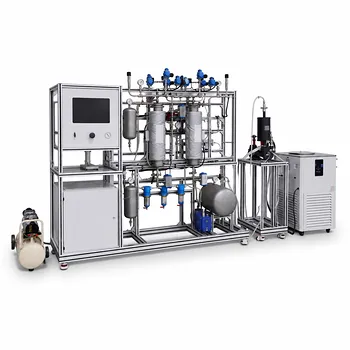
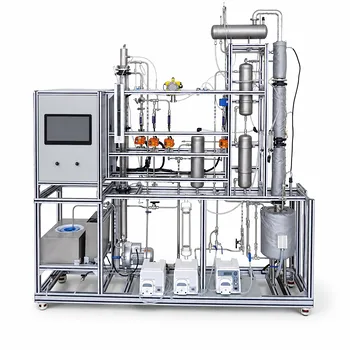
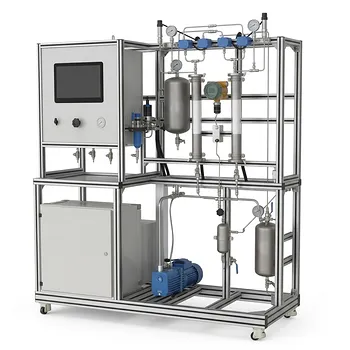
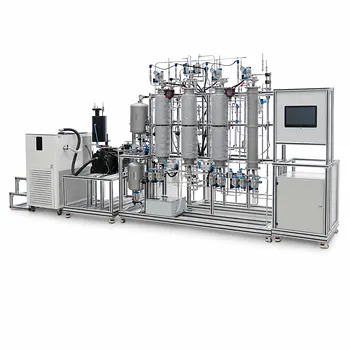
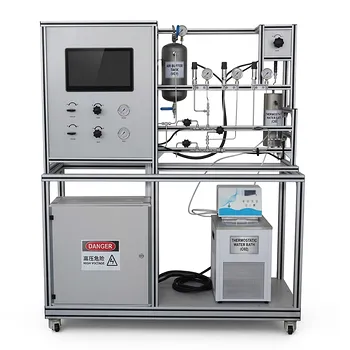
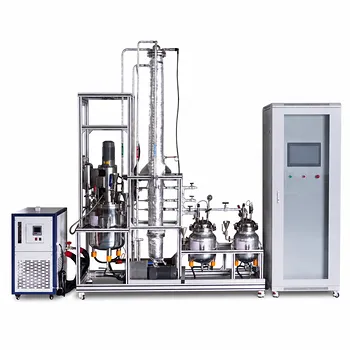
Pressure changes directly alter the concentration of gaseous reactants, accelerating or decelerating the reaction rate. When you compress a gas-phase system, you reduce the volume and pack more molecules into each unit of space, boosting collision frequency and speeding up the reaction. Conversely, if you raise the total pressure by adding an inert gas while keeping volume constant, you effectively dilute the reactants, their partial pressures drop, and the rate falls. To safely probe these dynamics, a gas-phase pilot plant must integrate precision control devices and layered safety systems that maintain stable reactant concentrations and prevent overpressure.
The core insight: In gas-phase kinetics, pressure changes affect rate primarily through reactant concentration. A safe, research-grade pilot plant therefore needs accurate pressure regulation, precise mass flow control, and engineered safety barriers—working together to let you explore high-pressure kinetics without compromising personnel or equipment.
How Pressure Alters Gas-Phase Reaction Rates
The key mechanistic link between pressure and reaction speed is molecular concentration. A change in system pressure almost always changes how many reactant molecules sit in a given volume, altering the odds of effective collisions.
The Volume-Driven Rate Increase
If you increase the total pressure by physically reducing the reactor volume, you squeeze the same number of gas molecules into a smaller space. The result is a higher molar concentration, more frequent collisions per second, and a faster reaction rate. This is the classic kinetic effect taught in every pilot plant—compression drives rate.
The Inert Gas Dilution Effect
Not all pressure increases boost reaction rates. When you raise the total pressure by injecting an inert gas at constant volume, the partial pressures of the reactants stay the same, but now they are spread across a larger volume if you allow the volume to expand to maintain constant overall pressure. In practice, if you hold total pressure constant and add inert gas, the reactant concentration drops because the system volume must enlarge to accommodate the extra molecules. The reaction slows.
This distinction is crucial for pilot plant experiments: you must decide whether you are manipulating pressure through volume compression or inert gas addition, because the kinetic outcome is opposite.
Equilibrium Shifts in Reversible Reactions
Beyond simple kinetics, many gas-phase reactions are reversible. Pressure then influences not just the forward rate, but the position of equilibrium, which can alter the net conversion and product distribution.
Le Chatelier’s Principle at Work
When a reaction changes the total number of gas molecules (Δn ≠ 0), raising the pressure shifts the equilibrium toward the side with fewer gas molecules. For the classic dissociation N₂O₄ ⇌ 2NO₂ (Δn = +1), an increase in system pressure pushes the equilibrium back to the reactant, decreasing the dissociation. In a pilot plant, this directly affects the measured conversion rate and highlights why rate studies must decouple kinetic acceleration from thermodynamic displacement.
Connecting Kp and Kc
The relationship Kp = Kc(RT)^(Δn) quantifies how partial pressures and concentrations are linked. While Kp is pressure-independent at constant temperature, the actual composition changes as you vary the total pressure for systems with Δn ≠ 0. In pilot-scale work, you use this equation to predict whether a higher operating pressure will increase or decrease the equilibrium yield of your target product.
Adapting Thermodynamic Calculations for Elevated Pressure
Ignoring pressure effects on entropy can lead to miscalculations when you scale up from lab data.
Pressure Lowers Gas Entropy
Gases experience a measurable entropy decrease when compressed. Squeezing oxygen from 101 kPa to 606 kPa, for example, restricts molecular motion and reduces standard molar entropy. In a gas-phase pilot plant that runs at elevated pressures, failing to adjust entropy values distorts predictions of Gibbs free energy and reaction spontaneity. Accurate heat-exchange sizing and safety analyses depend on these corrections.
Critical Safety and Control Features for Gas-Phase Pilot Plants
Studying pressure effects safely demands a combination of precise flow management and robust overpressure protection.
Flow and Pressure Regulation
- Mass flow controllers ensure that reactant gases enter the reactor at the exact setpoints, maintaining the intended partial pressures and concentrations even as total system pressure varies.
- Back-pressure regulators hold a steady system pressure downstream, allowing operators to explore different pressure levels without uncontrolled fluctuations.
- Precision pressure control valves allow rapid, automated adjustments to keep the reactor at the target pressure while responding to process upsets.
Overpressure and Emergency Safety
- Pressure relief valves and safety burst discs provide the first line of defense, venting excess gas before vessel pressure reaches a dangerous threshold.
- Automated emergency shutdown systems monitor critical parameters (pressure, temperature, flow) and initiate a fail-safe sequence—shutting off gas feeds, isolating the reactor, and safely venting—if any value exceeds safe limits.
Analytical Feedback
To truly study reaction rates, you need to measure composition in real time. Gas chromatographs or online analyzers allow you to track reactant depletion and product formation, linking pressure changes directly to rate changes and confirming that equilibrium constants remain constant.
Understanding the Trade-offs
Every pilot plant decision involves balancing competing priorities.
- High pressure accelerates kinetics but demands heavier vessel walls, higher-grade materials, and more rigorous safety systems, increasing capital cost and maintenance complexity.
- Inert gas dilution slows the reaction but can serve as a temperature control strategy by absorbing heat or moderating exothermic runaway.
- Near-critical or supercritical pressures may introduce non-ideal gas behavior, requiring you to replace simple concentration-based models with fugacity-based corrections.
- Safety redundancy is non-negotiable, but excessive protective devices can add cost and complexity. The plant must be designed for the maximum credible pressure scenario without over-engineering.
Making the Right Choice for Your Pilot Plant Goal
Your specific research or educational objective will dictate the optimal pressure strategy and plant configuration.
- If your primary focus is maximizing reaction rate: Operate at the highest practical pressure using volume compression, supported by accurate mass flow controllers and automated pressure control valves to keep concentrations stable.
- If your primary focus is studying equilibrium effects: Use a back-pressure regulator to step through multiple pressure levels, and pair it with online gas analysis to map the relationship between total pressure, conversion, and Δn.
- If your primary focus is student safety or basic education: Prioritize visible safety elements—labeled burst discs, clear pressure relief paths, and a manual emergency stop button—while keeping operating pressures moderate and processes transparent.
- If your primary focus is process scale-up preparation: Include systems to correct for entropy and non-ideality, and design the pilot plant with the same safety philosophy (HAZOP-compliant relief systems, automated shutdown logic) that will be required in the full-scale unit.
Ultimately, a well-designed gas-phase pilot plant gives you the power to deliberately isolate the kinetic and thermodynamic effects of pressure, all while keeping the experiment within a safe, controllable envelope.
Summary Table:
| Pressure Action | Kinetic / Safety Impact | Key Equipment Required |
|---|---|---|
| Volume Compression | Increases concentration & reaction rate | Mass flow controllers, pressure control valves |
| Inert Gas Dilution | Dilutes reactants & slows reaction rate | Back-pressure regulators, gas chromatographs |
| Overpressure Protection | Prevents hazardous runaways & equipment failure | Safety burst discs, relief valves, automated ESD systems |
Optimize Your Gas-Phase Research Safely
Are you looking to study high-pressure kinetics without compromising on safety? LABPARK provides state-of-the-art Educational and Vocational Unit Operations Pilot Plants in chemical engineering, bioprocess & biotech, and environmental & water treatment. Designed specifically for universities, research institutes, and progressive enterprises, our pilot plants integrate precision pressure regulation and layered safety systems to protect your personnel while delivering highly accurate data.
Ready to upgrade your laboratory? Contact LABPARK today to custom-design your next pilot plant system!
Related Products
- Gas Phase Mixing and Residence Time Distribution Determination Educational Unit Operations Pilot Plant
- Two Phase Flow Pattern Velocity Resistance Measurement Educational Pilot Plant
- Dual-Mode Gas Absorption and Desorption Unit Operations Training Pilot Plant
- Fixed-Bed Chemical Reaction and Gas Dust Tar Removal Unit Operations Pilot Plant
- Fixed Bed Gas Solid Catalytic Reaction Educational Pilot Plant
People Also Ask
- Why do gas-flow unit operations pilot plants require an expansion factor? Achieve Precise Flow Calculations
- Pulse vs. Step Injection for RTD: Practical Differences in Pilot Plants Explained
- Why use an experimental factor for terminal velocity in gas flow pilot plants? Streamline Frictional Flow Analysis
- How is the pressure-volume extrapolation method applied in educational pilot plants to calibrate gas sensors?
- What is the practical value of analyzing RTD during reactor scale-up? Optimize pilot unit operations.